
Definition
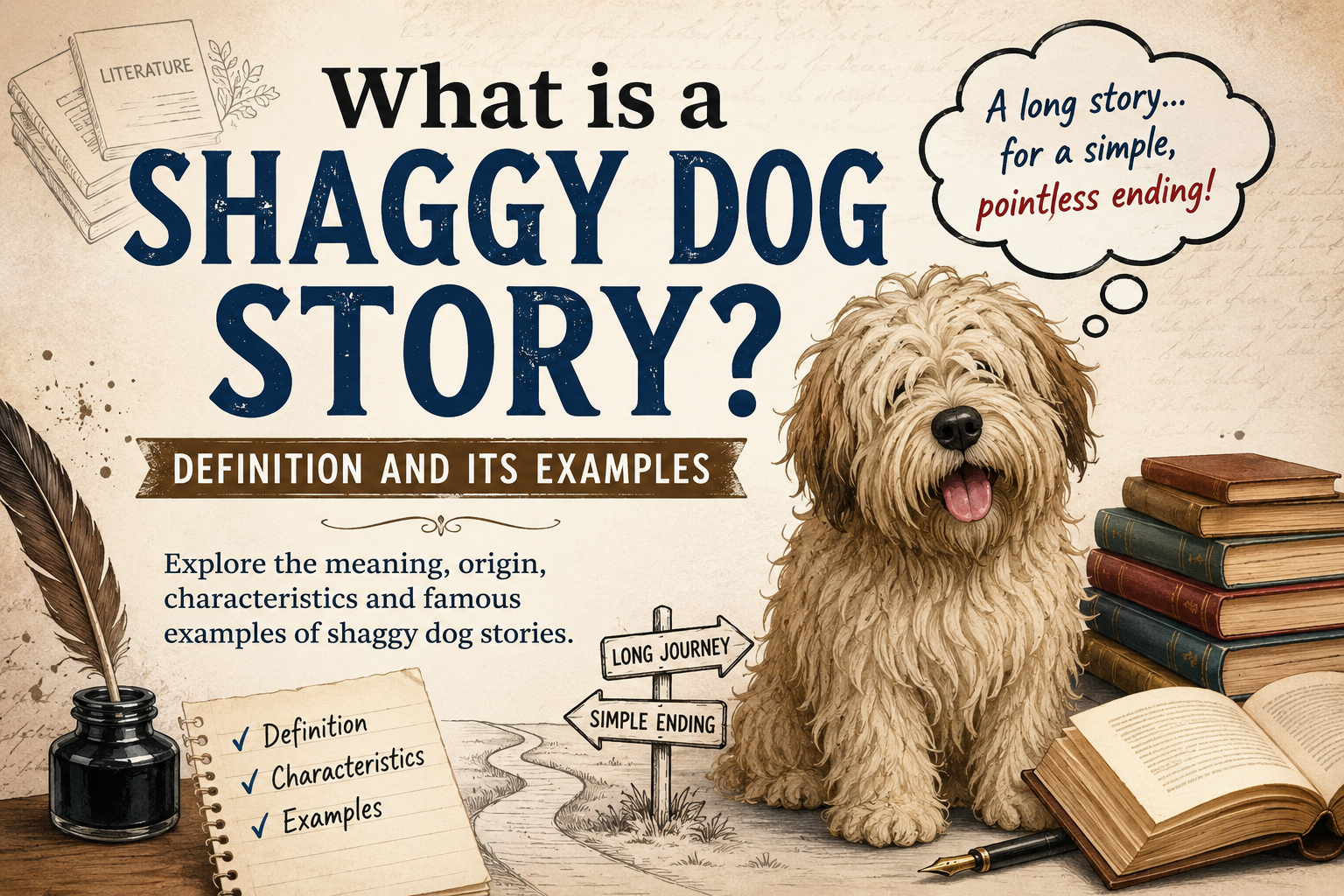
A shaggy dog story is an improbable kind of yarn, often long and spun out, which, as a rule, does not have a witty or surprise ending; but comes, rather, to a deflating and quasi-humorous conclusion that is absurdly inconsequential or pointless.
The expression “shaggy dog story” is believed to have originated from a popular anecdotal tale in which a narrator spends considerable time describing the search for an extraordinarily shaggy dog. After building suspense with elaborate details and numerous digressions, the story ends with the anticlimactic revelation that the dog is not particularly shaggy after all. The humour lies not in the conclusion itself but in the audience’s realisation that they have been led through an unnecessarily long and ultimately pointless narrative.
Characteristics
A shaggy dog story is characterised by excessive detail, elaborate descriptions, and frequent digressions that appear to move the plot forward but actually delay its conclusion. The storyteller intentionally prolongs the narrative, which encourages the audience to anticipate a dramatic, clever, or emotionally satisfying ending. Instead, the tale concludes with an insignificant, absurd, or deliberately disappointing resolution. This unexpected lack of payoff creates a unique form of humour based on anticlimax.
Unlike traditional jokes that depend upon a sharp punchline, a shaggy dog story derives its comic effect from the contrast between the audience’s expectations and the triviality of the ending. The longer and more elaborate the narration, the greater the humorous impact of its inconsequential conclusion. As a result, these stories often parody conventional storytelling by undermining the expectation that every narrative should culminate in a meaningful climax.
Examples
A well-known example concerns the Australian bee which had a consuming ambition to become a ballet dancer. It presented itself to the authorities in Sydney and was advised to go to Covent Garden, London. But how was it to get there? Eventually, it persuaded a racing pigeon bound for London to transport it. After many hazards, they arrived and the bee made a ‘bee-line’ for the Covent Garden Opera House. It explained its ambition and the powers that be were so impressed that they decided that a ‘pigeon-towed’ bee would be a unique addition to the corps. A lengthy shaggy dog story (roughly 2,500 words in English translation) takes place in Chapter 10 of Nikolai Gogol’s novel Dead Souls, first published in 1842. Arlo Guthrie’s famous classic anti-war story-song Alice’s Restaurant Massacree is a shaggy dog story about the military draft, hippies, and the improper disposal of garbage. Joseph Heller’s digressive and crazily funny novel Catch-22 (1961) might also be regarded as an example.
Shaggy dog stories have influenced various forms of modern literature, comedy, and popular culture. They appear in humorous novels, radio performances, stand-up comedy, television sketches, and internet storytelling. Writers and comedians frequently employ this narrative technique to satirise dramatic conventions, challenge readers’ expectations, and demonstrate that the journey of the story can be more entertaining than its destination. Their playful subversion of narrative structure continues to make them a distinctive form of comic storytelling.
Read also: Ancrene Riwle (Ancrene Wisse): Summary, Features, Authorship & Literary Significance