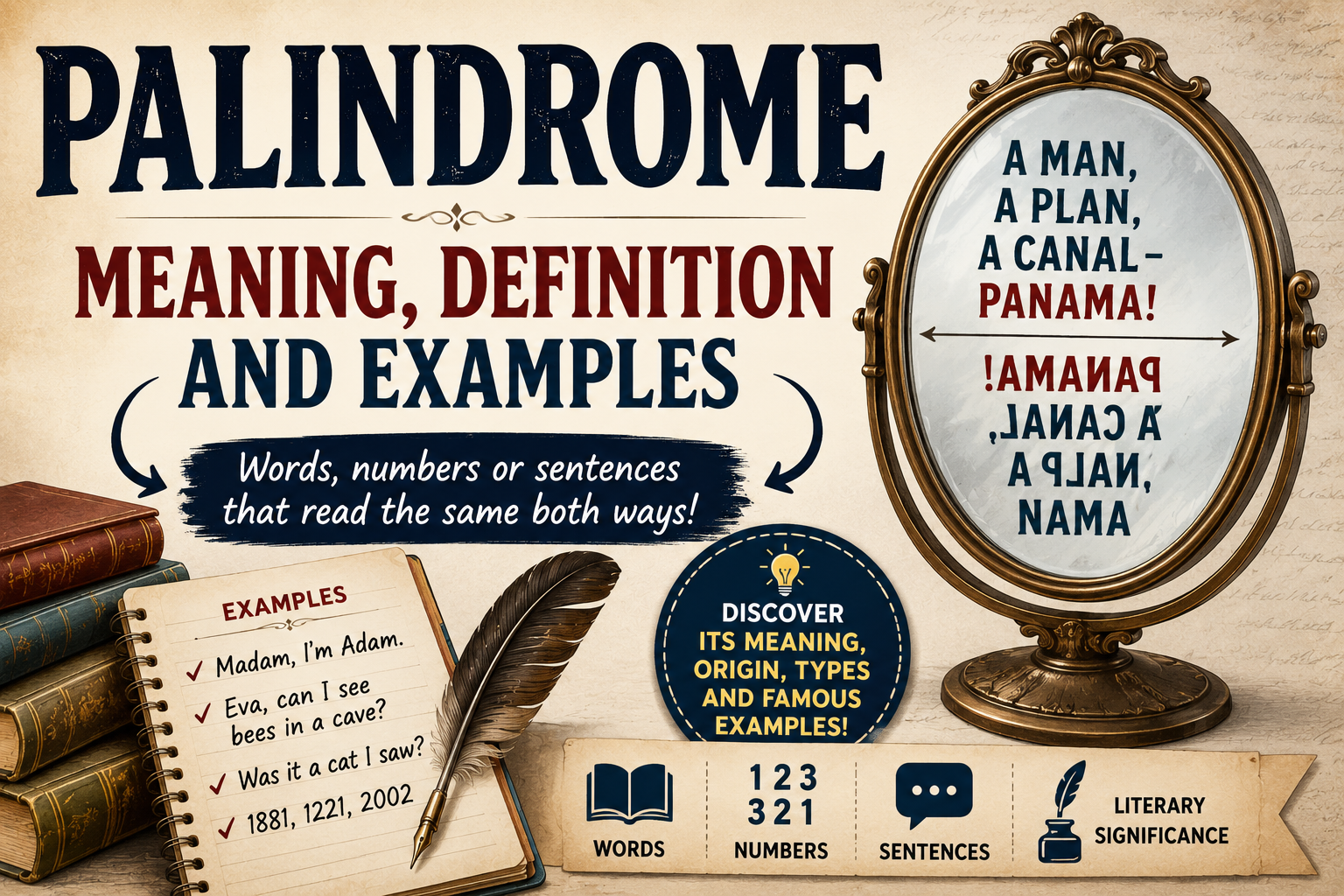

Palindrome (Gk. meaning “running back again”) is a word, number, or sentence that reads the same both forwards and backwards. Common palindrome words include civic, level, minim, radar, rotor, madam, refer, wow, and noon. Examples of palindrome numbers are 1881, 1221, 2002, 232, and 432.
Characteristics of a Palindrome
A palindrome is symmetrical in structure, meaning that its sequence of letters or numbers remains identical when read from left to right or from right to left. In the case of phrases and sentences, punctuation, spaces, and capitalisation are usually ignored. The defining feature of a palindrome is not its meaning but the perfect reversal of its characters.
Examples of Palindromes
Famous examples of palindromic phrases or sentences are:
- “Madam, I’m Adam,” to which the reply was, “Sir, I’m Iris”;
- “Able was I ere I saw Elba”;
- “Sums are not set as a test on Erasmus”;
- “A man, a plan, a canal – Panama!”;
- “Straw? No, too stupid a fad; I put soot on warts!”;
- “Deliver desserts,” demanded Nemesis, emended, named, stressed, reviled;
- “Eva, can I see bees in a cave?”;
- “Was it a cat I saw?”
The best-known collection of palindrome verses was produced by Ambrose Pampers in 1802. It consists of 416 palindromic verses recounting the campaigns of Catherine the Great.
Importance and Uses of Palindromes
Palindromes have fascinated writers, linguists, mathematicians, and puzzle enthusiasts for centuries because they combine creativity with linguistic precision. They frequently appear in word games, riddles, crosswords, and recreational mathematics. In literature, authors occasionally use palindromes to express verbal ingenuity, create memorable expressions, or add a playful stylistic effect to their works.
Besides words and sentences, palindromes also occur in numbers, dates, DNA sequences, music, and computer science. Palindromic numbers such as 1331 and 12321 are studied in mathematics, while programmers often encounter palindrome problems as exercises in algorithms and string manipulation. Their widespread occurrence across different disciplines highlights the universal appeal of symmetry and pattern.
Conclusion
A palindrome is a unique linguistic and mathematical pattern that remains unchanged when read in reverse. Whether expressed as a word, number, phrase, or sentence, it showcases the beauty of symmetry in language. From literary compositions to mathematical puzzles, palindromes continue to entertain, challenge, and inspire readers across cultures and generations.
You may also like: What Is Deus ex Machina? Definition, Features, Origin and Examples