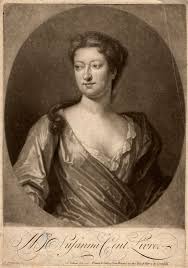

Susanna Centlivre (1667-1723) was an actress, dramatist, essayist, and poet, and known as the “Celebrated Mrs. Centlivre.” She faced strong anti-feminist criticism throughout her career, yet she built a reputation as one of the most prolific playwrights of her time. Much about her early life remains uncertain. Scholars still debate her exact date of birth, and reliable details about her childhood are scarce. However, her plays suggest that she knew French, most likely learned through private instruction. Some accounts even claim that she disguised herself as a young man to study at Cambridge University before arriving in London to pursue a career as an itinerant actress.
Centlivre married young. Her first husband, Mr. Carroll, reportedly died in a duel. Later, in 1707, she married Joseph Centlivre, who worked as the master cook to Queen Anne. Over time, she developed close connections with several prominent literary figures, including George Farquhar, Richard Steele, Eliza Haywood, Mary Pix, Colley Cibber, Nicholas Rowe, and the well-known actress Anne Oldfield. These associations placed her firmly within the literary and theatrical circles of her age.
She began by composing poetry and writing letters, some addressed to real individuals like Farquhar and others to imagined correspondents. Eventually, she turned her focus to drama and produced a remarkable body of work. In total, she wrote around nineteen plays, many of which enjoyed considerable popularity on the stage.
Among her most notable works are The Perjured Husband (1700), a blend of tragedy and tragicomedy performed at Drury Lane; The Stolen Heiress (1702); Love’s Contrivance (1703); and The Busie Body (1704), a lively farce remembered for the amusing yet foolish character Marplot. She later wrote Marplot in Lisbon (1710) as a sequel, though it failed to achieve the same success. In The Gamester (1705), she criticises the excessive gambling habits of the upper classes. Her later plays include The Wonder: A Woman Keeps a Secret (1714) and A Bold Stroke for a Wife (1717).
Through her plays, Centlivre explores themes such as marriage, class dynamics, and gender roles with wit and precision. Rather than presenting women as passive figures, she often portrays them as clever, independent, and capable of shaping their own destinies. Through lively dialogue and carefully constructed plots, she subtly questions patriarchal authority while still engaging her audience with humour and intrigue.
Her dramatic style combines elements of Restoration comedy with emerging sentimental trends. While she uses familiar stock characters like the rake, the fop, and the witty heroine, she also gives her female characters greater depth and agency. Characters such as Miranda in The Busie Body display intelligence and confidence, and challenge conventional expectations of women on the stage. In doing so, Centlivre helps shift English comedy toward a more socially conscious form.
Despite the challenges she faced in a male-dominated literary world, Centlivre achieved lasting success. Audiences received her plays warmly, and many remained popular for years after their first performance. Her career demonstrates not only her talent but also her resilience and determination. Today, critics recognise her as a significant figure in the history of English drama, especially for her contribution to comedy and her progressive portrayal of women.