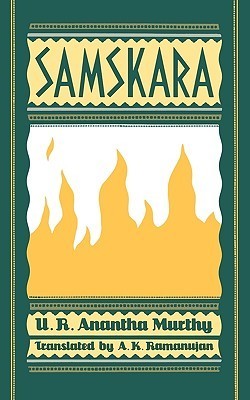

The novelist has designed the plot to suit the fictitious biography of his character. The events take place very rapidly and there are quick shifts in focus by the novelist. The main protagonist Pranesacharya is involved in a sexual affair, and after the death of his ailing wife Bhagirathi, suffers alone in his search for Chandri. It is only after he gets some knowledge in worldly affairs that he decides to return to his village and his ‘anxious return’ marks the beginning of a new life for him. His reunion with Chandri would not have been satisfying, and what will be his image now in the village after he had failed in solving a problem? The author deftly captured and ended the novel amid all the tension, anxiety, confusion, and uncertainty “Four or five more hours travel. Then, what ?….. He will travel, for another four or five hours. Then, after that, what? Praneshacharya waited, anxious, expectant. And along with the Acharya, the readers also waited, anxious, expectant”. All these questions continue to haunt the readers’ mind after reading the novel.
At the beginning of the novel, we saw that life in the village is dominated and regulated by rituals and orthodox beliefs. One striking feature of the novel is that death remains the leitmotif in the entire course of action. The archetype of ‘thanatos’ (meaning the death-instinct) seems to have gripped the existence of the villagers. Not even a single incident of birth or marriage takes place in the course of main action. Praneshacharya, the spiritual teacher of the village, is the only character with positive values in his personality, but he too is under the shadow of life-negating forces. After his encounter with Naranappa’s concubine Chandri in the dark forest, his quest for this biological woman is, in fact, a quest for his residual self. His journey through the forest, villages, and towns denotes a deep spiritual crisis. Now he suffers from the sickness of his soul.
In this state of great spiritual crisis, the Acharya found that the former security is forever lost to him. He is now in a fix as to whether he should confess his guilt, his changed self, or not. The decision to confess gets more and more difficult the longer it is postponed. Actually, he lacks the will to make an existential decision. His journey back to Durvasapura also happens rather than is undertaken voluntarily. The cart going in that direction has only one seat, so Putta is left behind and Pranesacharya moves towards yet another climactic moment of confession.
One of the greatest strengths of the ending lies in its refusal to offer a moral judgment. Ananthamurthy neither condemns Praneshacharya for his transgression nor glorifies his rebellion against orthodox values. Instead, the novelist places him at a crossroads where every choice carries moral consequences. This ambiguity reflects the complexity of human existence, where right and wrong cannot always be separated by religious doctrines. The reader therefore becomes an active participant who must decide the future course of the protagonist.
But, at that climactic moment, the novel ends abruptly, leaving much for our imagination to visualise. The story does not conclude. The Acharya may find Chandri in the village expecting her child by him, or he may have acquired a new state of consciousness-nothing is clear. This unresolved conclusion lends a new dimension to the structure of the novel.
The conclusion also reveals the central conflict between scriptural authority and lived experience. Throughout his life, Praneshacharya relies upon sacred texts to resolve every dilemma. After his encounter with Chandri, however, he discovers that human emotions, desire, guilt, and compassion cannot always find answers within rigid religious codes. His return to Durvasapura represents more than a physical journey; it symbolises a movement from unquestioned faith toward self-examination. The ending thus marks the collapse of absolute certainty and the beginning of moral introspection.
The open-ended conclusion, however, has lent even a greater significance to the novel and its central protagonist. Praneshacharya’s decision to confess is linked with the knowledge that a rotten corpse awaited his return. The absence of this corpse might still change his decision, but the novel ends before his journey is over, tracing from the static certainty of “the crest jewel of Vedanta” to the dynamic uncertainty of a lonely individual in search of a code by which he can completely be himself without any self-deception. Because of the contradictions within the protagonist, the possibilities of the age ever being completed into a circle are remote. The Acharya will perhaps never attain the pure state he is searching for, but his experience has encompassed a larger area than he had known in his earlier limited life, and he cannot go back completely to his former position.
Through the unresolved conclusion, Ananthamurthy critiques social orthodoxy. The Brahmin community spends much of the novel debating ritual purity and the funeral rites of Naranappa, yet it fails to confront deeper issues such as hypocrisy, compassion, and human suffering. By leaving the story unfinished, Ananthamurthy suggests that no simple solution can transform a society trapped within rigid conventions. Real change demands inner awakening rather than external observance of customs.
Chandri’s absence from the final pages is equally meaningful. Although she remains physically distant, her influence dominates the ending. She becomes the catalyst that exposes the limitations of Praneshacharya’s former life and compels him to confront his own hidden desires. Her role demonstrates that genuine transformation often begins through unexpected encounters rather than through philosophical instruction. In this sense, Chandri functions as the force that disrupts established hierarchies and awakens dormant humanity within the protagonist.
The ending of Samskara also reflects the characteristics of modern Indian fiction. The absence of closure mirrors the unfinished nature of human life itself, where questions often remain unanswered, and every resolution opens the door to another dilemma. This narrative strategy ensures that the novel continues to provoke reflection long after the final page.