
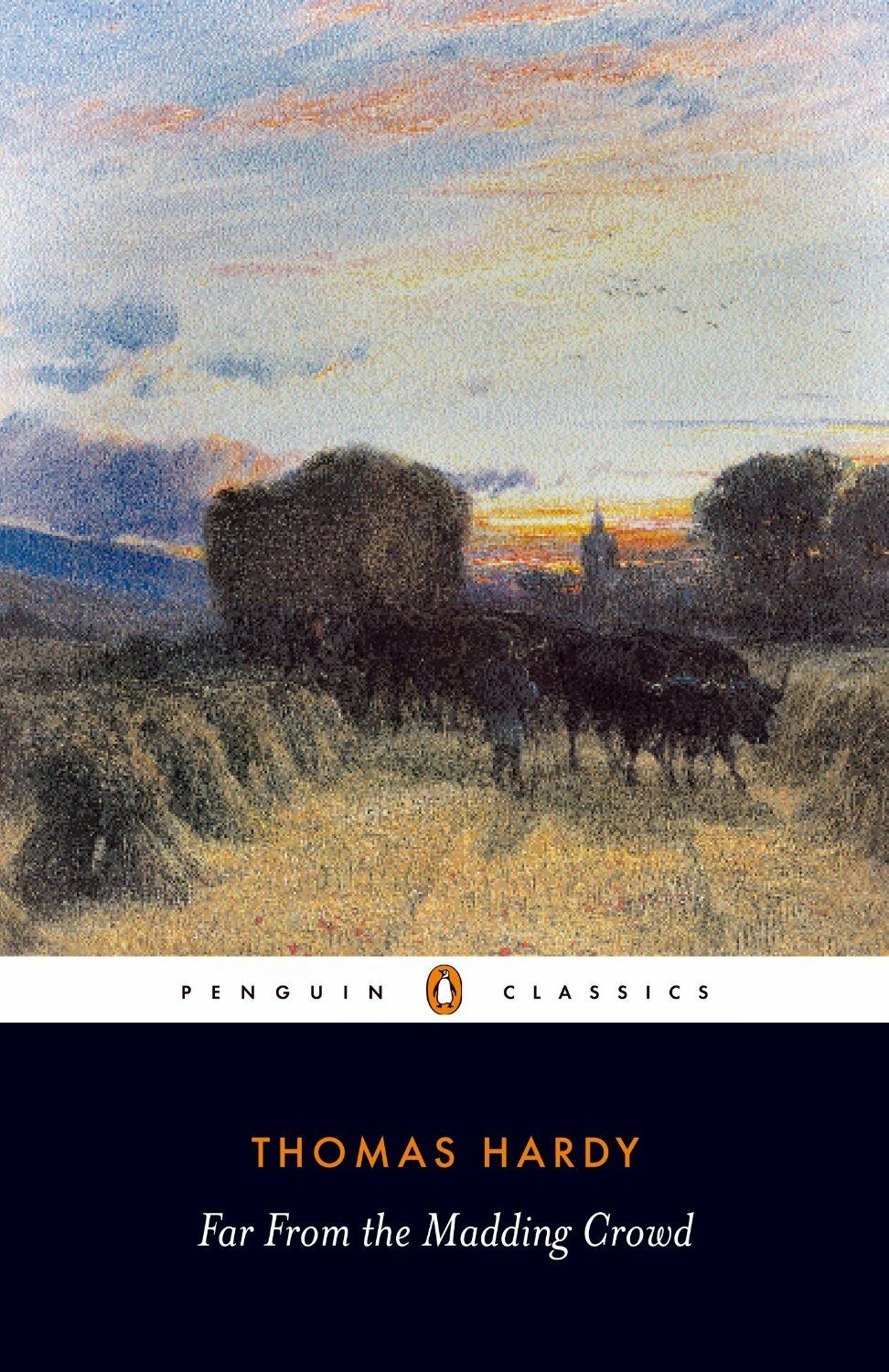

Thomas Hardy believes in hostile fate, luck, or destiny, or chance. According to him, fate or chance is malicious and operates in such a way as to deprive human beings of their expected or desired happiness. The hostility of fate in the novels of Hardy generally appears in the form of unforeseen happenings. i.e, in the form of chances, accidents, and coincidences. Hardy opines that the unseen power or fate that rules the world is indifferent and hostile to mankind. It takes a special delight in torturing or tormenting human beings who are its victims. Indeed, in all the novels of Hardy, chance plays a very important part. Far From the Madding Crowd is no exception to it. In this novel, the role of chance or fate is very significant. This is aptly established by the following Incidents depicted in the novel.
Gabriel Oak sees Bathsheba Everdene for the first time by chance. He is standing in his field when he suddenly discovers a pretty maiden, sitting on the top of household furniture, in a wagon, and consulting a mirror. He takes a fancy to her at first sight. Now, if the wagon had not come to a standstill, Oak would not have met Bathsheba.
We find the element of chance or accident in Gabriel’s loss of his two hundred sheep. It is a completely unforeseen occurrence. Oak was hoping to become one day an independent and prosperous shepherd- farmer. But one night, his younger dog drives two hundred of his sheep over a hill, and as a result, the sheep are all killed. Thus, his hopes of prosperity are dashed to the ground.
Again, chance helps Bathsheba to become a rich lady-farmer when she suddenly inherits her uncle’s farm. It is also a chance that her wheat ricks catch fire, and Gabriel goes to put it out. It is just by chance that after extinguishing the fire, he comes to know that the owner of the rickyard is Bathsheba and gets employed under her.
Another unforeseen occurrence is the effect of Valentine on Boldwood. Boldwood was a kind of woman-hater, but Valentine produced totally unexpected results. His passion for Bathsheba is kindled, and this passion has a volcanic character. Thus, Boldwood’s whole life is ruined on account of this uncontrollable passion. If Bathsheba had not sent the Valentine to him, he would have, in all probability, married another woman.
The tragedy of Fanny was due to chance. Just by chance, Fanny happened to forget the name of the church. So she went to All Souls’ Church instead of All Saints’ Church. For her failure to arrive at the right church at the right moment, Troy refused to marry her. Had she turned up at the right church in time, the story of her life might have been a happy one.
Again, Bathsheba’s meeting with Sergeant Troy is purely accidental. This accidental meeting leads to many complications. Bathsheba develops a liking for the handsome soldier, and her love brings disaster to her. If Troy had not met Bathsheba, there was some chance of her marrying Boldwood; and there was also some chance of marrying Fanny Robin, or at least saving her from the tragic fate which Fanny meets. Thus, the accidental meeting of Bathsheba and Troy leads to a series of disasters. Chance, once again, deprives Boldwood of Bathsheba, when suddenly Troy reappears and insists upon claiming his wife at the Christmas party.
Another major chance or accident is the delay that takes place in Fanny’s coffin being brought to Weatherbury. As a result of this unforeseen delay, Fanny’s coffin is placed in Bathsheba’s house. Troy also happens to see the dead Fanny lying in the coffin, and he kisses. Fanny. It was the final blow to Bathsheba’s relationship with Troy. Thus, the tragedy of Bathsheba’s life is directly brought about by Fanny Robin’s coffin being placed in her house.
Thus, we may conclude that chance, coincidences, or fate play a considerable part in this novel.
Also read: Discuss the Motifs and Symbols in E.M.Forster’s A Passage to India


1 Comment
Prasenjit Barman
Interesting!!! Please provide more such notes on novels🙏