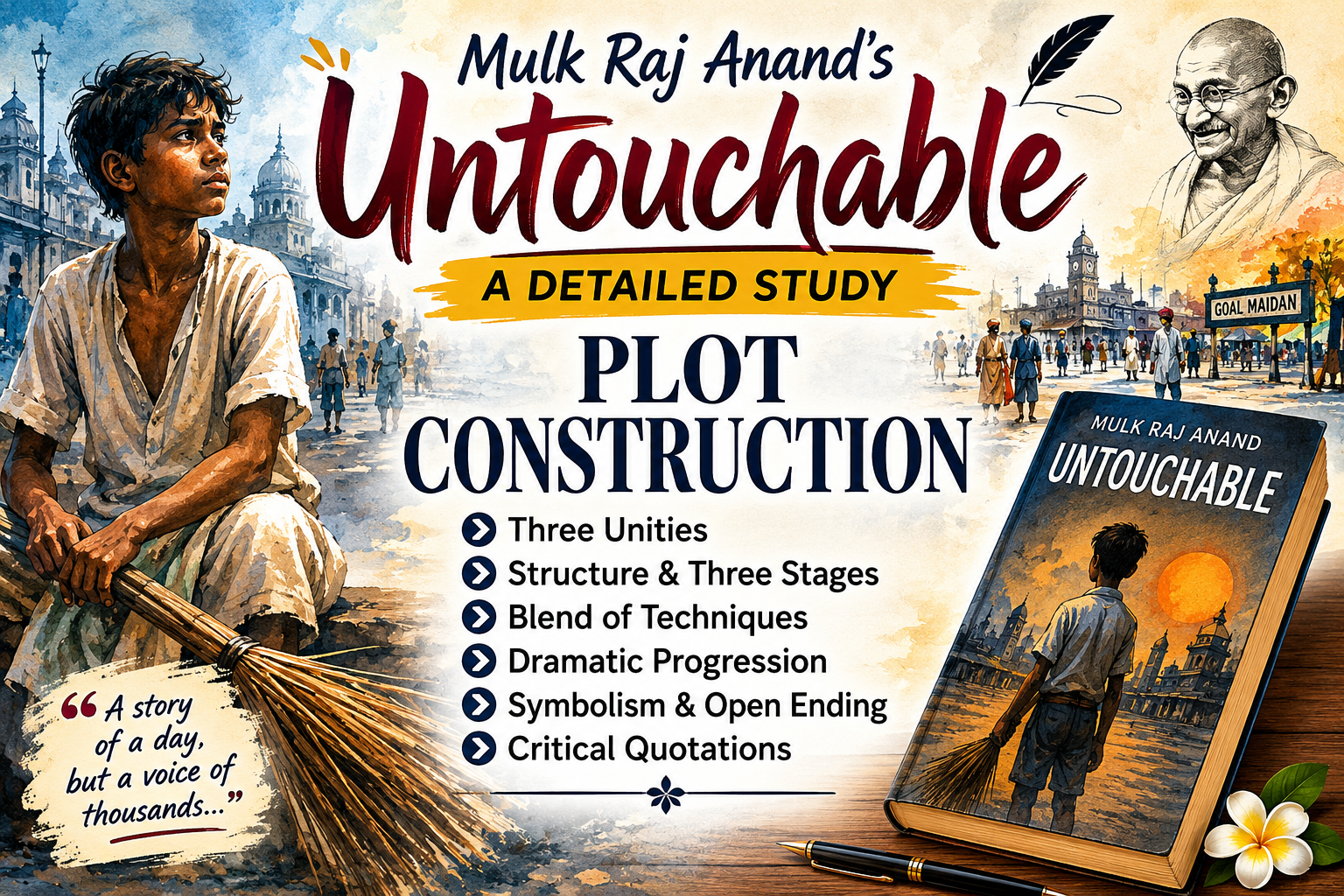

Introduction
The plot of the novel Untouchable is well planned and compact. It has a cogent beginning, well knit work of art, characterised by precision
of words, a well sustained middle and successful end, but the conclusion is not without drawbacks. It is conspicuous for three classical unities of time, place and action. It is a day’s journey in Bakha’s life, with every down to earth circumstance. Anand’s chief objective in writing the novel was to render the mental anguish and agony of the untouchables, as a result of a thousand years of servility, exploitation and injustice. All happened in Bulashah, a cantonment town. All incidents and episodes are coherent and forceful, which is to attract the reader’s attention to the miserable plight of the outcastes who are condemned to live in a totally polluted environment. The novel is a consummate harmony of form and content. E.M. Forster says, “The book is simply planned, but it has form. The action occupies one day and takes place in a small area. The great catastrophe of the ‘touching’ occurs in the morning and poisons all that happens subsequently, even such pleasant episodes as the hockey match and country walk. After a jagged course of ups and downs, we come to the solution, or rather to the three solutions, with which the book closes.”
Three Unities
The classical unities of time, place and action have been honoured. The entire action takes place in the pre-independence cantonments town of Bulashah and spans between the Goal Maidan and the railway station. It begins with a morning in Bakha’s life and ends with the fall of darkness. It is marked with tremendous focus on the spiritual anguish and agony of Bakha. Anand has overcome the incoherence of the psychological by the use of the ‘stream of consciousness’ technique, and the timely accounts of the social milieu and the environment add to the elegance of the novel. Thus, Anand maintains a perfect equilibrium between internal and the external, form and content.
The poet’s harangue apart, M.K. Naik says, “the narrative itself is a thing of perfect unity and chiselled finish. The whole action, which takes place during twelve hours from dawn to dusk, shows three clear stages of development. In the first stage, at the end of which suddenly comes the traumatic experience of pollution in the marketplace, Bakha had a comparatively easy time. Despite the abuses of his father and the rigours of his morning task, he is eagerly looking forward to getting the gift of a hockey-stick from Charat Singh in the afternoon, and the prospect of having a look at the sights and sounds in the bazar is an additional attraction. The climax of his felicity is reached when, with a packet of jalebis in his hand and the “taste of the warm and sweet syrup” in his mouth, he is moving through the market place. And then dramatically descends the blow, when, after the collision with the caste Hindu, his jalebis and his felicity both taste the dust.
The first stage occupies a little more than the first one-third of the book. The second stage covers slightly less than half of the book and shows graph of Bakha’s spirit going through rapid fluctuations, the indignity of crying “posh, posh, sweeper coming” and the shock of Sohini’s molestation at the hands of the priest being offset by the joy of getting the hockey stick and scoring a goal and the sympathy of friends, and these in turn are cancelled out by the fiasco in which the hockey match ends. A second encounter with his father plunges Bakha into the depths of despair, and then, equally dramatically as earlier, the third phase is ushered in with the coming of Colonel Hutchinson.
This third and last phase balances the first, and it accounts for about one-third of the novel. During this stage, three possible solutions to his problems are suggested to Bakha. Each stage ends on a dramatic note. Bakha’s course on this momentous day goes continuously through ups and downs, together ensuring that suspense is maintained throughout.
Blend of Eastern and Western Techniques
The formal structure of the novel blends the moral fable form and interplay of situation and character that Anand deemed as the outstanding feature of the Western short story. Bakha’s character is remarkable for its pathetic inappropriateness of natural vitality undermined by conditioned docility. In the epiphanous and moving scene, we observe the intercourse of character and incident yielding
the germ of a new consciousness in Bakha, on the one hand, of the realisation of his social identity. Gandhi’s approach marks the genesis of Bakha’s consciousness. Gandhi encourages the self-esteem of Bakha and the entire community of the outcastes and urges them to discourage self-abnegation. Bakha develops social awareness. He becomes aware of the social evils of untouchability, poverty and
pollution. It fulfills the requirement of the moral fable. The hypocrisy of the so-called custodians of Hindu tradition and culture has been
exposed. The novel concludes with a desire image implying the eradication of all social evils. (H.C. Harrex).
Critical Evaluation of the Plot
Another significant aspect of the plot construction of Untouchable is its dramatic progression. Anand arranges the incidents in such a way that each event intensifies Bakha’s sense of humiliation and alienation. The accidental touching of a caste Hindu in the marketplace acts as the central turning point of the novel. From this moment onwards, every subsequent incident—the priest’s attempted molestation of Sohini, the disruption of the hockey match, and Bakha’s conflict with his father—deepens the protagonist’s awareness of the oppressive social order. Thus, the plot develops not merely through external action but through the gradual evolution of Bakha’s consciousness.
The novel is remarkable for its psychological realism. Though the action is confined to a single day, Anand succeeds in revealing the accumulated suffering of generations of untouchables. Through Bakha’s memories, reflections, desires, and disappointments, the narrative transcends the limits of a single day’s events and acquires a wider social significance. The plot here operates simultaneously on two levels—the personal experience of Bakha and the collective experience of the entire untouchable community.
Anand’s use of coincidence is carefully controlled and artistically justified. The sequence of encounters Bakha experiences throughout the day appears natural and convincing because it arises directly from his social position. Every incident contributes to the central theme of untouchability and social discrimination. There are no unnecessary subplots or digressions. The economy of structure enhances the emotional impact of the narrative and keeps the reader’s attention firmly focused on the protagonist’s struggle for dignity and self-respect.
The plot of this novel also possesses symbolic significance. Bakha’s journey through the town can be viewed as a symbolic journey from ignorance to awareness. At the beginning of the novel, he admires the English way of life and accepts many social realities without question. By the end, after listening to Gandhi’s speech and the discussion on the flush system, he begins to contemplate the possibility of social transformation. Thus, the plot traces not only the events of a day but also the awakening of a new social consciousness.
Conclusion
Critics have often pointed out that the ending of the novel is somewhat open-ended. Anand does not provide an immediate solution to the problem of untouchability. Instead, he presents different alternatives represented by Christianity, Gandhian reform, and technological progress. This deliberate lack of finality is artistically effective because it reflects the complexity of the social problem. The plot therefore concludes not with a resolution but with hope and the anticipation of change, making Untouchable a powerful social document as well as a compelling work of fiction. According to E.M. Forster, “Some readers may find this comparison with the clear observation which
has preceded it, but it is an integral of the author’s scheme. It is the necessary climax and it has mounted up with tripple effect. Bakha
returns to his father and his wretched bed, thinking now of the Mahatma, now of the machine. His Indian day is over and the next day will be like it, but on the surface of earth if not in the depths of the sky, a change is at hand.”
Source: Based primarily on S. Sen’s critical study of Untouchable, with additional explanatory notes.
Also read V.S.Naipaul’s A House for Mr. Biswas as an autobiographical novel