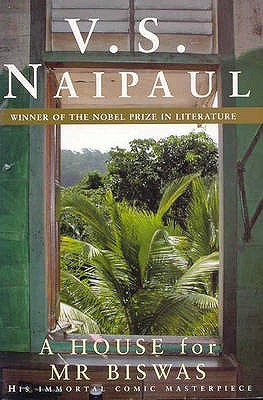

It is a commonplace of literary criticism to state that writers often find materials in the incidents of their own lives, and by the alchemy of genius, those facts are transmuted into the works of fiction. A novelist’s achievements lie in transcending individuality and endowing personal experiences with a universal dimension. It has been claimed that A House for Mr. Biswas is the most personal of Naipaul’s novels.
In dealing with three generations of Biswases, the novel parallels the three generations of Naipaul’s family, which migrated to Trinidad from native India. V.S.Naipaul’s father, Seepersad Naipaul, like Mr Biswas in the novel, was a struggling journalist working for the Trinidad Guardian, and the childhood of Anand resembled that of the novelist himself. The novel presents a comprehensive historical view of the lives of an Indian family settled in Trinidad. However, the novelist made the following comment on the resemblance of his father and Mr. Biswas: ” It is based on him, but it cannot be the real man”
Helen Hayward is fascinated by the autobiographical elements in Naipaul’s fiction, and said that “The autobiographical element forms a substantial component of Naipaul’s output, appearing not only in explicitly autobiographical works, but also in fiction and travel books.” The novel contains a number of autobiographical references and facts. The following lines of the prologue of the novel reveal that Mr. Biswas, who has been modelled on Seepersad Naipaul, was forty-six at the time of his death: “Mr. Biswas was forty-six and had four children. Had no money “. So there is a resemblance between the lifespan of the novelist’s father and the protagonist of the novel. It is known to us that the novelist’s father belongs to a poor Brahmin family, and we also find Mr. Biswas as a Brahmin: “In Tara’s house he was respected as a Brahmin and pampered, yet as soon as the ceremony was over and he had taken his gift of money and cloth and left, he became once more only a labourer’s child ”
Again, the novelist’s childhood was spent in his grandfather’s house, which was known as Lion House. There is no doubt that Lion House is reproduced in the novel as Hanuman House. As a sign painter, Mr. Biswas came into contact with Hanuman House and became the son-in-law of its owner. The wife of Mr. Biswas, Shama, belonged to a pious and land-owning Tulsi family. Shama is modelled on Droapatie Capildeo, the wife of Seepersad Naipaul.
In the course of referring to the wretched condition of his family, Naipaul wrote in his memoir that the family stayed far from town on an estate with his father’s in-laws, and his father had been given one of the servant rooms. The following description of the room allotted to Mr. Biswas in Hanuman House resembles that of the servant room of the novelist’s father; “His share of it was short and narrow: the long room, originally a verandah, had been enclosed and split up into bedrooms.”
Seepersad Naipaul worked as a reporter for the Trinidad Guardian, a local Paper, throughout his life. Mr. Biswas was a reporter of the Sentinel. Like the novelist’s father, we also find Mr. Biswas’ interview with the Indian farmers for his professional purpose: “In daylight, in a Sentinel motorcar and with a Sentinel photographer, he drove through the open plain to call on Indian farmers to get material for his feature on prospects for This Year’s Rice Crop.”
Recalling the days of his childhood, Naipaul describes the condition of his father in his autobiographical work Finding the Centre: “I didn’t see my father for days. His nerves deteriorated.” The protagonist of the novel also faced a worsening of the same situation in the course of his work in the Tulsi estate as an overseer at Green Vale. The novelist’s memory of the moving shadows thrown by the oil lamps during the days of his childhood enabled him to present an authentic description of the storm scene at Green Vale in the novel. The novelist also pointed out that once he had been involved in an argument with his father, and his father had thrown a glass of hot milk upon him in a great rage. This incident reminds readers of Mr. Biswas throwing food on his brother-in-law in a great rage at Hanuman House.
Like Mr. Biswas, Seepersad moved his family from house to house as he dreamed of a better and more stable life: “At the age of thirty-three, when he was already the father of four children… None of these stories was finished, and their name was always the same “. Hence, both Seepersad and Mr. Biswas reveal the literary bent of mind. Like Seepersad Naipaul, who died relatively young after suffering from heart-related illness, Mr. Biswas also dies prematurely, which also provides the autobiographical connection between the fictional character and his real-life counterpart.
Another important autobiographical aspect of the novel is the character of Anand, who is generally regarded as the fictional representation of V. S. Naipaul himself. Like the novelist, Anand grows up in a large extended family under difficult economic circumstances and develops an early interest in books and education. He is sensitive, observant, and intellectually inclined, qualities that we find closely resemble those of Naipaul during his childhood. Anand’s experiences of family life, schooling, and cultural displacement reflect the author’s own formative years in Trinidad. Through Anand, Naipaul recreates many of his childhood memories and presents the aspirations of a young colonial subject seeking a better future.
Towards the end of the novel, Anand wins a scholarship that offers him the possibility of higher education and a life beyond the limitations of Trinidad. This episode parallels Naipaul’s own achievement of winning a scholarship to study at Oxford University in England. Anand’s departure marks the beginning of a new phase of life, just as Naipaul’s journey to England opened the way for his literary career. The parallel between Anand’s educational advancement and the novelist’s own life strengthens the autobiographical dimension of the novel.
The setting of the novel also bears a close resemblance to the social and cultural environment in which Naipaul was raised. The depiction of the Indo-Trinidadian community, with its customs, religious practices, family structures, and economic struggles, is drawn from the author’s firsthand experience. The novel offers a realistic picture of the lives of Indian immigrants and their descendants in colonial Trinidad. By recreating this world with remarkable authenticity, Naipaul transforms personal and family history into a broader account of the immigrant experience and the search for identity in a colonial society.
The central symbol of the house may also be interpreted in autobiographical terms. Mr. Biswas’s lifelong struggle to own a house represents his desire for independence, dignity, and self-respect. Similarly, Seepersad Naipaul spent much of his life striving to provide stability and security for his family despite financial hardship. Thus, the house becomes more than a physical structure; it symbolises for them freedom from dependence and the achievement of a distinct personal identity. Through this symbol, Naipaul universalises the experiences of his father and presents the house as a representation of human aspirations for belonging and selfhood.
In light of the above discussion, it can safely be concluded that A House for Mr. Biswas possesses a strong autobiographical basis. The character of Mr. Biswas is largely inspired by Seepersad Naipaul, while Anand reflects many aspects of Naipaul’s own childhood and intellectual development. The settings, incidents, family relationships, and social conditions depicted in the novel draw heavily upon the author’s personal experiences in Trinidad. Yet Naipaul’s achievement lies not merely in recording family history but in transforming private experience into a universal narrative of human struggle, dignity, identity, and self-realisation. Through the figure of Mr. Biswas, he creates a character whose quest for independence and a home transcends its autobiographical origins and acquires universal significance. Thus, the novel validates Naipaul’s own observation: “An autobiography can distort; facts can be realigned. But fiction never lies: it reveals the writer totally.”
Further Reading
A House for Mr. Biswas by V. S. Naipaul
Finding the Centre by V. S. Naipaul
The World Is What It Is by Patrick French
The Enigma of V. S. Naipaul by Helen Hayward
Read also Chance and Coincidences in Far From the Madding Crowd by Thomas Hardy