
Definition
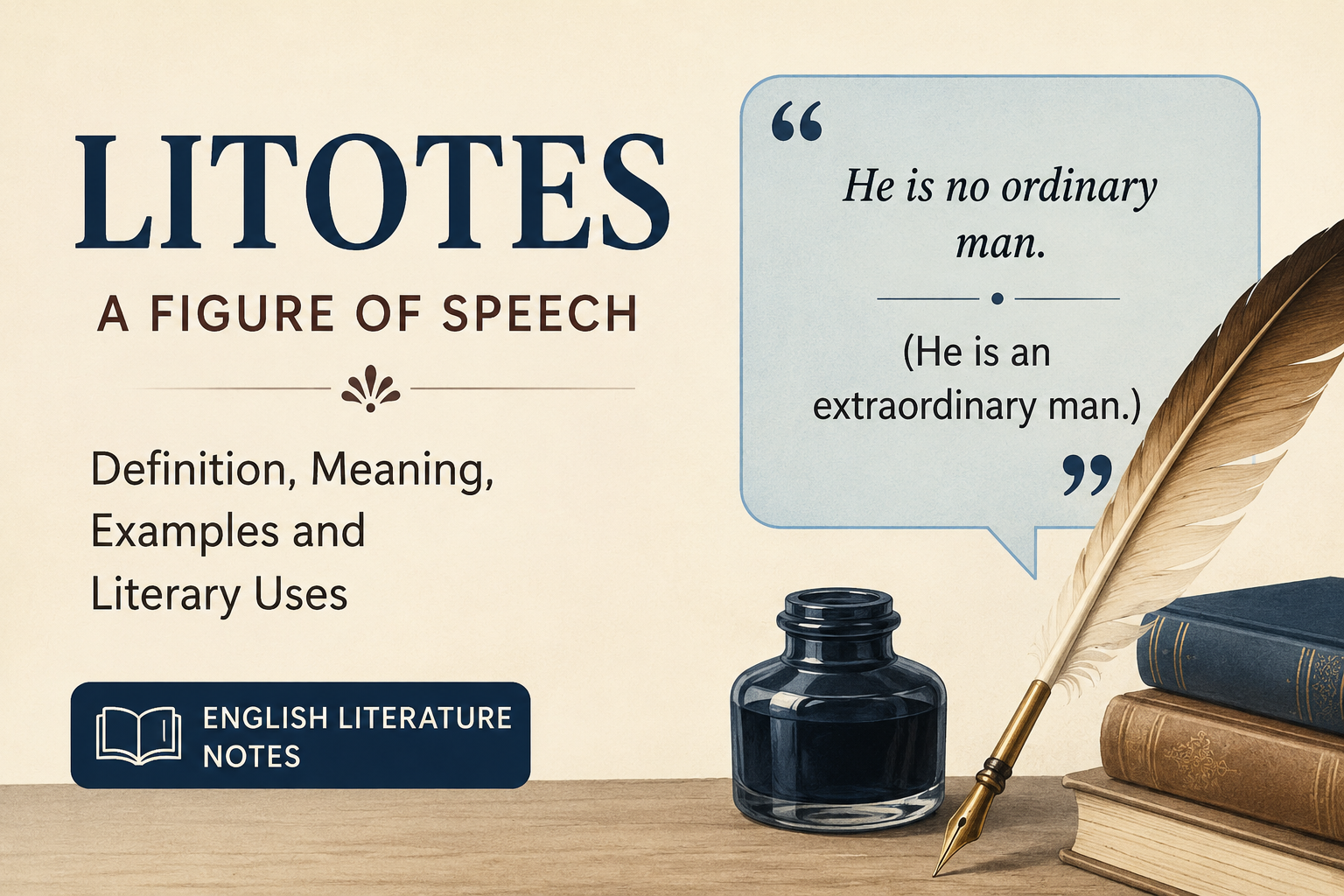
The term litotes is derived from the Greek word litos, meaning simple, plain, or modest. In rhetoric, litotes is a figure of speech in which an affirmative idea is expressed by negating its opposite. It is a special kind of understatement that produces emphasis indirectly. Instead of making a direct assertion, the speaker or writer denies the contrary, which suggests something stronger than the actual words express.
For example, when we say “Rabindranath was no ordinary poet,” we do not merely mean that he was different from ordinary poets; we imply that he was an exceptionally great poet. Similarly, “Napoleon was not a coward” strongly suggests that he was remarkably brave and daring.
Litotes is frequently used in everyday conversation, public speeches, poetry, drama, and prose because it allows a speaker to sound modest, tactful, ironic, humorous, or emphatic without making an exaggerated statement.
Nature and Effect of Litotes
Litotes differs from ordinary understatement. A simple understatement may reduce the force of an expression, but litotes often intensifies it. Consider the difference:
- Understatement: “The storm caused some inconvenience.”
- Litotes: “The storm was not a minor inconvenience.”
The second sentence, by denying the lesser possibility, suggests that the storm caused serious disruption.
This figure is especially effective in English prose and poetry, where restraint and indirectness are often valued more than excessive emotional expression. Classical rhetoricians admired litotes because it combines simplicity of expression with richness of implication.
Examples of Litotes
- The lecture was not uninteresting. (It was quite interesting.)
- She is no stranger to hardship. (She has experienced much hardship.)
- The scientist’s discovery was not insignificant. (It was highly significant.)
- He is not unfamiliar with Shakespearean drama. (He knows Shakespearean drama well.)
- The task is no easy matter. (It is extremely difficult.)
- Her performance was not without merit. (It had considerable merit.)
- The village is not far from the river. (It is quite near the river.)
- The child’s answer was not entirely wrong. (It was partly or largely correct.)
- That was no small achievement for a beginner. (It was a remarkable achievement.)
- The old professor is not lacking in wisdom. (He is very wise.)
Literary Examples
Litotes appears frequently in English literature because it can convey irony, emotional restraint, or subtle praise.
- “Nor are we not without a little care.” — Shakespeare, Hamlet
(We have considerable anxiety.) - “He was not without hope.” — a common literary construction meaning that he still had hope.
- “The result was no mean feat.” — often used in literary criticism and formal writing to indicate an impressive accomplishment.
Difference Between Litotes and Irony
Although litotes sometimes creates an ironic effect, the two are not identical.
- Litotes: “He is not a bad singer.” (He sings fairly well.)
- Irony: “What a wonderful singer!” said after a terrible performance.
Litotes generally softens or indirectly strengthens a statement, whereas irony often means the opposite of what is literally said.
Importance of Litotes
Litotes serves several important stylistic purposes:
- Emphasis through negation
- Politeness and tact
- Modesty in self-expression
- Humour and irony
- Formal elegance in literary and academic writing
Because of these qualities, it is widely used by orators, essayists, novelists, and dramatists. English writers prefer such indirect focus because it engages the reader’s intelligence and allows the meaning to emerge through implication rather than explicit declaration.
Conclusion
Litotes is a subtle but powerful figure of speech in which a positive meaning is conveyed by denying its opposite. Though outwardly simple and restrained, it often produces a stronger rhetorical effect than direct assertion. It may be serious, complimentary, humorous, ironic, or sarcastic, according to the context in which it is used.
Read also: Discuss the Term “Culture Industry” by Max Horkheimer and Theodor Adorno | Critical Theory