
Introduction: The Concept of the Culture Industry
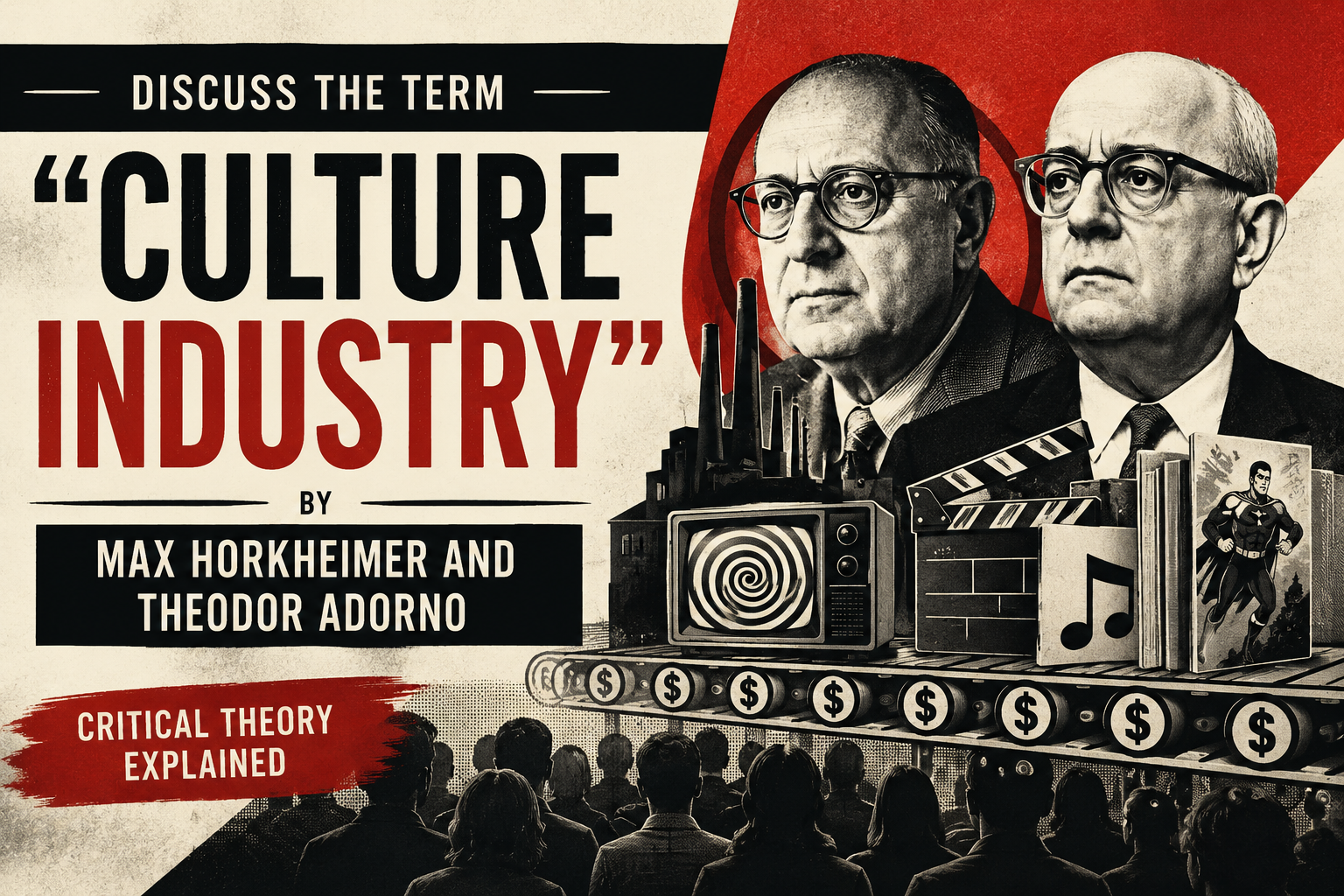
The term “culture industry,” coined by Max Horkheimer and Theodor Adorno, refers to the commercialisation of art in all its forms- music, literature, the visual arts and its subsequent permeation of every aspect of daily life that occurred in the first part of the 20th century. Written in exile in Los Angeles in the 1940s, Horkheimer and Adorno’s essay ‘The Culture Industry: Enlightenment as Mass Deception” is a central plank in their account of the transformation of life in modernity offered in Dialektik der Aufklärung (1944), translated as Dialectic of Enlightenment (1972).
Culture Industry versus Mass Culture
The choice of terms- ‘culture industry’ rather than ‘mass culture’ (their original choice) or ‘popular culture ’-provides a significant clue as to how this concept should be understood: the emphasis should be placed on the second word, not the first. For what Horkheimer and Adorno were struck by in their analyses of Hollywood was the fact that the application of industrial processes of production, distribution, and consumption to culture resulted in the complete deterioration of culture as they knew it. In effect, their implication is: where there is industry there cannot be culture. This is because, as Herbert Marcuse would later explain, under such conditions culture is performed rather than lived.
Standardisation and Commercialisation of Culture
The culture industry’s singular aim is to produce a form of culture compatible with the aims of capitalism. To make culture into the means of reliably turning a profit, it has to be standardised, and its disruptive power neutralised. Standardisation primarily occurs at the level of form, a fact that is masked by the apparent variety of what Horkheimer and Adorno scathingly refer to as pseudo-individualisation of content. For example, as several formalist studies of genre fiction (particularly crime, romance, and westerns) have shown, the difference tends to be confined to the incidentals of setting and character, and even then there are restrictions. Because of its commitment to market principles, the culture industry tends to try to repeat success via duplication and avoid failure by minimising innovation. This doesn’t mean it cannot make entertaining, complex, and interesting products, but it does mean at the end of the day all it makes is products.
The Culture Industry and the Loss of Authentic Art
Consequently, as Jameson explains in Late Marxism (1990), critical theory regards the offerings of the culture industry as inauthentic (meaning false or deceitful in both an ontological and ideological sense) because, like all commodities, they proclaim that happiness and pleasure already exist and are readily available for consumption. Authentic art, by contrast, offers no such consolation and instead affirms the sheer negativity of existence. The culture industry reverses Immanuel Kant’s famous dictum that art is ‘purposiveness without purpose’ and gives rise to ‘purposelessness for purpose’, or what Marcuse referred to as desublimation.
Criticism of the Culture Industry Thesis
Lastly, it is perhaps worth mentioning that the culture industry is not the same thing as the creative industry, although from a certain perspective one could rightly say their referent is the same. The creative industry is a techno-bureaucratic term whose precise ideological purpose is to erase the negativity implicit in Horkheimer and Adorno’s coinage, and as such is a clear-cut example of what they themselves would have called instrumental reason. The culture industry thesis has been criticised by Anglo-American Cultural Studies for failing to perceive the power of consumers to consume cultural products in their own highly individualised manner.
Also read: Discuss about The Authorised Version of the Bible 1611 by King James I