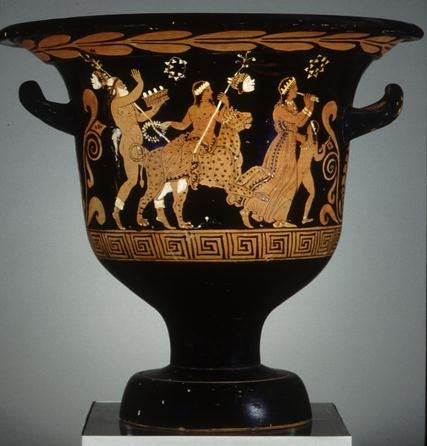

John Keats, in Ode on a Grecian Urn, expresses his deep admiration for the timeless beauty carved upon a Grecian urn. He is led to glorify the world of art and feels its superiority to the reality of human life. The world of art remains everlasting, ever beautiful, ever appealing. The figures carved on the marble urn are a work of art. They lack one thing-reality. But, on the other hand, they are not subjected to death, decay and destruction. In the real world, love passes away, trees shed their leaves, and the fashion in music changes. But the world of art remains always true and happy in its suggestiveness and silence. This is a great realisation for Keats. To him, it is clear that art is far better than the real world. His mind is filled with an ecstatic delight.
Keats closes his poem in a triumphant note. He draws from this urn a moral lesson. And this becomes the moral of his poetic creed. The generation of men comes and goes. But man’s art lives forever. The Grecian urn conveys to the world the supreme lessons of beauty and truth. And Keats passes his final verdict in the last two lines of the poem:-
Beauty is truth, truth beauty’,-that is all
Ye know on earth, all ye need to know.
In the concluding lines of the ode, Keats draws a moral lesson from the urn that exhibits the perfection of the world of art. To him, beauty and truth are not two different things, not even twin things, but the same thing seen from different angles only.
According to Keats, beauty possesses the power to reveal deeper truths about life and existence. Unlike scientific or philosophical truths that appeal primarily to reason, beauty appeals directly to human imagination and emotion. When a person experiences genuine beauty, whether in nature, art, music, or poetry, he gains an insight into the harmony and order underlying the universe. Thus, beauty becomes a pathway to truth, which enables human beings to perceive realities that cannot always be expressed through logical arguments.
The scenes engraved on the urn capture moments of joy, love, celebration, and artistic perfection. Though the figures are frozen in time, they preserve the essence of human experience for all generations. The lover will forever pursue his beloved, the trees will remain forever green, and the music, though unheard, will eternally resonate in the imagination. Through this permanence, the urn communicates an enduring truth about the aspirations and emotions of humanity.
Keats’s concept of “Beauty is truth, truth beauty” also reflects the principles of the Romantic Movement. Romantic poets valued imagination, emotion, and artistic intuition over cold rationality. For Keats, poetry was not merely a form of entertainment but a means of discovering profound truths about life. He believed that true art transcends temporal limitations and speaks to universal human experiences. Therefore, a beautiful work of art remains meaningful because it embodies truths that are timeless and relevant to all ages.
Critics have interpreted the famous statement in different ways. Some view it as Keats’s declaration that beauty itself is the highest form of truth. Others believe that the line suggests a harmony between aesthetic beauty and spiritual or moral truth. Regardless of these interpretations, the statement remains one of the most celebrated expressions of Keats’s aesthetic philosophy. It emphasises his conviction that art, beauty, and truth are inseparably connected and that their union gives lasting value to human life.
Keats suggests that perfection can be attained only through the harmonious union of beauty and truth. Once this unity is lost, a work becomes weak, artificial, and imperfect. A work that lacks beauty cannot fully embody truth, for its very foundation remains flawed. Likewise, a work of art that is not grounded in truth possesses no lasting beauty, however attractive it may appear on the surface. Such beauty is merely superficial and cannot endure. True art, therefore, unites beauty and truth, and it is this union that gives art its permanence. While human life is transient and subject to change, great works of art continue to preserve and communicate universal truths across generations. Thus, for Keats, the inseparable relationship between beauty and truth forms the essence of enduring art and represents the highest achievement of human creativity.
You may also like Inscape and Instress: Definition, Characteristics and Examples