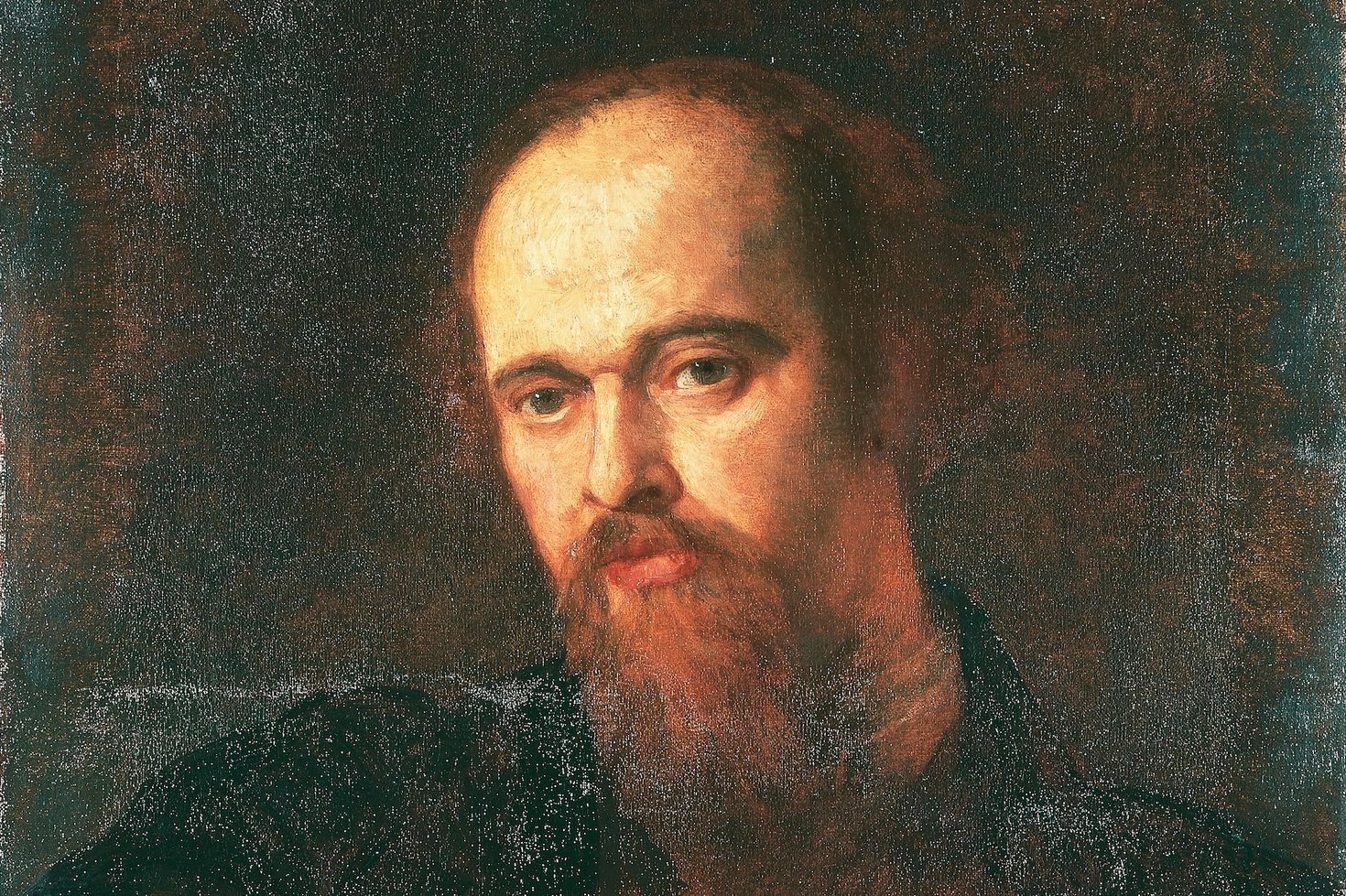

Early Life and Education of Dante Gabriel Rossetti
Dante Gabriel Rossetti was born in London on May 12, 1828. His father was an Italian refugee and came to London, where he became professor of Italian at King’s College. His father was a highly cultured man and had something of a poet. Rossetti’s mother was half English and half Italian. She was very fond of literature and highly cultured. Quite early in life, Dante Gabriel Rossetti showed his talent as both an artist and a poet. In 1836, he attended a day school in Poland Place and King’s College, where he remained until 1842.
Rossetti and the Pre-Raphaelite Brotherhood
Wishing to be an artist, Rossetti joined a drawing academy in Broosbury at the age of sixteen in 1846. In the same year, he became acquainted with Holman Hunt and Millais, and this led to the formation of the famous Pre-Raphaelite Brotherhood, a School of Artists, which identified itself with the ideals and methods of the Italian painters before Raphael. In the same year, he became acquainted with Holman Hunt and Millais, and this led to the formation of the famous Pre-Raphaelite Brotherhood, a School of Artists, which identified itself with the ideals and methods of the Italian painters before Raphael.
Rossetti was one of the founding members of the Pre-Raphaelite Brotherhood, established in 1848. The movement sought to revive the simplicity, sincerity, and vivid detail found in Italian art before the time of Raphael. The Pre-Raphaelites rejected the artificial conventions of academic art and advocated a return to nature, truth, and emotional intensity. Rossetti became the leading spirit of the movement and greatly influenced both Victorian painting and poetry. Rossetti began his career as a painter with unflinching realism, which later on was enriched with his plastic imagination through symbolism and medievalism. While producing the most original works of painting, Rossetti wrote a good deal of his best poems, published in the magazine of the Brotherhood called The Germ.
Rossetti as a Poet and Artist
Between 1860 and 1870, Rossetti was at the zenith of his fame. During that period, he became acquainted with A. C. Swinburne, George Meredith, and William Morris, who acknowledged him as their leader. But Rossetti became a drug addict. That ruined his temper and health. His marriage with Ellanor Siddel, which was celebrated after nine years of courtship in 1860, was not very happy owing to his morbid melancholy, self-will, and drug habit. Mrs Rossetti was very frail in health with a consumptive tendency and died from an overdose of laudanum (an alcoholic tincture of opium) in 1862. In his excessive grief, Rossetti buried his unpublished works in his wife’s grave, which was, however, opened seven years later and published as poems by D. G. Rossetti. After a period of considerable mental and physical suffering, Rossetti died in 1882.
Rossetti made remarkable contributions to both literature and art. His poetry is marked by sensuous beauty, rich imagery, musical language, and an intense interest in medieval themes. Unlike many Victorian poets who focused on social and moral issues, Rossetti concentrated on beauty, love, passion, dreams, and spiritual longing. His poems reveal a close relationship between visual art and poetry, which reflects his belief that painting and poetry should complement one another.
Rossetti remains one of the most important figures of the Victorian Age. His innovative combination of visual and verbal art, along with his emphasis on beauty and imagination, helped shape the development of modern poetry. Today, he is remembered not only as a founder of the Pre-Raphaelite Movement but also as one of the finest poet-painters in English literary history.
Major Works
Rossetti’s chief works are:
- The Blessed Damozel – Rossetti’s most famous poem, depicting a maiden in heaven longing for reunion with her lover on earth.
- The House of Life – A celebrated sonnet sequence exploring love, beauty, memory, and mortality.
- The Bride’s Prelude – A narrative poem dealing with love and tragedy.
- The Burden of Nineveh – A reflective poem on civilisation, history, and faith.
- Dante and His Circle – Rossetti’s translations of early Italian poets, including Dante Alighieri.
You may also like Pied Beauty as a Religious or Devotional Poem – Critical Analysis