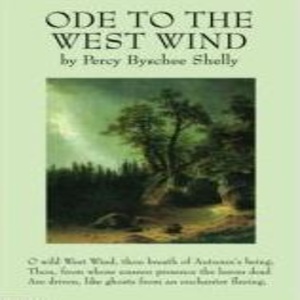

P.B.Shelley’s celebrated ode titled Ode to the West Wind is an invocation to the spirit of the wild and uncontrollable west wind. He extols this spirit of the west wind in its two-fold capacity as a destroyer and preserver. The poet celebrates here the uncontrollable power of the west wind. He describes its activities on the land, in the sky, and on the sea, vividly and vigorously.
The opening stanza gives a graphic account of the activities of the west wind on the land. The wild wind shakes, sheds and carries away dead leaves, ‘yellow and black and pale and hectic red’. These leaves look like the pestilence-stricken multitude. The wind also carries and collects the seeds within their dark wintry beds. When spring comes, these seeds give birth to a new world of nature. Earth becomes lively and beautiful with new colours and odors. So, an important activity of the west wind lies in its power to bring about transformation in nature
The second stanza describes the activities of the wind in the sky. The poet draws a picture of the sky at the approach of the storm. The wind carries away loose clouds and scatters them all over the sky. Deep, dark clouds cover the whole sky. They seem to hang like the dry, bright, dishevelled hair of the Maenad, the women-worshippers of the Greek wine-god Bacchus. The wind brings out of the sky lightning, hailstorms, and torrential rain.
The third stanza contains the activities of the west wind on the sea. The beginning of this stanza shows how the west wind stirs the calm surface of the blue Mediterranean. The stanza concludes with the picture of the horror caused by the wind on the Atlantic Ocean. The surface of the Atlantic is terribly affected by the mighty current of the wind. Even the submerged vegetation is destroyed by the powerful rush of the wind over the surface of the ocean. Through these activities, the west wind represents the perpetual cycle of death and regeneration. Its destructive energy ultimately prepares the way for creation and renewal.
The west wind also possesses a sense of freedom and irresistible movement. Shelley repeatedly describes it as ‘Wild Spirit’ and emphasises its uncontrollable energy. Nothing seems capable of resisting its movement across the earth, sky and sea. This immense freedom contrasts sharply with the poet’s own condition. Shelley feels physically and emotionally burdened by the difficulties of his life and longs to participate in the wind’s freedom. His desire to become an instrument of the wind suggests that he wishes to transcend his personal limitations and become a powerful voice capable of influencing the world.
The activities of the west wind also acquire a political and revolutionary significance. Shelley was deeply concerned with oppression, injustice and the possibility of social transformation. The wind’s ability to sweep away the old and prepare the ground for something new can therefore be understood as an image of revolutionary change. When the poet asks the wind to scatter his thoughts ‘among mankind’, he imagines poetry itself becoming an agent of transformation. His poetry may function like the wind—unseen but powerful, capable of carrying ideas across boundaries and awakening people to a new consciousness. The west wind consequently becomes both a natural force and a symbol of intellectual, political, and poetic regeneration.
Of course, in the concluding stanza, the poet prefers his appeal to the west wind. He gives out his vision of the millennium. He finds his kinship with the wind. But he is kept suppressed by the oppressive circumstances of his life. He appeals to the wind to inspire him with its energy. He will then sing the song of joy and hope to humanity. He knows well that, after the end of the dark present, a bright future is sure to come. After all, if winter comes, spring cannot remain far behind. The wind is here a force of inspiration.
Also read: Lyric Poetry: Definition, Characteristics and Examples