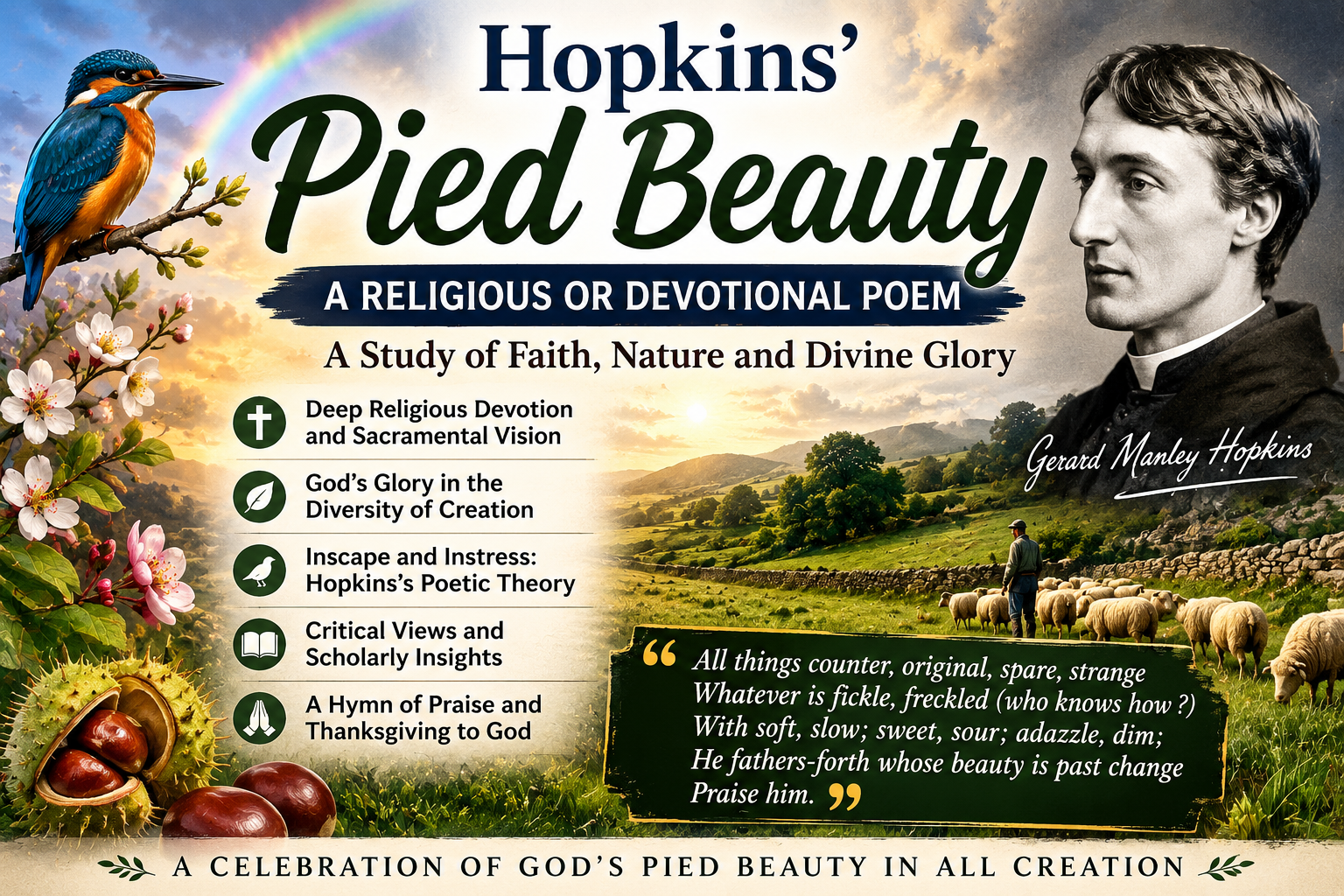

Gerard Manley Hopkins’s poetry bears an intense religious ardour, which finds its natural outlet in the most daring verbal and intellectual skill. He keeps his form and emotion under strict discipline, naturally imbibed through his religious training. His spiritual conflicts are beautifully expressed in the modern Tantalus (referred to in Greek mythology), who knows no peace because his spiritual thirst has not been quenched. The impact of the sensual world of feelings upon his spiritual sensibility seems to keep the poet confined within an order of ideas. He interprets the world with all its freeness, glory and celestial gleam in a religious spirit and conveys to man the message of God whose bounty of beauty is past all changes. Hopkins poetry carries the unique message of God to a man in an age of unrest and confusion, and this is the staple food of his religious poetry.
Hopkins wrote the present poem, Pied Beauty, during 1877-78, immediately after he had become a Jesuit priest. The poem, like another poem of the period, “Starlight Night“, is deeply imbued with the unalloyed religious sentiment of a true devotee. A sacramental emphasis on the greatness of God runs all throughout the poem. The poem echoes the poet’s total faith in the incarnation of God all around this very earth.
The poet praises God for the pied beauty with which He has filled the universe. “Glory be to God”, the mighty maker of all dappled and rare things. A man should, therefore, turn to God, who is the Creator of all things in the Universe. He is all beautiful, and his beauty will never die. Man is to worship God, who is beauty incarnate. He should, therefore, sing hymns of glory to God alone. In fact, Hopkins finds the glory of God manifested in His various rich and colourful gifts to mankind. Nature has her simple and elemental beauties. Even in such primitive things of nature as the skies, birds, and pretty chestnuts, we find the strange contrast of colours, created by God. This is elaborated with religious enthusiasm.
As a Jesuit priest, Hopkins believed that the natural world was a manifestation of divine presence. Every object in nature, however ordinary or insignificant, bears the imprint of God’s creative power. The varied colours and patterns found in the sky, birds, landscapes, and human activities are not accidental but expressions of God’s infinite imagination. Thus, the poem becomes a hymn of thanksgiving in which nature becomes a visible sign of an invisible spiritual reality.
The poem’s religious significance lies in its celebration of diversity within unity. Hopkins praises not only beautiful and harmonious things but also things that are irregular, mottled, and varied. In doing so, he departs from the traditional notion that beauty consists solely in symmetry and perfection. For Hopkins, even “fickle,” “freckled,” and contrasting things reflect the glory of God. The multiplicity of creation ultimately points to the unity of the Creator, whose beauty is eternal and unchanging. While the world is marked by change and variety, God remains constant and perfect.
The poem also reflects Hopkins’s theory of “inscape” and “instress.” According to Hopkins, every object possesses a unique inner essence or identity called inscape. The force that holds this identity together and enables the observer to perceive it is called instress. In Pied Beauty, the poet recognises the distinctive individuality of each created thing and traces it back to God, the ultimate source of all uniqueness and order. Thus, the poem, in addition to an appreciation of nature, is a spiritual meditation on God’s creative energy.
Critics have frequently emphasised the devotional character of the poem. According to Norman White, Hopkins’s poetry seeks to reveal “the presence of God in the created world.” Similarly, William York Tindall observes that Hopkins found in nature “a direct revelation of divine glory.” These critical views support the idea that Pied Beauty is essentially a hymn of praise celebrating God’s omnipotence and creativity. The poem transforms ordinary natural observations into an act of worship and spiritual contemplation.
The concluding injunction, “Praise him,” gives the poem the character of a prayer or doxology. Like a biblical psalm, it begins and ends with praise to God. The entire poem may therefore be regarded as an expression of gratitude, wonder, and reverence before the mystery of creation. Hopkins invites mankind to look beyond the surface appearance of things and recognise the divine hand that fashions and sustains the universe.
The landscape, with its fold of sheep and its peasants at work in the fields, is beautiful to look at. God has blessed humanity with all antithetical things-swift and slow, sweet and sour, bright and dim. All things come from Him. He is the mighty creator of all things ‘counter, original, spare, strange’. His glory comes out in the pied beauty of the whole universe. And God’s beauty remains forever Man should sing His glories. It is God alone who creates beauty. It is God alone whom man should, therefore, glorify.
Pied Beauty is regarded as a characteristic piece of Hopkins’s religious poetry. It brings out clearly his deep faith in God and in all His mighty creations. Hopkins’s devotion to God comes out in every line of this poem, as heard in the quoted lines below:
All things counter, original, spare, strange
Whatever is fickle, freckled (who knows how ?)
With soft, slow; sweet, sour; adazzle, dim;
He fathers-forth whose beauty is past change
Praise him.
You may also like Discuss the symbolism of James Joyce’s short story “Araby”