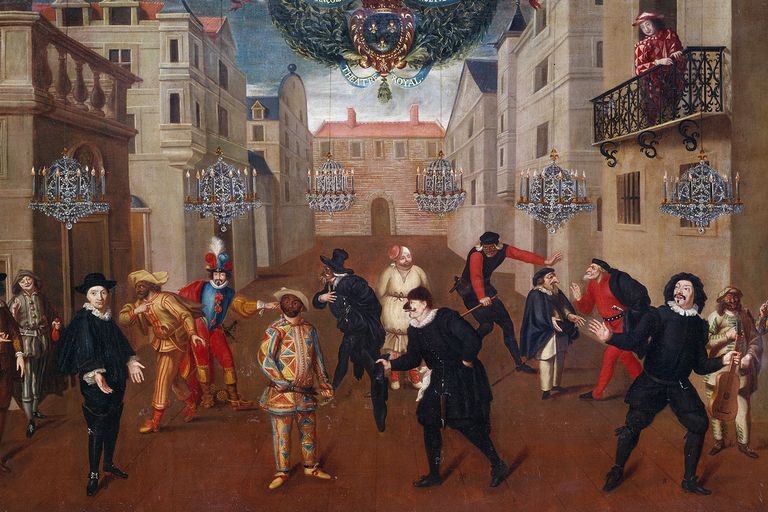

In medieval Italy, the arti were groups of artisans or guilds; hence, the term means ‘comedy of the professional actors’. The absolute origins of this dramatic genre are obscure, but they are probably Roman. Also known as “Italian comedy,” it was a humorous theatrical presentation performed by professional actors who traveled in troupes throughout Italy in the 16th century.
The plots of commedia dell’arte were usually based on love intrigues involving people of all ages; masters and servants, mistresses and confidantes. Both plot and dialogue were often improvised after basic rehearsal (improvisation was important because performance could be adapted to local and contemporary needs), and the success of a piece depended very largely on the comic ingenuity of the performers, who would include mime, farce, clownish buffoonery and music in the presentation. Characters were stock types. The main male characters were: Pantaloon, the Captain, a Doctor, the Inamorato, the servants Harlequin, Brighella and Scapino. The main female characters were also stock types. There was Inamorata, her confidante the Soubrette – as like as not in love with one of the servants – plus Canterina and Ballerina who provided interludes in the main action. In spirit, if not in fact, a play like Shakespeare’s Comedy of Errors (1594) owes something to the traditions of commedia dell’arte, and one can detect the influence of the form in the work of Ben Jonson, Molière, and Goldoni; in pantomime, farce, puppet plays and ballet.
Another important feature of commedia dell’arte was the use of masks. Most of the comic characters appeared wearing distinctive masks and costumes that immediately revealed their personalities to the audience. For example, Harlequin usually wore a colourful patched costume and represented a witty, mischievous servant, while Pantaloon was shown as a greedy and foolish old merchant. These masks helped create exaggerated comic effects and made the characters easily recognisable even to ordinary spectators.
Physical comedy was also a central element of commedia dell’arte. The actors relied heavily on gestures, acrobatics, dancing, mimicry, and slapstick humour rather than elaborate scenery or written dialogue. Because of this lively style of acting, performances became highly entertaining and energetic. Unlike classical drama, which was often limited to educated audiences, commedia dell’arte appealed to both the upper and lower classes because of its simple plots, visual humour, and lively performances. Since the actors travelled from place to place, the form spread rapidly across Europe and became one of the earliest examples of professional popular theatre. The female performers in commedia dell’arte also deserve special mention. Unlike many earlier theatrical traditions in Europe, where men played women’s roles, women in commedia dell’arte performed openly on stage. This was an important development in the history of European theatre. Actresses became admired for their singing, dancing, and acting abilities.
Commedia dell’arte greatly influenced the development of Western drama and comedy. Its stock characters, comic misunderstandings, disguise scenes, and witty exchanges can be seen in the plays of William Shakespeare, Molière, Ben Jonson, and Carlo Goldoni. Even modern theatre, circus comedy, silent films, and cartoons continue to use elements derived from this dramatic tradition.
Also read: Definition of Couplet, Triplet and Quatrain and its examples