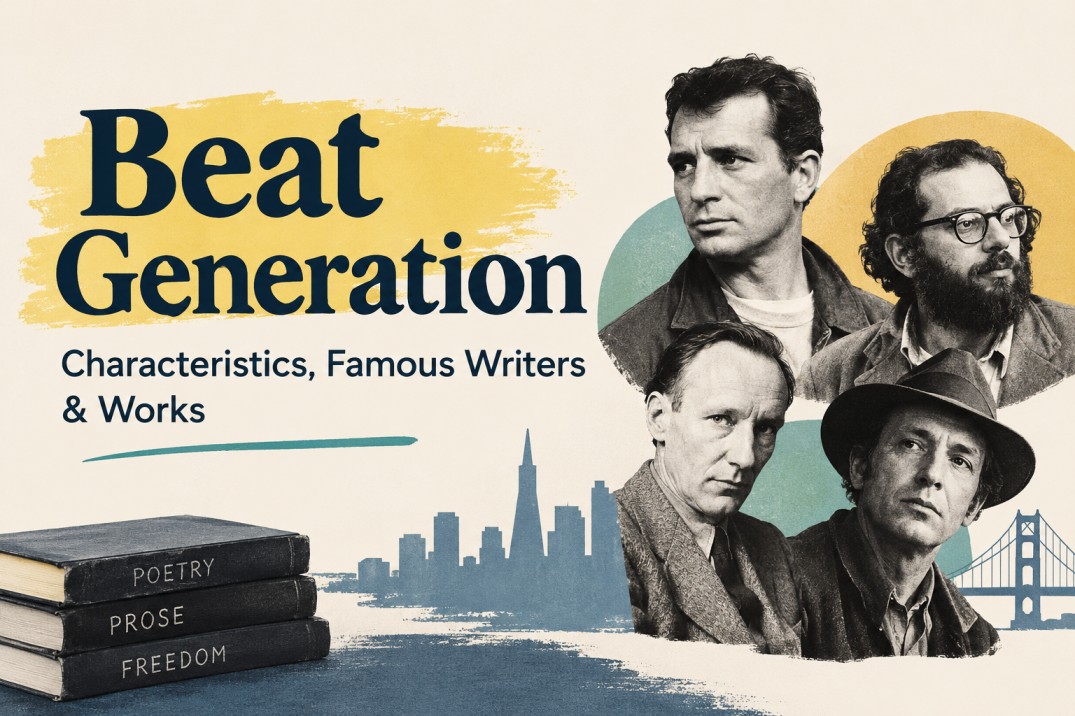

The term ‘beat’, in this restricted sense, is generally believed to have been devised by Jack Kerouac (1922-69). It bears connotations of down-beat, off-beat, down-and-out, drop-out and beatitude, and denotes a group of American writers (especially poets) who became prominent in the 1950s. They are particularly associated with San Francisco, USA, and their generally accepted father-figures Kenneth Rexroth, Henry Miller, and William Burroughs.
Historical Background of the Beat Generation
The Beat Generation emerged in the United States in the years following the Second World War. The movement developed partly as a reaction against the conformity, consumerism, and conventional social expectations associated with post-war American society. During the 1950s, economic prosperity and suburban middle-class values became increasingly prominent, but the Beat writers questioned whether material success could provide genuine freedom or spiritual fulfilment. Their writing expressed dissatisfaction with what they regarded as the restrictions imposed by conventional American culture.
The movement was particularly associated with two important literary centres: New York and San Francisco. New York was significant in the early development of the Beat circle, while San Francisco became an important centre for Beat poetry during the 1950s. The famous Six Gallery reading of 1955, at which Allen Ginsberg first publicly read Howl, became an important event in the history of the movement. The subsequent publication of Howl and Other Poems in 1956 and the obscenity trial surrounding the poem brought considerable public attention to Beat literature.
The Beat writers (and many of the ‘Beat generation’) developed their own and a highly idiosyncratic style. Their convictions and attitudes were unconventional, provocative, anti-intellectual, anti-hierarchical, and anti-middle-class (the ‘squares’). They were influenced by jazz, by Zen Buddhism and by American Indian and Mexican Peyote cults, and their Bohemian lifestyle was popularly associated with drugs, free’ sex, drink, and permissive living in general. It was in some respects anarchic and provoked considerable hostility.
Major Characteristics of Beat Literature
One of the principal characteristics of Beat literature is its rejection of conformity. Beat writers challenged established ideas about respectable behaviour, conventional careers, sexuality, religion, and family life. They sought alternative ways of living and writing that would allow greater individual freedom. Their works frequently portray outsiders, travellers, artists, wanderers, and individuals who resist the expectations of mainstream society.
Another important characteristic is the celebration of spontaneity and experience. Instead of presenting life according to conventional literary structures, Beat writers generally attempted to reproduce the immediacy of lived experience. Kerouac, for example, developed what he called “spontaneous prose,” in which rapid movement, improvisation, repetition, and loosely connected episodes contribute to the rhythm of his narratives.
Beat literature is also marked by its strong connection with jazz and improvisational music. Jazz provided the writers with both a cultural influence and a model for literary composition. The rhythms of bebop, particularly the music associated with figures such as Charlie Parker and Dizzy Gillespie, influenced the cadence and structure of Beat poetry and prose. Ginsberg’s poetry, for instance, frequently employs long, breath-driven lines that can resemble the improvisational flow of jazz.
Spirituality and Eastern Influences
Although the Beat writers are often associated with rebellion and unconventional lifestyles, their interests were not limited to social protest. Spiritual seeking was an important element of the movement. Many Beat writers turned towards Buddhism, Zen philosophy, Hinduism, meditation, and other forms of Eastern thought as alternatives to what they perceived as the spiritual emptiness of consumer-oriented society.
Gary Snyder’s engagement with Zen Buddhism is particularly significant, while Kerouac’s The Dharma Bums explores Buddhism, nature, meditation, and alternative forms of spiritual experience. The Beat interest in Eastern philosophies contributed to the growing popularity of Buddhism and other Asian spiritual traditions among sections of American counterculture during the later twentieth century.
Language and Literary Style
Beat writers use form, diction, rhythm, and narrative technique in their writing. They combine colloquial speech, slang, repetition, unusual punctuation, extended sentences, spontaneous associations, and references to popular culture. Beat poetry frequently abandons traditional rhyme and metre in favour of rhythms derived from speech, music, and breath.
The writers also blurred the boundaries between literature and lived experience. Both their novels and poems focus on journeys, friendships, relationships, drug experiences, spiritual quests, and encounters with different social groups. As a result, autobiography, fiction, poetry, travel writing, and personal confession frequently overlap in Beat literature.
Important Writers of the Beat Generation
Although Jack Kerouac and Allen Ginsberg are among the most widely recognised Beat writers, the movement included a larger circle of poets and novelists. Ginsberg’s Howl and Other Poems (1956) represents as well as anything the disillusionment of the Beat movement with modern society, its materialism and militarism, and its outmoded, stuffed-shirt, middle-class values and mores. Ginsberg’s Kaddish (1960), an elegy for his mother, and Reality Sandwiches (1963) were other important publications. William S. Burroughs became known for his experimental novels and fragmented narrative techniques, particularly Naked Lunch. Gregory Corso’s Gasoline (1958) and Bomb (1959) combined humour, rebellion, philosophical reflection, and social criticism. Gary Snyder connected Beat writing with Zen Buddhism, environmental consciousness, and an appreciation of nature. Lawrence Ferlinghetti’s Pictures of the Gone World (1955) and A Coney Island of the Mind (1958).
Women writers and participants have also received increasing scholarly attention in discussions of the Beat Generation. Writers such as Diane di Prima, Joyce Johnson, Carolyn Cassady, and Hettie Jones contributed to the literary and cultural world surrounding the movement. Their experiences also reveal that the Beat scene was not exclusively a male literary phenomenon and invite a reconsideration of the movement’s representation of gender and sexuality.
Conclusion
The Beat Generation represented a broader cultural challenge to conformity and established social values in post-war America. Through writers such as Jack Kerouac, Allen Ginsberg, William S. Burroughs, Gregory Corso, Gary Snyder, and Lawrence Ferlinghetti, the movement transformed the relationship between literature and personal experience. Its continuing significance lies in its experiments with literary form and its persistent questioning of conventional ideas about society, freedom, spirituality, and individual identity.
Also read: Readerly and Writerly Text: Roland Barthes’ Theory Explained