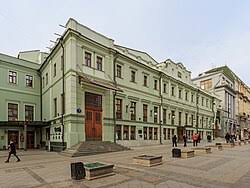

Moscow Arts Theatre was founded in 1898 by the actor and theatre director Konstantin Stanislavsky (1863–1938) and the playwright and theatre director Vladimir Nemirovich Danchenko (1858-1943), to create a repertory theatre which would provide the public with the best in classic and modern drama, and pursue the highest professional standards. Though its founders were soon forced to abandon their policy of offering cheap tickets, they succeeded in other aspects of theatre reform: the ‘star system’ was replaced by ensemble performance, artificial styles of acting gave way to a style based on psychological realism, and scenery, sound effects, and lighting were used to create an illusion of everyday reality on stage. They also promoted the role of the director as the figure whose ideas provided a single, unifying vision for a production.
Stanislavsky developed a systematic method of acting, later known as the “Stanislavsky System,” which emphasized emotional truth, concentration, imagination, and the inner motivation of characters. This method revolutionized modern acting and later influenced theatre and cinema across the world, particularly method acting in America. Through workshops and studios associated with the theatre, generations of actors were trained to perform with sincerity and psychological depth rather than exaggerated theatrical gestures.
The plays of Anton Chekhov are particularly associated with this theatre. His play The Seagull was successfully revived by the theatre two years after its first disastrous production in 1896, leading to the rehabilitation of Chekhov’s reputation as a dramatist. His work provided an ideal vehicle for its ‘house style’ of psychological realism, which encouraged the audience to identify with and experience a character’s emotions, and promoted ensemble acting in which the psychological realist acting style helped to reveal the subtext of the characters’ interactions. Another author closely connected with the theatre was Mikhail Bulgakov, whose play The Days of the Turbins, a sympathetic portrayal of a family on the ‘wrong’ side in the revolution, was first performed in 1926.
Unlike earlier theatres that depended heavily on decorative spectacle, the Moscow Arts Theatre aimed at unity in performance, set design, costume, lighting, and music. Every element of production was carefully coordinated to support the mood and realism of the play. This artistic discipline transformed theatre into a serious art form and influenced dramatic practices in Europe, America, and other parts of the world. It became a cultural centre where literature and theatre worked together to reflect social realities and human psychology. The productions of Chekhov’s plays such as Uncle Vanya, Three Sisters, and The Cherry Orchard achieved worldwide fame because of the theatre’s subtle acting style and emotional realism. These productions established the Moscow Arts Theatre as one of the most influential theatrical institutions of the twentieth century.
The first visit to Britain of a company from the theatre took place only in 1958; Harley Granville-Barker met Stanislavsky in 1914 to discuss plans to recreate an original Moscow Arts Theatre production in London, but war and revolution intervened. After 1917, the theatre’s repertoire and realistic acting style made it a target for attacks from the left; Chekhov’s plays were thought to be too sympathetic to the gentry and officer classes, and of little relevance to Soviet life. The theatre was protected by the Bolshevik state, which designated it an academic theatre in 1921, and it continued to produce classics as well as new works. In 1932, it was renamed after the writer and dramatist Maxim Gorky, and its realistic style was promoted as the only model for the rest of the Soviet theatre to follow, rather than the avant-garde experimentation of the 1910s and 1920s. The theatre was officially renamed The Gorky Moscow Art Theatre. It was not until the autumn of 1970 that Oleg Yefremov, an actor, producer, and former student of the Moscow Art Theatre Studios who wanted Russia to once again be a major contender in the theatre world, took over control of the theatre and began to reform it. In 1987, the theatre split into two troupes: the Chekhov Moscow Art Theatre (artistic director Oleg Yefremov) and the Gorky Moscow Art Theatre (artistic director Tatiana Doronina).