
Background of Magna Carta
After the sudden death of his brother Richard, John became the king of England without any difficulty. He was, however, oppressive and selfish and hardly did anything to win love and obedience from his subjects. In fact, by his successive steps of action, marked equally with injustice and wrong, he could only manage to lose the support of all the sections of his subjects. His foreign policy was disastrous and led to financial problems in the country. He tried to raise money from his subjects and adopted repressive measures for the same. The result was the collective protest from his subjects, who could no longer bear his acts of wrong and injustice. The barons closed their ranks and formed a united front. Other people of lower ranks also joined the front with an avowed assertion to have the formal recognition of their rights and the amendments of their grievances. A Charter was prepared, and the king was pressed to sign it. That was known as the Magna Carta.
Signing and the Main Clauses of Magna Carta
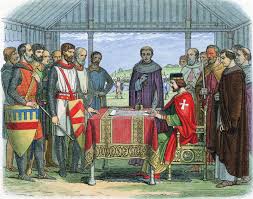
The Magna Carta was signed at Runnymede, a meadow near the River Thames in England, between King John and the rebel barons. Though originally meant to protect the interests of the feudal barons, it gradually became a symbol of the rights and liberties of all English people. It is often regarded as the foundation stone of constitutional government in England.
The Great Charter that was reluctantly sealed by the king on June 15, 1215, had sixty-three clauses. Four clauses were, however, of lasting importance in the constitutional history, though unwritten, of England. Those clauses restricted the king from imposing taxes, arbitrarily at his own will, without the consent of Parliament. Those clauses also did not permit any arbitrary imprisonment, eviction, or dispossession from the property of any subject by the king. The clauses also provided for the liberty as well as the justice of every subject, the right to have the trial by jury, and the equality of all before the supremacy of the law.
Magna Carta and the Rule of Law
One of the most remarkable features of the Magna Carta was the principle that the king himself was not above the law. Before this charter, English kings often ruled according to their own wishes. The Magna Carta established the idea of the “rule of law,” according to which even the monarch must obey the law of the land. This principle later became the basis of modern democracy.
The Magna Carta also influenced the development of the English Parliament. Since the king could not impose taxes without the consent of his subjects, the practice of consulting representatives gradually developed into the parliamentary system. Thus, the charter indirectly contributed to the growth of representative government in England. Over and above those clauses are found to have been evoked even against the crown in the cases of the struggle between the king and Parliament.
Influence and Importance of Magna Carta
The influence of the Magna Carta extended far beyond England. Its principles inspired many later constitutional documents such as the Petition of Right (1628), the English Bill of Rights (1689), and even the Constitution of the United States and the Universal Declaration of Human Rights. Therefore, its importance is not only national but also international.
Although King John later tried to cancel the Magna Carta with the help of the Pope, the charter survived and was reissued by later kings. Over time, it became a powerful symbol of liberty, justice, and protection against arbitrary rule. The Great Charter Magna Carta was a triumphant document of the subjects against the ruthless despotism of the feudal king. In reality, it proved to be a great starting point for English national liberty and individual freedom. Magna Carta occupies a unique place in world history because it laid the foundation of civil liberty, constitutional monarchy, and democratic governance. It transformed the relationship between the ruler and the ruled and remains one of the most significant political documents in history.