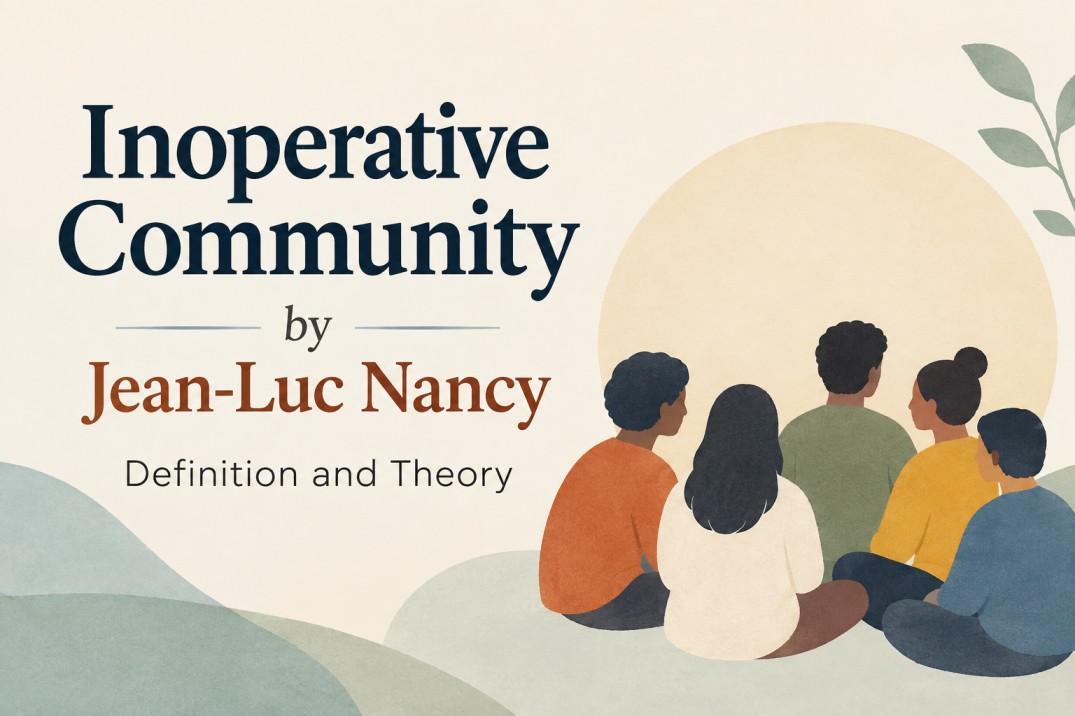

The French philosopher Jean-Luc Nancy proposed the theory of ‘inoperative community’, or ‘communauté désoeuvrée’, which rejects the idea that community can be created through work. By inoperative (‘désoeuvrée’), Nancy does not mean dysfunctional or failing, but rather a spontaneous or ‘unworked’ inclination to come together that has no object or purpose other than itself. The community does not confer a higher purpose upon its constituents, Nancy claims. It does not, as religious, quasi-religious, and metaphysical philosophers argue (he has in mind Martin Heidegger, but one could also name Alain Badiou, transform humans from animals into men and women. The coming together is not motivated by individual desire or collective insecurity but inheres in the human situation as a passion for sharing. This model of community is resolutely set in the present, and Nancy explicitly rejects those models of a community (particularly Marx-inspired models) that situate community as either a lost idyll or a future ideal that can never be realized.
For Nancy, community is grounded in the condition of being-with rather than in a shared identity, common ideology, or collective project. Human beings exist in relation to others, and their existence is always exposed to and shaped by this relation. Nancy describes individuals as “singular beings,” meaning that each person retains their distinctiveness while simultaneously participating in a shared existence. Community does not erase this difference by demanding unity or sameness; instead, it emerges from the sharing of finite and singular lives. In this sense, an inoperative community is not a political programme to be accomplished but an ongoing mode of coexistence in which people encounter, communicate, and share their existence without being absorbed into a homogeneous collective. Through this, Nancy offers a significant alternative to traditional notions of community based on identity, productivity, and common purpose.
Also read: Time Play: Definition, Meaning, Techniques and Examples in Drama