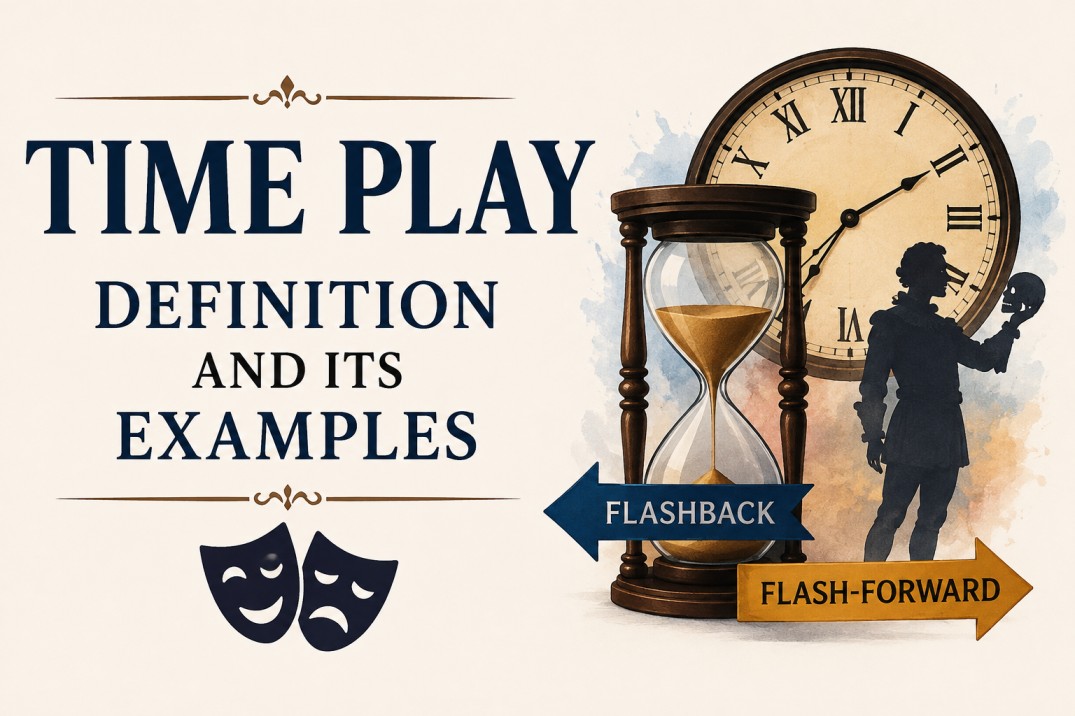

Time play is a loose category for a form of drama that in some way exploits or manipulates chronological sequence by various dramatic means. The most common techniques include the flashback, in which events from the past are presented within the dramatic present, and the flash-forward, in which the action or audience’s awareness is projected into a future time.
Time play involves a deliberate manipulation of the conventional linear progression of dramatic time. Instead of presenting events strictly in the order in which they occur, playwrights here rearrange, compress, extend, interrupt, or reverse chronological sequence to create suspense. Through this, the information is revealed gradually.
Several playwrights have used such devices throughout the history of drama. Shakespeare, for example, makes an interesting use of the passage of time in The Winter’s Tale. Between the third and fourth acts, the Chorus announces that sixteen years have passed since Perdita was ‘lost’. This leap in time enables Shakespeare to move the plot forward while showing how theatrical convention can make a substantial period of time acceptable to an audience.
The most well-known dramatist to experiment extensively with the relationship between space, time, memory, and human experience was J. B. Priestley (1894–1984). His interest in the nature of time was influenced particularly by the theories of J. W. Dunne, presented in An Experiment with Time (1927) and The Serial Universe (1934). Dunne questioned the conventional idea that time is experienced simply as a continuous, linear progression and proposed ideas concerning different dimensions of time and the possibility of experiencing events beyond the immediate present. Priestley incorporated similar ideas into several of his plays, most notably Time and the Conways (1937), I Have Been Here Before (1937), An Inspector Calls (1945), and Johnson over Jordan (1939). In Time and the Conways, for instance, Priestley dramatically manipulates chronology: Act I is set in 1919, Act II moves eighteen years forward to 1937, and Act III returns to 1919. This unusual structure allows the audience to see the contrast between the characters’ youthful hopes and their later circumstances, while also raising questions about fate, free will, memory, and the possibility of changing the future.
H. G. Wells, particularly through his science-fiction explorations, is an important example of a writer who treats time as something that can be traversed and manipulated. Another is Graham Greene, who in his autobiography Ways of Escape, reflects on the possibility of using symbols associated with both the past and the future. The concept of time is especially significant in science fiction, where writers frequently employ time travel, alternate timelines, temporal paradoxes, and futuristic settings to examine human identity, causality, history, and the consequences of individual choices.
Also read: Death Drive by Sigmund Freud: Meaning, Theory and Explanation