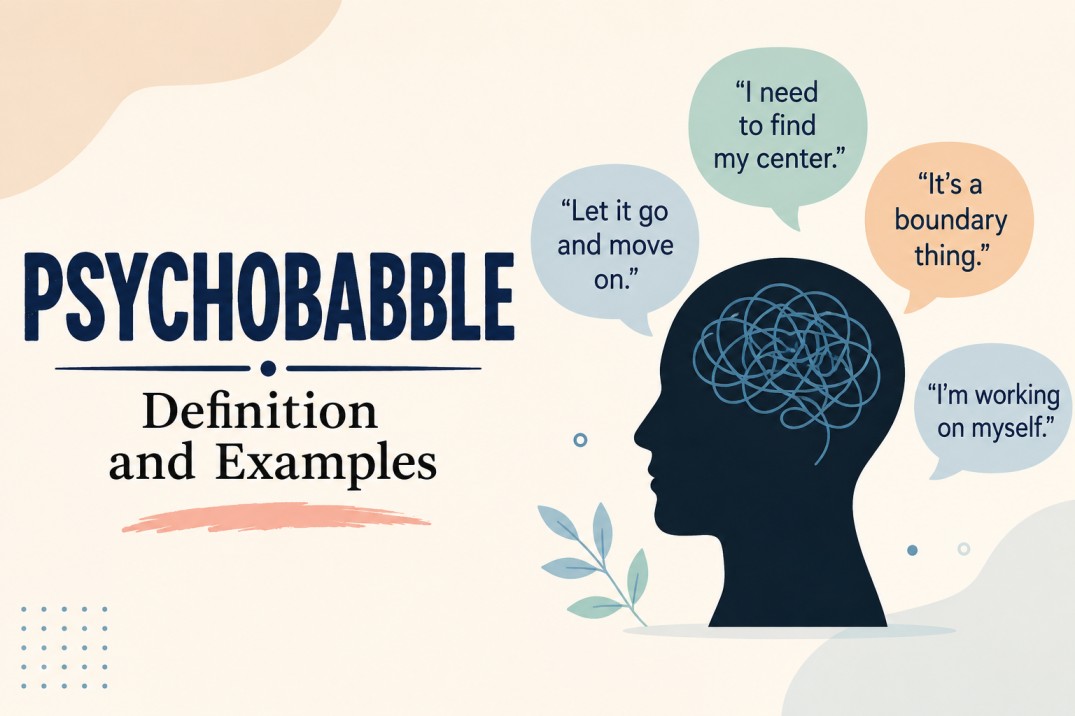

The term ‘Psychobabble’ was coined by R. D. Rosen in Psychobabble: Fast Talk and Quick Cure in the Era of Feeling (1977) – a critique of DIY ego-psychology – and defined as: ‘a set of repetitive verbal formalities that kills off the very spontaneity, candour and understanding it pretends to promote ‘.
It’s an idiom that reduces psychological insight to a collection of standardized observations, that provides a frozen lexicon to deal with an infinite variety of problems. Common in everyday speech and re-created/reproduced in fiction (e.g. Cyra McFadden’s clever satirical novel The Serial: A Year in the Life of Marin County, 1977). It is discussed by David Lodge in a witty essay in Working with Structuralism (1981), in which he cites such instances as: ‘get centred’, ‘into the pits’, ‘flash on’, ‘blow away’, ‘off the wall’, ‘wig out’, ‘upfront’, ‘spaced/spaced out/spacey’. All have metaphorical or semi-metaphorical meanings, in some cases, a good deal removed from the literal sense. For example, ‘off the wall’ signifies ‘spontaneously’.
Psychobabble is often characterized by its simplification of complex psychological ideas into fashionable expressions and ready-made formulas. Such expressions may sound therapeutic, sophisticated, or emotionally insightful, but they do not necessarily convey genuine psychological understanding. Phrases such as “I need some space,” “I’m working on myself,” “get in touch with your feelings,” or “that’s a boundary issue” can sometimes be useful, but when they are used mechanically or without regard to the particular situation, they become examples of psychobabble. The term carries a critical implication: psychological language can become a kind of social jargon that gives the appearance of insight while avoiding deeper reflection or meaningful communication.
In literature and popular culture, psychobabble can also function as a satirical device. Writers may reproduce the vocabulary of therapy and self-help to portray particular social groups, cultural trends, or attitudes toward identity and emotion. Its use can reveal how psychological terminology enters ordinary conversation and gradually acquires meanings that differ from those of professional psychology. Thus, psychobabble is not simply the use of psychological words in everyday speech; rather, it refers to the formulaic, fashionable, or pseudo-psychological use of such language, especially when it substitutes clichés for genuine emotional understanding. The concept remains relevant because contemporary self-help culture, social media, and popular psychology continue to produce new forms of therapeutic vocabulary.
Also read: What is Pulp literature and its examples