
The phrase “a willing suspension of disbelief”, employed by Samuel Taylor Coleridge in 1817, means that the reader willingly suspends the analytical and scrutinising function of the mind and puts himself in a mood in which he can believe whatever he is told. Coleridge himself wondered what it was that might allow his readers to be sucked into a narrative that was unrealistic by nature and conjectured that it was the job of the writer to interject “human nature and a semblance of truth” into their work so that their audience might be capable of relating to it personally. In The Rime of the Ancient Mariner, there is obviously a willing suspension of disbelief on our part. The poem contains several impossible incidents, and yet we feel inclined to believe whatever we read.
The Ancient Mariner has, Lamb says, “a supernatural cast” but is thrown into relief and made convincing by its realistic setting. The framing of the tale is the first key to the reader’s buying in. Before we are drawn into the Mariner’s past, we find him first at a wedding, selecting a certain young man to whom he will deliver his story. “He holds him with his glittering eye / The wedding-guest stood still / And listens like a three years child”. This introduction grounds the events to come within a believable reality. As the reader comes to relate with the reluctant recipient of the Mariner’s lesson, they consequently become the listeners, accepting the narrative within their personal realm of experience. On a further level, the listener in the poem is reduced to the level of a three-year-old child, “so the Guest is now psychologically vulnerable to fantasy” (Uddin). In turn, we become the child, lost inside a fantastical story.
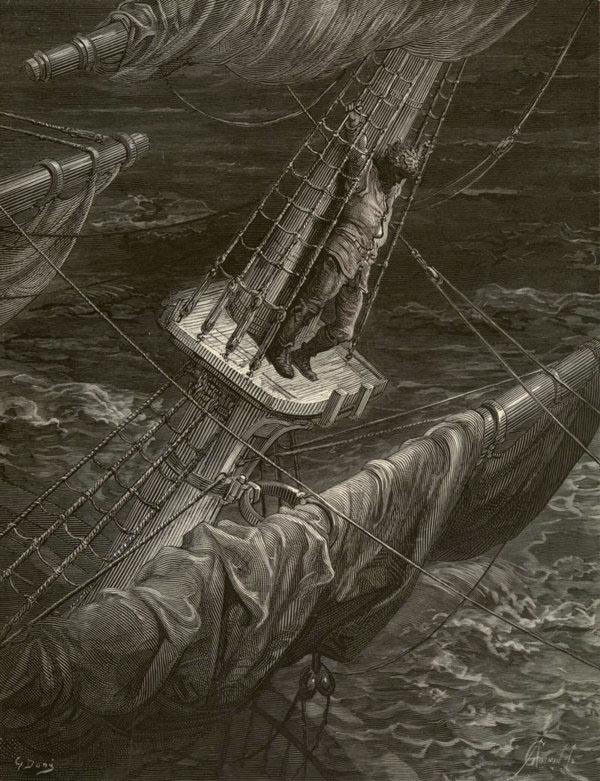
Once we enter the world of the Mariner’s ill-fated voyage, Coleridge sets us in a world that, while being grounded within natural reality is nonetheless as distant and mysterious to us as it was to the general reader in his own day. Even now, with a certain level of demystification and exploration, the ocean maintains a certain amount of depth, darkness and mystery that can be attributed to few other Earthly places. There is the Mariner’s hypnotic gaze, the mysterious appearance of a skeleton ship, the coming back to life of the ship’s dead crew, the angelic lights making signs to the land. With these supernatural elements, the poet has artistically interwoven convincing pictures of Nature, and the blending of these two kinds of incidents is so skilful that it strikes us as quite convincing and credible.
The poem is made more realistic by the masterly analysis of the thoughts and feelings of the Mariner. The poet makes us share the Mariner’s experiences by truthfully portraying his mental states. The details of the voyage, too are described with such order and regularity and there is such a diary-like airs about it that we accept it as being a faithful recording of facts. Everything seems to have been actually seen.
As the Mariner endures his punishment, the reader easily places his trials inside a religious context. Although not every reader is inherently religious, religious morals and mythology are still very much an ingrained part of us. As the Mariner desecrates the world governed by an omnipotent spiritual power, so he suffers his due. The supernatural figures who play for his life take on the terms of powerful deities, and though they punish him, his punishment is not without a powerful lesson. In fact, it serves a higher importance and makes him a more penitent person. This idea of trespass, punishment, and transcendence follows the seemingly familiar pattern of religious fable.
Finally, we place ourselves willingly with the Mariner because we understand his psychological turmoil. We relate to his fear of the unknown, his isolation, and his intense guilt- all common, relatable human suffering: “But oh! more horrible than that / Is the curse in a dead man’s eye? The Mariner endures the deaths of his mates, their consequent resurrection, and his subjection to a bizarre spiritual realm, but he also endures human suffering. We feel his isolation, and his desire to redeem his mistake, and remember that he is very much a real person. Not only do we take on the role of the listener, but we also take on the role of the Mariner himself. As Nasir Uddin remarks,” Coleridge’s mastery lies in that he has properly utilised this basic and universal humanity in attaining acceptability for all those unnatural happenings that turn natural with this helpless, forsaken, guilt-ridden tragic figure!
The moral “he prayeth best who loveth best; both man, and bird and beast” gives a human touch to the story and adds to its credibility. Last but not least, the simplicity and melody of the words, the rhythm and the music also have their part in producing an air of realism: “Alone, alone, all, all alone / Alone on a wide wide sea/ And never a saint took pity on / My soul in agony!
Coleridge delivers a tale deeply rooted in a supernatural realm beyond our own, but he also contributes the human element that allows us to put ourselves inside it, and even “believe it” for a time. As C.M.Bowra rightly remarks: “The Ancient Mariner is not a phantasmagonia of unconnected events, but a coherent whole which, by exploiting our acquaintance with dreams, has its own causal relations between events and lives in its own right as something intelligible and satisfying.”
Read also: Character of Wife of Bath in Chaucer’s Prologue to the Canterbury Tales