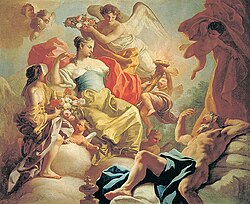

The source of Alfred Lord Tennyson’s poem Tithonus is the classical myth of the love of the goddess Aurora (the goddess of dawn) for Tithonus, a lovely Trojan Youth. Tithonus entreated the goddess to grant him immortality but forgot to ask for the perpetuation of his youth and beauty. The goddess granted the prayer of her earthly lover, blessed him with immortality, but sadly felt the ironic effect of his prayer. Tithonus became immortal but was subjected to the burden of age- to its decay and infirmity. He could not have his old youth and vitality and was reduced to a shadow of what he once happened to be.
That very mythological tale forms the theme of Tennyson’s poem, expressed in the monologue of the hero. This monologue contains his bitter lamentation for his own immortality, with the burden of age and deformity. Tithonus expresses in the monologue his bitter feeling of desperation for a state that he desired but did not realize its impact thoroughly. His grief and despair are profound enough and inspire an elegiac note all through his monologue. Tithonus has grown, though he is not subjected to the law of mortality of earthly life. But his immortality haunts him cruelly and consumes him totally. He sadly laments in a situation, not at all anticipated by him-
I wither slowly in thine arms
‘Here at the quiet limit of the world.
A white hair’d shadow roaming like a dream!
Tithonus knows and feels that he is now nothing more than a white-haired shadow of his former self. His youth and beauty that made him so attractive in the days gone by and turned the goddess amorous of his youthful loveliness are all gone. Under the blessing of the goddess, he, no doubt, enjoys immortality, but that is only under the acute suffering of old age and decrepitude.
The monologue is, indeed, elegiac in appeal. Tithonus continuously feels how glaring is now his difference from his much-loved goddess Aurora. She possesses eternal youth and beauty, while he has eternal life with the ailments of age. This distinction makes him particularly sad at the difference between his beloved, the goddess, and himself :
Yet hold me not for ever in thine East.
How can my nature longer mix with thine?
So, despairing Tithonus earnestly appeals to the goddess to take back the gift of immortality. He wishes earnestly to her to release him and restore him to the ground below. There is a touching tragic note in his appeal-
Release me and restore me to the ground.
The theme of the poem is not exhausted in the hero’s lamentation over the curse of cruel immortality that he has to bear. It has also another note of a deeper significance that forms the moral of the poem. This is the lesson for restraining man from his desire after that which is not granted to the human world. After all, no man should desire ‘to vary from the kindly race of men’ nor seek to pass to ‘beyond the goal of ordinance’, allotted to his race. This is heard in the pathetic cry of Tithonus, which, too, has an elegiac undertone.-
Why should a man desire in any way
To vary from the kindly race of men,
en Or pass beyond the goal of ordinance.
In this poem, Tennyson’s use of nature imagery intensifies the elegiac mood. The recurring pictures of the dawn, the stars, the mist, and the fading world around the speaker create an atmosphere of quiet sorrow. Aurora rises each morning in freshness and splendour, while Tithonus remains trapped in endless decay. The contrast between the cyclical renewal of nature and the static condition of immortal old age deepens the pathos of the poem. Nature follows the divine law of birth, growth, decline, and death, but Tithonus has been unnaturally separated from this harmonious order.
The poem uses dramatic monologue, a form in which Tennyson exposes the inner conflict of the speaker through his own words. Tithonus speaks directly to Aurora, but his speech gradually becomes a meditation on the human condition itself. His memories of youthful love, his awareness of physical deterioration, and his yearning for release make his voice intensely personal and emotionally convincing. The reader is moved not by the mythological story but by the universal fear of growing old without dignity, purpose, or hope of rest. In this way, Tennyson transforms a classical legend into a profound reflection on human suffering.
The elegiac note here is strengthened by its tone of resignation. Tithonus no longer rebels against fate; instead, he recognizes the wisdom of mortality. Death, which human beings usually fear, appears in the poem as a merciful release from endless weariness. His final appeal to Aurora is gentle rather than passionate, and this subdued sorrow is characteristic of true elegy. The poem combines lamentation and moral insight, and shows that immortality without youth and change is not a blessing but a curse. Tennyson ultimately suggests that mortality gives meaning and completeness to human life, and that acceptance of this is essential for peace and harmony. Thus, Tithonus stands as one of Tennyson’s finest meditations on age, suffering, mortality, and the wisdom of accepting the human condition.
Also read: Discuss Tennyson’s Tithonus as an instance of the dramatic monologue