
Introduction
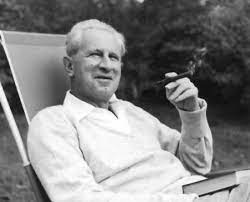
The distinction between the metaphoric pole and the metonymic pole of language was developed by the Russian linguist Roman Jakobson. According to Jakobson, language operates through two fundamental processes:
- Selection — choosing one word from a set of possible alternatives.
- Combination — arranging chosen words into a meaningful sequence.
These two processes give rise to the metaphoric and metonymic poles of language. Understanding them is important for the study of linguistics, stylistics, and literary criticism, especially poetry and prose.
Metaphoric Pole of Language
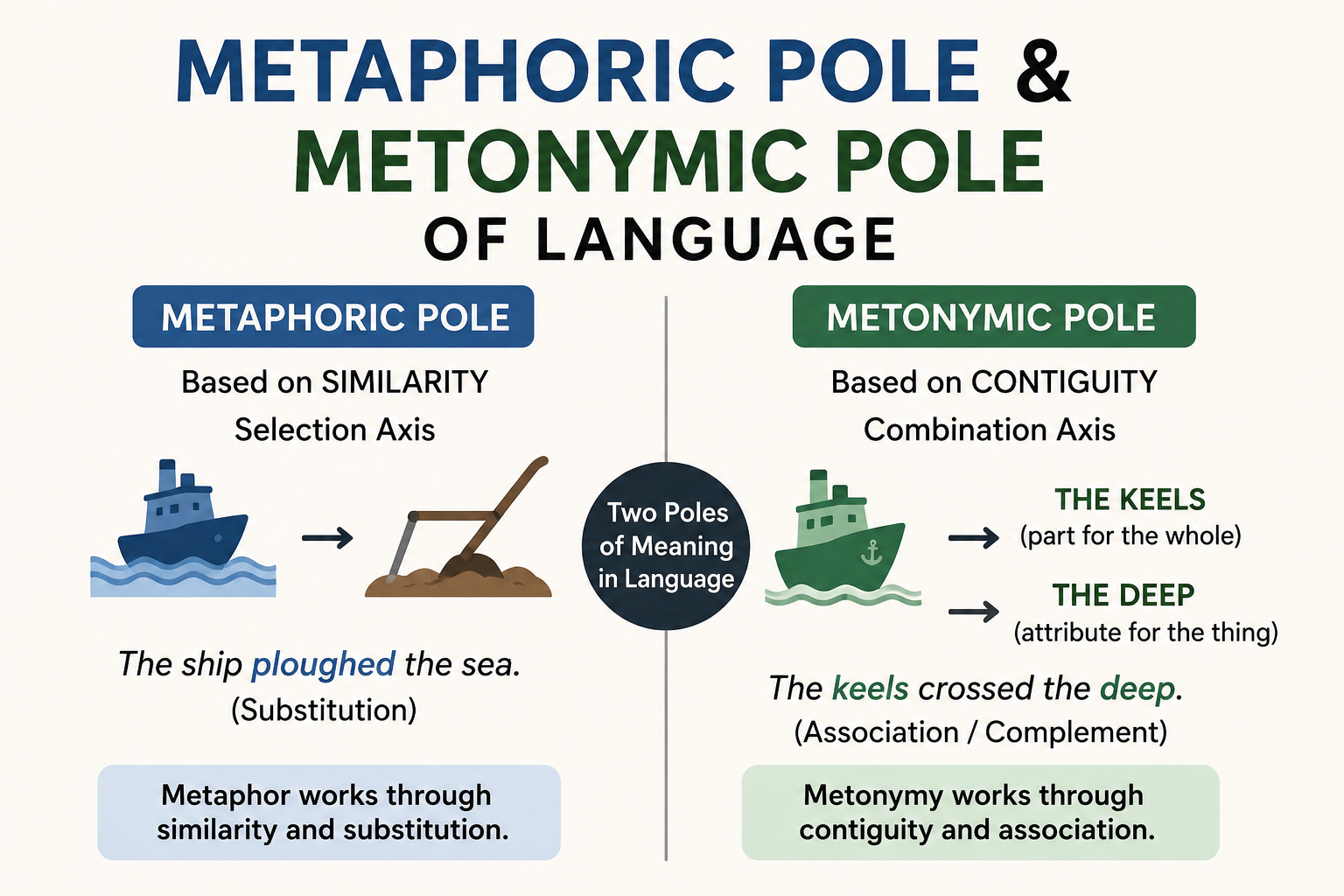
The metaphoric pole is based on similarity between things that are not ordinarily connected. It corresponds to the selection axis of language because the speaker selects one term in place of another on the basis of resemblance. In this process, the response to a stimulus functions as a substitute for the original expression. Similarity may be:
- Positional similarity — words occupying similar grammatical positions.
- Semantic similarity — words sharing a resemblance in meaning or effect.
The study of poetic tropes is largely concerned with metaphor, since poetry frequently creates new meanings through unexpected similarities.
Example: “The ship crossed the sea”. If we replace crossed with ploughed, the sentence becomes: The ship ploughed the sea. Here, the movement of a ship through water is compared to the movement of a plough through soil. The two actions are different, but they share a perceived similarity of cutting through a surface. This substitution creates a metaphor.
Key Features of the Metaphoric Pole
- Based on similarity or resemblance.
- Works through substitution.
- Connected with the selection axis.
- Commonly associated with poetry and figurative language.
Metonymic Pole of Language
The metonymic pole is based on contiguity or association in space, time, or cause-and-effect relationships. It corresponds to the combination axis of language because meaning emerges through the connection of associated elements. In this process, the response functions not as a substitute based on similarity, but as a complement or associated element related to the original stimulus.
Example of Combination:
“The ship crossed the sea”. we first select the words from the vocabulary of English and then combine them according to grammatical rules.
Example of Synecdoche
If ship is replaced by keels, we get: The keels crossed the sea. Here, keels (a part of a ship) stand for the whole ship. This figure of speech is called synecdoche (part for the whole, or whole for the part).
Example of Metonymy
If sea is replaced by the deep, we get: The ship crossed the deep.
The deep is closely associated with the sea and refers to one of its characteristic attributes. This is an example of metonymy, where an attribute, cause, effect, or associated idea is used to represent the thing itself.
According to Howard Jackson, synecdoche may be regarded as a subtype of metonymy, since both are based on contiguity rather than similarity.
Key Features of the Metonymic Pole
- Based on association or contiguity.
- Works through complementation or contextual connection.
- Connected with the combination axis.
- Frequently used in narrative prose and everyday speech.
Comparison between the Two Poles
| Aspect | Metaphoric Pole | Metonymic Pole |
| Basis | Similarity | Contiguity / Association |
| Language Axis | Selection | Combination |
| Main Process | Substitution | Complementation / Connection |
| Common Figure | Metaphor | Metonymy / Synecdoche |
| Literary Association | Poetry | Prose and narrative |
Importance in Literary Studies
Jakobson believed that poetry tends to emphasise the metaphoric pole, while realistic prose tends to focus on the metonymic pole. Poets generally create meaning through resemblance and imaginative comparison, whereas prose writers frequently build meaning through contextual associations and sequential connections.
For example:
- Metaphoric: Time is a thief.
- Metonymic: The crown announced new laws. (“crown” stands for the monarchy or king.)
Both processes are essential for effective communication, and most literary works contain elements of both metaphor and metonymy.
Conclusion
The metaphoric pole and the metonymic pole represent two fundamental ways in which language creates meaning. The metaphoric pole operates through similarity and substitution, corresponding to the selection axis of language. The metonymic pole operates through contiguity and association, corresponding to the combination axis. Roman Jakobson’s distinction between these two poles has become highly influential in linguistics, structuralism, and literary criticism, helping readers understand how figurative language and narrative expression function in both poetry and prose.
Also read: Litotes in English Literature: Definition, Meaning, Examples and Literary Uses