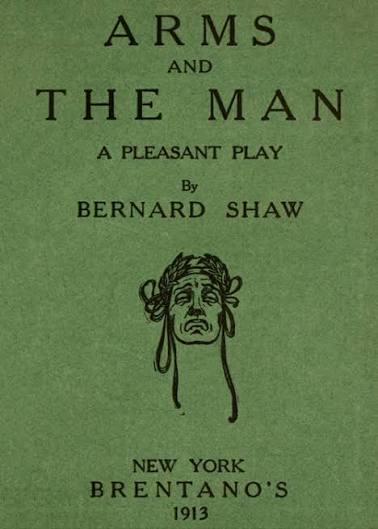

The most fascinating character in ‘Arms and the Man’ is Bluntschli. He is the central character of the play, and he keeps the plot moving. Bluntschli is a professional soldier who fights not for patriotism but for money. Being a professional soldier, he has the habit of seeing everything from a professional point of view. He is a staunch realist and has no romantic illusions regarding love and war. According to him, there is no such thing as heroism. He believes that it is the duty of a soldier to live as long as he can. It is for this reason that he flies from the field and enters Raina’s bed-chamber to save himself.
His realism is based on the experience and observation of life. As a practical man, he faces facts and sees things as they are. His views are established on sound reasoning. But Bluntschli is not void of romanticism. He has an “incurably romantic disposition”, and he is a romantic idiot. It is because of the romantic disposition that he ran away twice from home when he was a boy, joined the army instead of his father’s business and climbed the balcony of the house when a man of sense would have dived into a cellar. He could have sent back the coat, but he came back sneaking to have another look at the lady.
One of the most memorable aspects of Bluntschli’s character is his famous preference for chocolates instead of cartridges. When Raina discovers chocolates in his ammunition pouch, she is astonished because she expects a soldier to carry bullets. Bluntschli explains:
I always carry chocolate instead; and I finished the last cake of that yesterday.
This destroys the conventional image of the heroic soldier. Shaw uses this incident to expose the absurdity of romantic notions of warfare. The nickname “Chocolate Cream Soldier,” given by Raina, becomes a symbol of Bluntschli’s practical wisdom. Unlike Sergius, who values empty heroics, Bluntschli values survival and common sense. Shaw exposes that real courage lies not in reckless bravery but in intelligent action.
Like a typical Shavian hero, he is anti-romantic, anti-conventional and rational and logical in his views. He has penetrating insight and superior understanding. He has his own views on love, war and soldiering. His arguments are forcible and convincing. He is a man not of heroic but of commonplace courage. Bluntschli is a hero not because he faces bullets but because he faces facts. He is a self-acting man who acts upon instinct and not according to social codes and conventions. Bluntschli constantly challenges the traditional glorification of war. He ridicules military heroics and reveals the reality behind battlefield victories. Speaking of Sergius’s celebrated cavalry charge, he remarks that military success often depends more on luck than on courage or strategy. Bluntschli believes that experienced soldiers prefer safety to unnecessary risks:
It was the cradle and grave of military reputation.
His famous declaration, “Nine soldiers out of ten are born fools,” reflects Shaw’s criticism of blind patriotism and military romanticism. Through Bluntschli, Shaw presents war as a practical profession rather than a noble adventure.
Like a Shavian hero, neither a coward nor one to be carried away by sensual indulgence. He is hard-working, sincere, and when he takes up a work, he does it wholeheartedly and to the best of his ability. He has more than average vitality. It is also noted that his business-like habit seems to have dried up in him the tender human emotion. Though he has the sentiments, he never indulges in pursuing them. He is also a shrewd judge of human nature. His cleverness is acknowledged by everyone he comes in contact with.
Bluntschli is an anti-hero. He would not like to put his life into danger for nothing or to take a needless risk. But he is not to be considered a coward. He never surrenders himself to the situation, whatever brave it may appear. Bluntschli never hesitates to fight a duel when Sergius asks for. He is the mouthpiece of Shaw. Through him, Shaw expresses his own ideas regarding love and war. He is short is the representative of average humanity, he is what Shaw would like a man to be. He represents a step forward in the evolution of Shavian Superman.
But he is a true romantic. He loves Raina, but he makes her conscious of her pretences and shams. He frankly tells about her sham of love for Sergius. There is a gradual development of love between Raina and Bluntschly. Despite her romantic temperament, Raina is intelligent; she is wrapped up in illusions, but when she sees the horrors of war through the condition of Bluntschli, she faces the reality of war. Bluntschli is attracted to her for her noble attitude and thrilling voice. His second visit to Raina’s house is prompted by his desire to see Raina. He frankly declares his passion for Raina. This love is not sentimental; it grows out of an understanding of the two. He rouses the latent rationalism of Raina and educates her by curing her of her sloppy sentimentalism.
Another significant aspect of Bluntschli’s character is his role in transforming Raina’s outlook on life. At the beginning of the play, Raina lives in a world of romantic dreams, admiring Sergius as an ideal hero. Bluntschli gradually opens her eyes to reality. He exposes her theatrical poses and sentimental attitudes. He frankly tells her “You are a romantic young lady”. This is not meant as a compliment but as a criticism of her unrealistic view of life. Under Bluntschli’s influence, Raina learns to distinguish reality from illusion. Thus, he acts not merely as a lover but also as a guide who helps her achieve intellectual maturity.
Bluntschli is a shrewd judge of human character and correctly interprets human motives and actions. He understands the character of Nicola and calls him the best man in Bulgaria. He is clear-eyed in all things, even love not excepted. He is a perfect humorist, and much of the wit of the play is derived from him. He is also a fine talker and a master of expressive phrases and epigrams. Nicola, the servant, pays a compliment to him when he says,
The Swiss is no fool, he isn’t”. Even Sergius, his beaten rival, expresses his admiration of Bluntschli, “What a man! Is he a man?
Many critics have regarded Bluntschli as Shaw’s ideal spokesman. According to G. K. Chesterton, Shaw’s heroes are men of reason who challenge accepted social conventions, and Bluntschli perfectly embodies this quality. His practical intelligence, honesty, and independence make him a typical Shavian hero. A. C. Ward praises Bluntschli’s enduring appeal and writes:
His freedom from romantic illusions might have made him seem a dull dog or a pompous prig, but he has a saving grace of whirlwind exuberance.
Thus, Captain Bluntschli emerges as one of Shaw’s finest dramatic creations. He combines realism with humour, intelligence with humanity, and practicality with genuine feeling. His rejection of romantic illusions does not make him cynical; rather, it enables him to understand life more clearly than the other characters. Through Bluntschli, Shaw attacks false ideals of war and love while celebrating common sense, honesty, and rational thinking. As a result, Bluntschli remains one of the most memorable and beloved characters in modern English drama.
Also read Discuss the significance of Woodifield Episode in The Fly by Katherine Mansfield