
I sit in the top of the wood, my eyes closed.
Inaction, no falsifying dream
Between my hooked head and hooked feet:
I sit in the top of the wood, my eyes closed. (Lines 1-4)
Ted Hughes’s poem Hawk Roosting is about a hawk that is made to speak and express its position and power. The present extract is from the soliloquy of that hawk, resting quite at ease at the top of a tree.
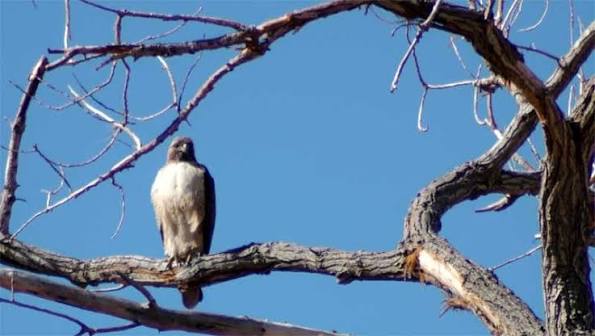
The hawk perches on the topmost branch of a tree, in a posture of repose, with its eyes closed. It indulges in no activity, and is absolutely in a state of indolence, delightfully thinking and feeling of its own advantageous position. The hawk is quite satisfied with its position on the top of a high tree. After all, this is no deception, dream, or fanciful, unreal situation for the bird. The hawk is in its posture of repose, between its head and feet, rather curved and hook-like. It may even drowse, as it rehearses its function to catch, kill, and eat its prey.
The hawk’s closed eyes and complete stillness also suggest its supreme confidence in its own power. It does not appear anxious about its surroundings or concerned about possible danger. Its position at the top of the tree gives it a commanding view of the world beneath it. The contrast between its apparent inactivity and its latent capacity for violence is important. Although the hawk is physically motionless, the reader is aware that it is a predator capable of sudden and decisive action. Thus, the calmness of the hawk is not a sign of controlled strength and self-assurance.
The extract also introduces the idea of the hawk’s instinct and its unquestioning acceptance of its role in the natural world. The hawk does not distinguish between right and wrong in the human moral sense; it simply follows the instincts that govern its existence. The expressions “hooked head” and “hooked feet” emphasize the physical features that enable it to seize and kill its prey. Hughes therefore presents the hawk as a creature perfectly adapted to its environment, possessing both the physical equipment and the confidence necessary for survival. The first stanza consequently establishes the hawk’s dominant personality and prepares the reader for its later assertions of absolute power and authority.
The stanza is a simple but vivid description of the hawk, roosting at the topmost branch of a tree. Of course, the whole description is given by the hawk itself, but it is quite clear and expressive, and bears out a complacent mood of the hawk.