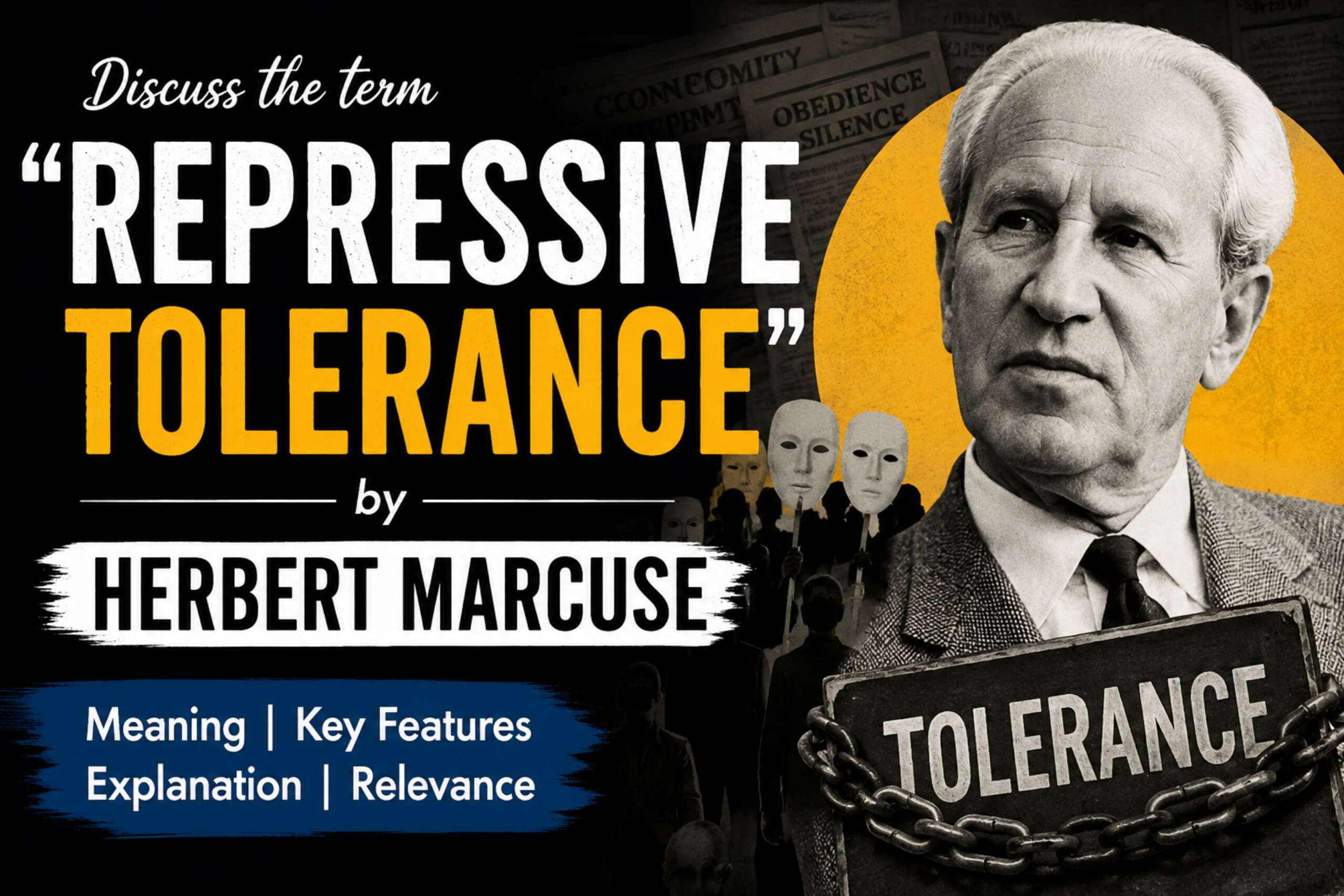

What is Repressive Tolerance?
The term “repressive tolerance” refers to the passive acceptance of social and governmental practices, policies and actions which restrict freedom in an absolute sense. The Frankfurt School theorist Herbert Marcuse coined this term in an essay of that title for a book co-written with Robert Wolff and Barrington Moore, Critique of Pure Tolerance (1965).
Herbert Marcuse’s Main Argument
Repressive tolerance, Marcuse argues, takes two main forms: (i) the unthinking acceptance of entrenched attitudes and ideas, even when these are obviously damaging to other people, or indeed the environment (the painfully slow response to warnings about climate change and environmental degradation might be seen as an example of this); and (ii) the vocal endorsement of actions that are manifestly aggressive towards other people (the popular support in the US and the UK in the aftermath of 9/11 and 7/7 for the respective government’s attempts to override or limit habeas corpus is a clear example of this). Genuine tolerance, Marcuse argues, can only exist in a situation of intolerance for these limits on real freedom.
Marcuse argues that in advanced industrial societies, tolerance is not always liberating. When all opinions are treated as equally valid, dominant and oppressive ideologies can continue to exercise power without challenge. Thus, indiscriminate tolerance may reinforce existing systems of domination rather than promote genuine freedom and social change.
Key Features of Repressive Tolerance:
- It appears as tolerance but preserves existing power structures.
- It legitimises dominant ideologies.
- It creates an illusion of freedom and democratic choice.
- It discourages critical resistance and social transformation.
- It serves the interests of powerful political and economic groups.
Slavoj Žižek’s books Violence (2008) and In Defence of Lost Causes (2008) continue and update this line of thought.
Relevance to Literary and Cultural Studies
In literary and cultural studies, the concept of “repressive tolerance” is used to examine how dominant ideologies present themselves as natural, neutral, or universally acceptable. It helps critics analyse the ways literature, media, education, and political discourse may normalise inequality while appearing tolerant and democratic.
Thus, Marcuse’s concept of repressive tolerance challenges the liberal belief that all forms of tolerance are inherently beneficial. He argues that genuine freedom requires resistance to ideas and institutions that perpetuate domination and restrict human emancipation.
Read also What is Qasida? Definition, Characteristics and Examples