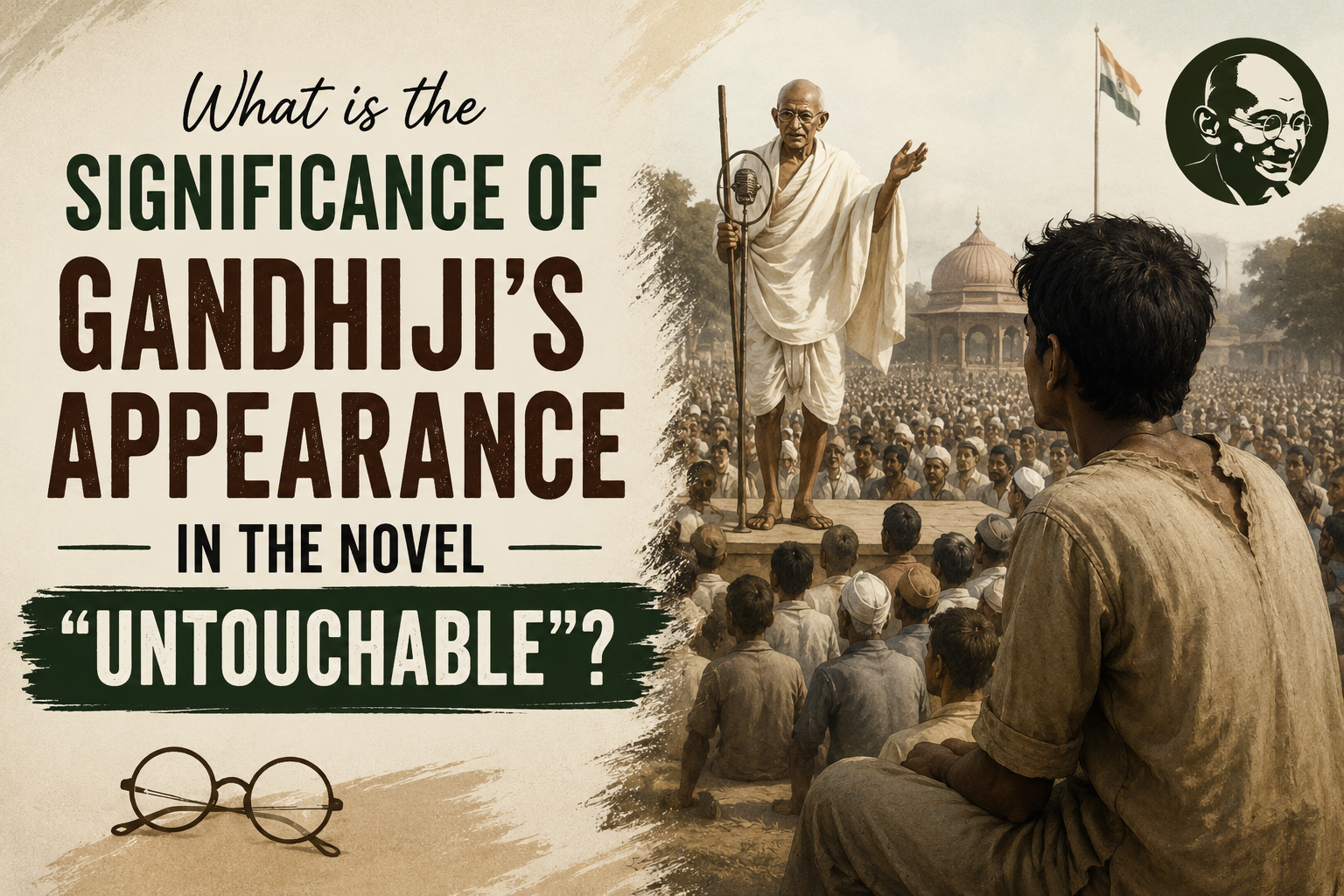

Mahatma Gandhi is indeed one of the most significant and influential figures of the present century. In “Untouchable” and “The Sword and the Sickle.” Mulk Raj Anand brings him (Gandhiji) into the central character’s plot of the novel. The magnetic personality of Gandhiji moved the spirit of Indian multitudes to act with high devotion to the cause of winning independence through non-violent means and inspired a number of novelists in all Indian languages to write their works projecting the Gandhian ideology. Towards the end of this novel, “Untouchable”, Mahatma Gandhi makes a brief appearance. A large crowd is gathered in the Goalbagh (Goal Maidan) to listen to the speech of the great man whose arrival is greeted with the words, “Mahatma Gandhi Ki jai.” Gandhiji has the strange calibre of rallying the multicoloured, multi-tongued India to himself. His power lies in what he has come to signify to the common mind.
Bakha, the main character of this novel, observes that among the crowd (in the Goalbagh) there are businessmen from the town, Muhammadans from the local carpet factories, the sikhs, the Christian girls from the Salvation Army colony and people from the outcastes’ colony. Bakha finds himself in the midst of a humanity that includes him in its folds, and yet debars him from entering into a living contract with it. Gandhi unites him with the crowd around him because “Gandhi was is everybody’s mind, including Bakha’s.” He (Bakha) recalls having heard that “Gandhiji was very keen on uplifting the untouchables.” Bakha thinks that Mahatmaji might ultimately unite him with this crowd in every other aspect also.
The novelist, Mulk Raj Anand, devotes many pages to the Gandhi legend, being the propagandist, tries to convey the message-‘untouchability should be abolished.” In his address, Gandhi strongly condemns the practice of untouchability and describes it as a moral evil that has no place in a civilised society. He argues that the so-called untouchables are an integral part of Hindu society and deserve equal respect and dignity. Through Gandhi’s words, Anand highlights the urgent need for social reform and human equality.
Gandhi’s appearance is significant because it introduces one possible solution to Bakha’s suffering. Throughout the novel, Bakha experiences humiliation, discrimination, and exclusion. Gandhi’s message gives him hope that social attitudes can change through moral awakening and collective action. For the first time, Bakha hears a national leader publicly speaking against the injustice that has shaped his entire life.
Gandhi’s presence broadens the scope of the novel from the personal tragedy of one individual to the larger national issue of caste discrimination. Here, Anand shows that the problem of untouchability is not merely Bakha’s personal burden but a social evil affecting millions of people in India. Gandhi’s speech transforms the novel into a powerful commentary on social justice and human rights.
At the same time, Anand does not present Gandhi’s views as the only solution. After the speech, Bakha listens to discussions about social reform and modern technology, particularly the flush toilet, which could eliminate the degrading occupation of manual scavenging. Thus, the ending presents different possibilities for ending untouchability—Gandhian reform, political change, and technological progress. The reader is left to reflect on which path can bring genuine freedom and dignity to the oppressed. Through Gandhi, Mulk Raj Anand conveys a strong message against untouchability and emphasises the need for equality, compassion, and social reform in Indian society.
Also read V.S.Naipaul’s A House for Mr. Biswas as an autobiographical novel