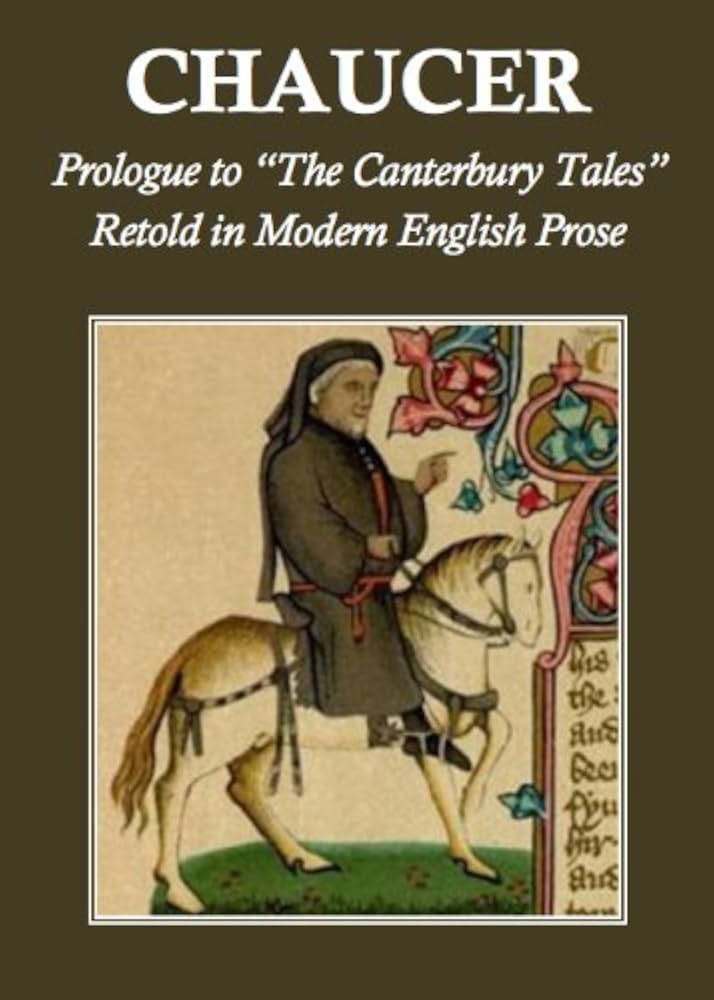

In Chaucer’s Prologue to the Canterbury Tales, there was a religious-minded poor Parson in the group of pilgrims riding to Canterbury. He was highly virtuous in thought and work. He was a true scholar who knew Christ’s gospel quite well and would teach and preach it with devotion. He was gentle and hard-working and also patient in adversity as had been tested many times. The Parson was averse to forcing his parishioners to pay his fees rather, he would give them money in their need out of what he had received from the rich or from his own pocket. The little that he had was enough for him. His parish was very wide with the houses far apart. With a staff in hand, he never forgot to visit his distant parishioners-be they rich or poor in their sickness or grief despite rain or thunder. He thus set a noble example for his parishioners and practised what he preached.
Out of the gospel, he took those words and to them added this saying, “If gold can rust what will then iron do?” That is because if a priest, whom we trust, is evil, then we should not be surprised at the corruption of the common man. A priest should know that a defiled shepherd cannot expect a clean sheep. A priest should, therefore, set an example of cleanness and teach his parishioners as to how they should live clean. He never left his ecclesiastical responsibilities to a stranger and left his parishioners to get corrupted. This Parson did not run to London to make money by singing masses for the souls of the wealthy people who are dead now or to become a chaplain in one of the guilds. He stayed at his parish and took care of the spiritual needs of his people so that they would never be misguided by the devils. He was a true priest and not a money-minded fellow. He was personally holy and virtuous but did not hate the sinners. His manner of speaking was neither haughty nor scornful, but he was kind and gentle in his guidance. His objective was to lead the people to heaven by fair example. If, however, anyone proved obstinate irrespective of whether he was rich or poor, the Parson did not hesitate to rebuke him severely. In fact, there was no better priest anywhere.
Chaucer presents him as a priest who understands that religious service is not limited to preaching from the pulpit. He actively participates in the lives of his parishioners and responds to their physical, emotional, and spiritual needs. His willingness to help the poor with his own resources distinguishes him from those ecclesiastical figures who regard religion as a means of personal financial gain. His simple way of life also reflects his genuine Christian values. He does not desire wealth, luxury, social status, or worldly recognition. Instead, he considers service to others to be the true purpose of his religious vocation.
Chaucer’s criticism of the medieval Church is evident through the character of the Parson. By placing him alongside characters such as the Monk, Friar, Summoner, and Pardoner, Chaucer creates a clear contrast between genuine religious devotion and religious hypocrisy. While several ecclesiastical figures misuse their religious positions for money, pleasure, or personal advancement, the Parson remains committed to his spiritual responsibilities. His character suggests that corruption in the Church does not result from religion itself but from the failure of religious individuals to follow the principles they are expected to teach. In this sense, the Parson becomes a standard against which the conduct of other religious characters can be judged.
The Parson can therefore be regarded as one of the most admirable figures in The Canterbury Tales. His greatness lies not in social position or material wealth but in the consistency between his beliefs, words, and actions. He teaches through both preaching and personal example, showing that genuine religious authority depends upon moral integrity. Chaucer’s portrayal of the Parson ultimately presents an ideal of Christian leadership based on humility, charity, patience, sincerity, and responsibility. His character remains significant because he represents the possibility of moral goodness within an institution otherwise depicted as deeply affected by greed, hypocrisy, and worldly ambition. Through this character, Chaucer has shown how a good person should be and indirectly what practices and behaviors a true priest should avoid.