
The Sick Rose
The advent of true romanticism in English literature occurred and flourished with the publication of ‘Lyrical Ballads’ in 1798 by William Wordsworth and Samuel Taylor Coleridge. A group of poets took birth with immense potential just before that romantic period. William Blake was one of them with real genius. He followed the old sacred tradition of prophets and thinkers with spiritual insight. Blake is often regarded as a pre-Romantic poet because his poetry emphasises imagination, emotion, symbolism, mysticism, and rebellion against rigid social conventions. His poems combine simplicity of language with deep philosophical meaning.
The poem ‘The Sick Rose’, included in ‘Songs of Experience’, symbolically presents human life on this earth. When a child is born, actually his/her soul freshly comes from the abode of God, so purity is a vital part of childhood days. But with advancement on earth, everyone must enter into the world of experience, which is always painful and torturous for the soul. So, days of experience are the days of sinfulness. In Blake’s poetry, the states of Innocence and Experience represent two contrary conditions of human life. Innocence symbolises purity, joy, and spiritual freedom, whereas Experience symbolises corruption, suffering, repression, and the harsh realities of society.
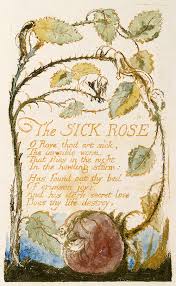
The poem ‘The Sick Rose’ tells us how the beauty and soft youth of a rose are destroyed by a worm. The speaker addresses the rose and informs it that it is sick. An invisible worm that normally flies under the cover of night and in the midst of extreme storm has entered into the bed of the rose. The bed of the rose is of red warm joy. And the worm’s dark, secret love destroys the life of the rose itself. The poem is highly symbolic and open to multiple interpretations. Some critics interpret the worm as a symbol of corruption, jealousy, lust, disease, or destructive sexuality. The rose may symbolise innocent love, beauty, femininity, or even a human soul corrupted by worldly experience.
The dark secret love of the worm is actually the path of destruction of the innocence and beauty of the rose. While good or virtue is described by ‘bed of crimson joy’, evil is indicated by a number of words like sick, storm, night, howling storm, dark, secret, and destroy. Here, the rose symbolically stands for purity and innocence, and it is destroyed by the worm, the agent of the world of experience. So symbolically, the presentation is unique. The poem is remarkable for its brevity, simplicity, and intensity. Though it contains only eight lines, Blake creates a powerful atmosphere of mystery, secrecy, fear, and destruction through suggestive imagery and symbolic language.
The contrast between the beautiful rose and the destructive worm highlights Blake’s belief that evil and corruption often secretly invade innocence and purity in human life. Thus, The Sick Rose becomes a symbolic poem about the loss of innocence and the destructive forces operating within human existence.
Also read: Summary and Analysis of Philip Sidney’s Loving in Truth