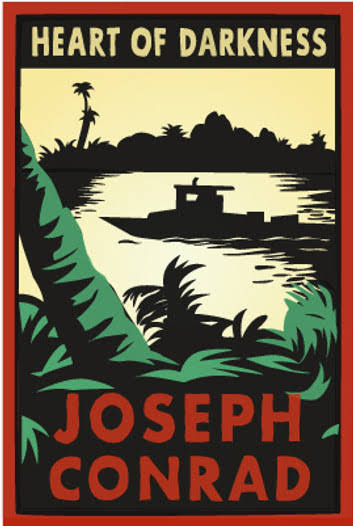

There is hardly anything in Joseph Conrad’s “Heart of Darkness” that offers no symbolic meaning. Almost everything, including the Congo, the journey, the darkness of the African jungle, ivory, the characters, from Kurtz to the doctor or the knitting women, etc., is symbolic. Central to the action, there is a journey motif. Marlow’s journey on the Congo River can be said to represent a journey motif. Marlow’s journey on the Congo River can be said to represent a journey into one’s inner spirit. As Marlow progresses further up the river in his search for Kurtz, he begins to learn more and more about himself. He comes to realize that he probably has more in common with the natives than the smug Europeans who have come to civilize them. At the end of his journey, Marlow learns that everyone has a dark side to them, but that some people can conceal it better than others.
The ivory symbolizes greed and the destructive nature of man. The managers and agents of the Company are so obsessed with obtaining ivory that they forget about their morals and so-called civilized ways. The significance of ivory begins to move away from avarice and takes on a purely evil connotation as Marlow approaches those hearts of darkness: the Inner Station and Kurtz. Kurtz’s relationship with ivory seems to have been reiterated by every company member throughout the course of the story. Of course Kurtz “harvested” more ivory than all the other stations combined, and therefore it almost seems appropriate that Conrad would use extensive ivory imagery in describing Kurtz. Earlier, during his digression on Kurtz, Marlow says. “The wilderness had patted him on the head, and, behold, it was like a ball-an ivory ball”. By the time that Kurtz is carried out on a stretcher, the evil has completely overtaken him. The evil has now grown to encompass his entire body and soul. Kurtz’s lust for ivory is recounted by the Russian: Once he threatened to shoot the Russian, who was squirreling a small quantity of ivory-” because he could do so. and had a fancy for it, and there was nothing on earth to prevent him from killing whom he jolly well pleased.” The almost god-like power that Kurtz wields is unchecked, save for disease.
In the novel, ivory plays a dual role in significance. On one hand, it is representative of evil and greed, and on the other, it is representative of the measures taken to acquire it in the first place (i.e., mistreatment of blacks). Conrad’s use of ivory in order to symbolize darkness is also in keeping with his occasional reversal of the colors normally associated with good and evil, white and black. Ivory as a material is one of the purest and whitest found in nature, while Kurtz’s soul is purely black.
Marlow discovers the white worsted wrapped around a negro’s neck at the Outer Station. The fabric can be said to represent the attempt of the Europeans to colonize the natives and the strangling effect it has on them. Kurtz’s painting at the Central Station is perhaps the most extensive symbol in the novel. The painting is of a blindfolded woman carrying a lighted torch that distorts her face. The woman likely symbolizes the Europeans who have come to civilize the natives. The torch she carries represents the European customs and values that they try to force upon the native Africans. The woman is blindfolded because the Europeans cannot “see” the negative effects that their customs have on the natives. Her face has become distorted because, to the natives, the European customs seem rather repulsive.
Eldorado Exploring Expedition is symbolic of the Whites’ search for something that cannot be attained. Eldorado is historically known as a city of gold that never actually existed. However, the prosperity that could possibly be gained was so overwhelming for this group that they felt compelled to risk their life for it. Then, the candle on the steamship is another symbol. Marlow brings a candle into Kurtz’s quarters as Kurtz is dying on the ship. The candle is symbolic of Kurtz’s losing struggle for life. When Kurtz finally submits to death. Marlow blows out the candle.
Also read: Bring out clearly the significance of the title of the story The Fly by Katherine Mansfield