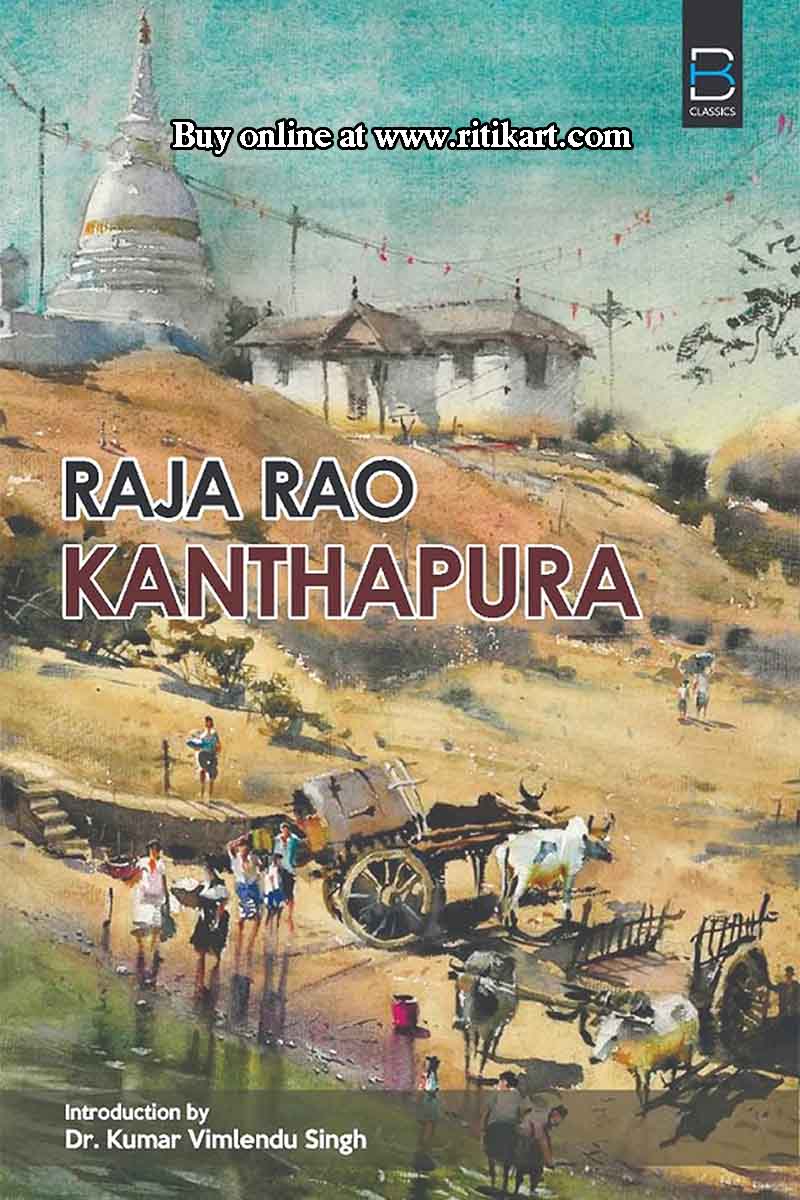

As James Joyce in his “Ulysses” or T.S. Eliot in his “The Waste Land”, so also Raja Rao in his novel “Kanthapura” made great use of the mythical legends and techniques. By juxtaposing the myths and legendary tales of the past with the present state of society in the village called “Kanthapura”, Rao glorified the present status of the Gandhian freedom struggle and its impact on the villagers as well as all the Indians. Thus, the past is restored with a definite purpose to criticize or glorify the present, and to impart to the novel the dignity and status of an epic or Purana. As Meenakshi Mukherjee has also pointed out, the novel is a bold attempt at creating a ‘Sthala puran’ (i.e., a legendary tale of a specific locality), because the whole thrust is on the particular locality of the village-its topography, crops, poverty, its class-divided society, its illiteracy, superstitions, petty rivalries and jealousies of its people.
The story is narrated by Achakka, an elderly village woman whose oral style resembles the traditional recitation of Puranic tales. Her long, flowing sentences, repetitive expressions, digressions, and communal memories recreate the atmosphere of an oral storytelling session in a village courtyard. The narrative does not only record historical events; it transforms them into collective memory. Through Achakka’s voice, the experiences of ordinary villagers acquire the permanence and sacredness usually associated with legendary chronicles. Through this oral texture, Raja Rao bridges the gap between written fiction and the indigenous Indian tradition of Purana-kathana.
Though a regional novel, “Kanthapura” presents the microcosm of the village to stand for macrocosmic India. What happened in Kanthapura was happening all over the country during those starring days of the Gandhian Freedom struggle. But here Rao has created a new sthala-puran for this region, dealing with the brave struggle and self-sacrifice of the people of Kanthapura to liberate their Bharatmata to say even more specifically, the novel is a Gandhi puran, where the Gandhian movement is assimilated into the racial heritage as myth and legend. The deft use of Rao’s mythical technique has highly enriched the texture of his novel with a rare expansiveness, elevation, and dignity.
The geography of Kanthapura itself acquires a sacred dimension similar to that found in traditional Sthala Puranas. The river Himavathy, the Kenchamma temple, the village streets, the Skeffington Coffee Estate, and even the surrounding hills are described with ritualistic attention. In classical Sthala Puranas, a place becomes holy because divine events are believed to have occurred there. In Kanthapura, political awakening becomes the sacred event that sanctifies the village. The freedom struggle is not portrayed as an external political movement imposed upon the villagers; rather, it emerges from the very soil of Kanthapura and gradually transforms the village into a symbolic representation of Bharat Mata. Thus, local space is elevated into national sacred space.
Just as in myths, some characters are gods or demi-gods, always larger in power than humanity; here also Moorthy is presented as a figure much above the common run of men. A dedicated, selfless soul, he is idealized to the extent of being regarded as a local Mahatma. The village women think of him as the small mountain, whereas of the real Mahatma as the big mountain. In the novel, gods and goddesses, heroes and heroines of epics jostle with the contemporary personalities. The past and the present are brought together and projected into the future.
The use of the mythical technique makes Gandhi the invisible god, and Moorthy the visible Avatar. The reign of the Red men becomes Asuric rule, and it is resisted by the Devas, the Satyagrahis. In his strange kind of ‘Harikathus’, Jayaramachar with splendid unconcern jumbles traditional mythology and contemporary politics: Siva is the three-eyed and so also Swaraj: self-purification, Hindu-Muslim unity, and Khaddar being the three eyes. Gandhi himself is Siva incarnate, engaged in slaying the serpent of foreign rule, as the boy Krishna killed the serpent Kaliya. ‘Bhajans’ and ‘Harikathas’ mix religion and politics freely and often purposely; the reading of the Gita and the charka-spinning are elevated into a daily ritual, like puja. This juxtaposition of the past and the present, of men and gods, is kept up throughout the novel up to the very end. Gandhi’s trip to England to attend the Second Round Table Conference is invested with ‘Puranic’ significance. It is likened to Rama’s adventurous mission to rescue Sita: “Rama will come back from exile, and Sita will be with him, for Ravana will be slain and Sita freed, and he will come back with Sita”. Here Gandhi is Rama. Swaraj Sita and Redmen Ravana, along with Jawaharlal as the brother Bharata.
The novel may also be viewed as a modern Indian epic of transformation. Traditional Puranas usually narrate the victory of dharma over adharma, and Raja Rao structures the Gandhian movement according to this moral pattern. The British colonial administration appears as a force of oppression and disorder, while the satyagrahis embody truth, sacrifice, and righteousness. Moorthy’s personal evolution—from a young Brahmin influenced by Gandhi to a suffering leader who endures imprisonment and social ostracism—resembles the spiritual journey of a Puranic hero. His suffering is not merely individual; it becomes a form of collective tapasya undertaken for the liberation of the nation. In this way, the political struggle is endowed with ethical and spiritual significance, which is one of the defining characteristics of a Gandhi Purana.
As Srinivas Iyengar puts it, the novel “is a veritable grammar of the Gandhian myth – the myth that is but a poetic translation of the reality”. The legendary history has helped Rao to create a new sthala-purana for the region of Kanthapura. This has been finally done by mythicizing the fact or reality, by mythicizing the heroism of the local hearts and heads in the cause of their motherland. Just as the local goddess protects the village Kanthapura and a greater god protects all, Moorthy is the local ‘avatar’ while Gandhi is the greater deity. Jayaramachar raises Gandhi to the level of a god by identifying his activities with the ſeat of ‘Kaliya daman’ by Krishna. These analogies do temporarily illuminate the historical situation of the thirties, and give an insight in the unlettered mind of the village people, in which myth and fact are not clearly distinguishable. For such a mind, a fact does not become significant until it can be related to a myth.
Another important aspect is Raja Rao’s attempt to Indianize the English novel form. Instead of relying solely on Western realism, he incorporates bhajans, Harikathas, folk beliefs, ritual practices, and epic analogies into the narrative structure. The result is neither a conventional historical novel nor a simple regional narrative. It is a unique synthesis in which history, myth, religion, folklore, and politics coexist organically. This synthesis reflects the Indian cultural imagination, where the sacred and the secular are often inseparable. By presenting Gandhi through familiar mythic symbols, Raja Rao makes the nationalist movement intelligible and emotionally meaningful to the rural masses.
“Kanthapura” is a “Gandhi Purana” where the facts about the Gandhian freedom struggle have been mythicised. By mythicising the heroic struggle and self-sacrifice of the people of this South Indian village, Rao has created a new sthala-purna, a new local legend. The novelist rises from the particular to the general, and by weaving the ancient myths and legends into the structure of the novel, he gives the novel the quality of timelessness and universality, which all great works of art have.
Also read: Character of the Nameless Narrator in Margaret Atwood’s Surfacing