
Introduction
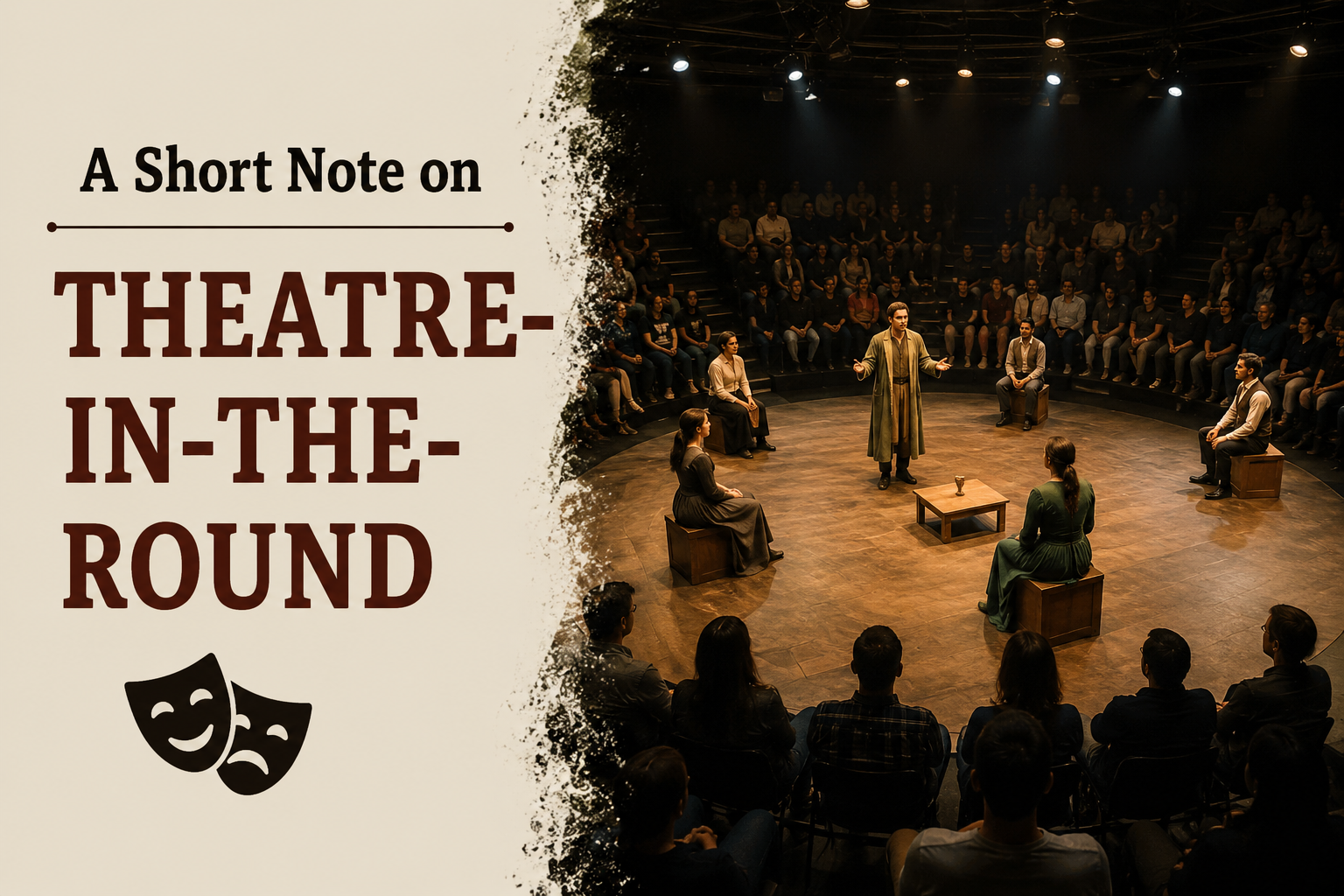
Theatre-in-the-round is a form of theatrical presentation in which the acting area is surrounded by the audience. It is far from being a new idea, though it has had some vogue since the 1930s. It seems very probable that some of the Cornish Mystery Plays were performed in the air with an audience ranged around the actors on banks. One may suppose, too, that Mumming Plays and related dramatic entertainments were thus presented. In modern times theatre-in-the-round achieved prominence in Russia in the 1930s, where Okhlopov, using his realistic theatre, even involved the audience in the drama. At that time, too, Robert Atkins was producing Shakespeare in The Ring at Blackfriars.
Key Features of Theatre-in-the-Round
In theatre-in-the-round, the audience surrounds the stage, creating a more intimate relationship between actors and spectators. Unlike the traditional proscenium stage, there is no single “front” of the stage. Actors must constantly move and adjust their positions so that all sections of the audience can see the performance.
In America, it has been a particularly popular form of presentation, especially in universities. Margo Jones was the main American exponent. In France, also, it has had some success, particularly in the hands of André Villiers who, in 1954, founded the Théâtre en Rond in Paris. In England, the leading light and dedicated crusader was Stephen Joseph, who established something of a tradition for theatre-in-the-round at Stoke-on-Trent. Joseph also worked on it in London, Southampton, and Scarborough.
Advantages
This form of theatre offers several important advantages:
-
It creates a close connection between performers and audience.
-
The audience feels more directly involved in the action.
-
It encourages naturalistic acting because performers cannot rely heavily on elaborate scenery or stage effects.
-
The arrangement produces a stronger sense of shared experience and immediacy.
Challenges
Theatre-in-the-round also presents difficulties:
-
Large or complex scenery is difficult to use because it may block the audience’s view.
-
Directors must carefully plan actor movement and stage composition so that no part of the audience is neglected.
Lighting and sound design require special attention because the audience is seated on all sides of the acting area.
Conclusion
Theatre-in-the-round is one of the most dynamic forms of stage presentation. It transforms theatre into a more intimate, immediate, and participatory experience. From early folk and mystery plays to the experiments of Okhlopov, Margo Jones, André Villiers, and Stephen Joseph, this form has continued to influence modern theatrical practice across the world.
Also read: Qasida: Definition, Characteristics, History and Examples