
Introduction
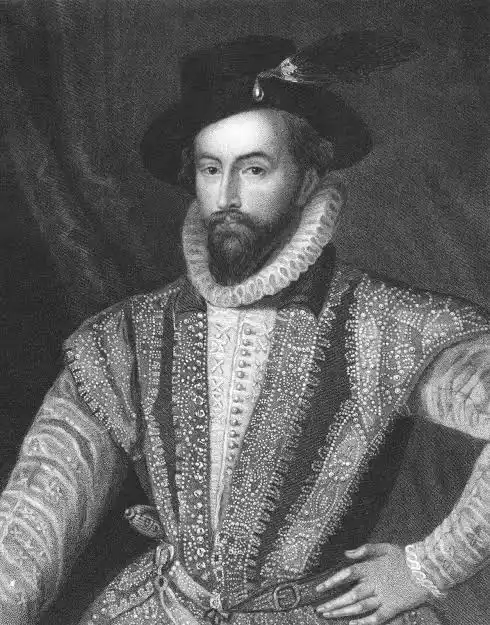
Sir Walter Raleigh (1552–1618) was an English poet, statesman, historian, courtier, explorer, and colonist. He was one of the most important and versatile figures of the English Renaissance. His life combined literary achievement with political ambition, military activity, exploration, colonial enterprise, and courtly influence. Raleigh typifies the Renaissance ideal of the complete individual who excelled in different forms of endeavour.
Early Life, Career, and Rise to Power
Raleigh was born at Hayes Barton in East Budleigh, Devon, England. From an early age, he had a strong opposition to Catholicism because Queen Mary’s persecution affected several members of his Protestant family. He was educated at Oxford, although he never completed his degree. His education, however, provided him with the intellectual foundation that later contributed to his work as a poet, historian, and political thinker.
Raleigh’s fortunes changed dramatically during the reign of Queen Elizabeth I. In 1581, he went to Ireland to help suppress an uprising in Munster. His service there brought him suddenly into the favour of Elizabeth I. He became one of the Queen’s most prominent courtiers and received considerable royal patronage.
He was knighted in 1584 and became a Member of Parliament. He also received extensive estates in Ireland. Raleigh was granted a royal patent to explore Virginia, an enterprise that contributed to the beginnings of future English settlements in North America. His association with Virginia is particularly significant because the later English colony of Virginia was connected with the colonising projects that he promoted.
Personal Life and Later Years
Raleigh’s rise at court was accompanied by controversy. In 1591, he secretly married Elizabeth Throckmorton, one of Queen Elizabeth’s ladies-in-waiting, without the Queen’s permission. As a consequence, Raleigh and his wife were sent to the Tower of London. After his release, the couple retired to Raleigh’s estate at Sherborne. Although Raleigh was a favourite of the Queen, he was not universally popular. His pride, ambition, extravagant spending, and unconventional ideas attracted criticism. His political career was marked by periods of success as well as disgrace and imprisonment.
After the accession of James I, Raleigh’s position deteriorated further. He was accused of treason and spent many years imprisoned in the Tower of London. In 1617, he was released to undertake another expedition to Guiana. The expedition failed to achieve its objectives, and the death of his son during the expedition further damaged Raleigh’s position. He was subsequently arrested and executed for treason at Westminster in 1618.
Raleigh represents the ideal of the Renaissance man through his knowledge, individual achievement, discovery, ambition, and worldly experience. His activities extended far beyond poetry. He was a courtier, soldier, statesman, explorer, historian, colonist, and writer. His career also reflects the uncertainties of the Elizabethan and Jacobean worlds. The same qualities that brought him royal favour, like ambition, confidence, intellectual independence, and adventurousness, also contributed to his political difficulties.
Sir Walter Raleigh as a Poet
In his poetry, Raleigh was distinguished by the simplicity of his vocabulary and the obviousness of his images; he was a plain man’s poet. Yet, every poem was a skilfully constructed argument in which he dispensed traditional morality through didactic imperatives.
A prominent theme in Raleigh’s poetry is mutability, or the transitory nature of worldly life. His poems frequently express an awareness of change, mortality, disappointment, and the instability of human achievements. They combine simplicity with melancholy and reveal an awareness of the fleeting nature of human existence. His poetic voice can move from playful wit to serious reflection, and from worldly confidence to resignation.
Famous Works of Sir Walter Raleigh
In 1576, Raleigh published a commendatory verse at the beginning of The Steele Glas, a satire by George Gascoigne. This early contribution established his connection with the literary culture of the Elizabethan period. His poems have remained important because of their concise expression, intellectual structure, irony, and treatment of mortality and change.
Ocean’s Love to Cynthia
Perhaps Raleigh’s most significant poetic achievement is the fragmentary Ocean’s Love to Cynthia. It is a brooding, obscure, and allusive poem concerned with loss and longing. The poem draws upon the imagery of love while also suggesting wider reflections on ambition, disappointment, and the instability of human life. The unfinished nature of the poem adds to its enigmatic quality. It is particularly valuable for understanding Raleigh’s more reflective and melancholic poetic imagination.
The Nymph’s Reply to the Shepherd
One of Raleigh’s most famous poems is The Nymph’s Reply to the Shepherd. It was written as a poetic response to Christopher Marlowe’s The Passionate Shepherd to His Love (1592).
While Marlowe’s shepherd presents an idealised vision of love and rural pleasure, Raleigh’s nymph responds with scepticism. She reminds the shepherd that youth, beauty, flowers, pleasures, and love are all subject to time and change. Thus, the poem transforms the idealistic invitation of Marlowe’s poem into a meditation on mutability and mortality.
The Lie
In The Lie, Raleigh adopts a more openly critical and satirical voice. The speaker sends a “lie” throughout the world and commands it to confront different forms of corruption, hypocrisy, pride, and falsehood. It reflects Raleigh’s distrust of worldly appearances and institutions. Its direct language and repeated imperatives give it considerable force. At the same time, the poem expresses the characteristic moral seriousness that runs through much of Raleigh’s poetry.
The Wood, the Weed, the Wag
In The Wood, the Weed, the Wag, Raleigh combines grimness with humour. Here, he treats serious subjects without completely abandoning wit and playfulness.
The Passionate Man’s Pilgrimage
Raleigh’s The Passionate Man’s Pilgrimage bears the subtitle “Supposed to be written by one at the point of death.” Themes are death, spiritual preparation, and the transitory nature of worldly existence. Its meditative tone has encouraged readers to connect the poem with Raleigh’s own final years. The poem may therefore be regarded as an appropriate literary reflection of the poet’s troubled life and impending death. Its theme of resignation gives particular poignancy to Raleigh’s literary reputation.
Raleigh’s Place in English Literature
Raleigh was not only a poet but also an important prose writer. His historical and geographical writings demonstrate his intellectual interests and his involvement in exploration and political affairs.
His major prose work includes The History of the World, published in 1614. Written during his imprisonment in the Tower of London, the work represents Raleigh’s wide-ranging historical knowledge and his reflections on power, political ambition, morality, and the rise and fall of rulers and kingdoms.
Another important work is The Discoverie of the Large and Bewtiful Empire of Guiana, published in 1596. The book records Raleigh’s account of Guiana and his expedition to the region. It was perhaps more successful as a written account than the voyage itself, combining geographical description, political ambition, and the Renaissance fascination with exploration and distant lands.
Raleigh’s extraordinary life contributed significantly to his posthumous reputation. Deserted by his king and betrayed by friends, Raleigh remained proud even in death. His career combined adventure, political ambition, literary accomplishment, exploration, imprisonment, and tragedy, making him one of the most fascinating personalities of the English Renaissance. As Agnes M. C. Latham writes in her introduction to a collection of Raleigh’s poems:
There is, and always has been, something legendary, something fantastic and not quite credible about him.
She then presents him as a figure who seemed larger than ordinary life, almost as though he had stepped out of an Elizabethan play. Her description captures the extraordinary mixture of virtues and vices, ambition and failure, achievement and tragedy that made Raleigh such an enigmatic figure.
Conclusion
Sir Walter Raleigh was much more than an Elizabethan poet. He embodied the Renaissance ideal of the versatile individual who participated in literature, politics, exploration, history, and public life. His career moved between royal favour and imprisonment, achievement and failure, ambition and tragedy. His life ended with his execution at Westminster in 1618, but his literary and historical reputation survived. His extraordinary career and enigmatic personality continue to make him one of the most memorable figures of the English Renaissance.
Also read: Dante Gabriel Rossetti: Biography, Major Works and Contribution to the Pre-Raphaelite Movement