
Introduction
Blank verse is a literary device that consists of unrhymed five-stress lines; properly, iambic pentameter. It was introduced in England by the Earl of Surrey in the 16th c. in his translation of Virgil’s Aeneid (c. 1540). Surrey probably took the idea from the versi sciolti (“freed verse´) of Molza’s Italian translations of the Aeneid (1539). It has become the most widely used of English verse forms and is the one closest to the rhythms of everyday English speech. This is one of the reasons why it has been particularly favoured by dramatists.
Characteristics of Blank Verse
The significant characteristic of blank verse is its combination of regular metre and the absence of rhyme. In English literature, it is most commonly written in iambic pentameter, in which each line generally contains five iambic feet. An iamb consists of an unstressed syllable followed by a stressed syllable, which produces a rhythmic pattern that can be represented as da-DUM. A typical line of blank verse contains approximately ten syllables arranged into five metrical feet. However, as we have seen, accomplished poets vary the rhythm through their substitutions, pauses, enjambment, and changes in stress.
One of the greatest strengths of blank verse is its flexibility. Although it follows a recognizable metrical pattern, it does not require every line to sound mechanically identical. Poets can alter the rhythm to express different emotions, create emphasis, or reproduce the natural movement of speech. A sudden pause can suggest hesitation or grief, while a variation in stress can draw attention to an important word. This combination of order and freedom makes blank verse particularly suitable for both dramatic dialogue and extended poetic reflection.
Examples
It was almost certainly first used for a play by Thomas Sackville and Thomas Norton in Gorboduc (1561), and then became the standard verse for later Tudor and Jacobean dramatists who made it a most subtle and flexible instrument: for instance, Thomas Heywood in A Woman Killed with Kindness (1603):
O speak no more!
For more than this I know, and have recorded
Within the red-leaved table of my heart.
Fair, and of all beloved, I was not fearful
Bluntly to give my life into your hand,
And at one hazard all my earthly means.
Go, tell your husband; he will turn me off,
And I am then undone. I care not, I:
‘Twas for your sake. Perchance in rage he’ll kill me,
I care not, ’twas for you. Say I incur
The general name of villain through the world,
Of traitor to my friend; I care not, I.
Beggary, shame, death, scandal, and reproach,
For you I’ll hazard all: why, what care I?
For you I’ll live, and in your love I’ll die.
Blank Verse in Drama
Blank verse became especially important in English drama because it occupies a position between ordinary prose and highly patterned rhymed poetry. It provides dialogue with rhythm and elevation while also retaining a resemblance to natural speech. This allowed dramatists to represent ordinary conversation, emotional conflict, philosophical reflection, and heroic action within the same metrical form.
The development of blank verse in Elizabethan and Jacobean drama demonstrates its extraordinary adaptability. William Shakespeare, Christopher Marlowe, Ben Jonson, and other dramatists used it extensively. Marlowe’s dramatic verse, in particular, demonstrated the power and grandeur that could be achieved through iambic pentameter. Shakespeare subsequently developed the form further by introducing variations in rhythm, pauses, enjambment, and sentence structure. His later plays often contain blank verse that closely approaches the rhythms of natural speech while retaining its poetic character.
Thereafter it was used a great deal for reflective and narrative poems, notably by John Milton in Paradise Lost (1667). During the late 17th c. and the first half of the 18th c. it was used much less often. John Dryden, Alexander Pope, and indeed the majority of 18th c. poets preferred the heroic couplet. However, Thomson used it in The Seasons (1726–30), so did Thomas Young in Night Thoughts (1742) and Cowper in The Task (1785).
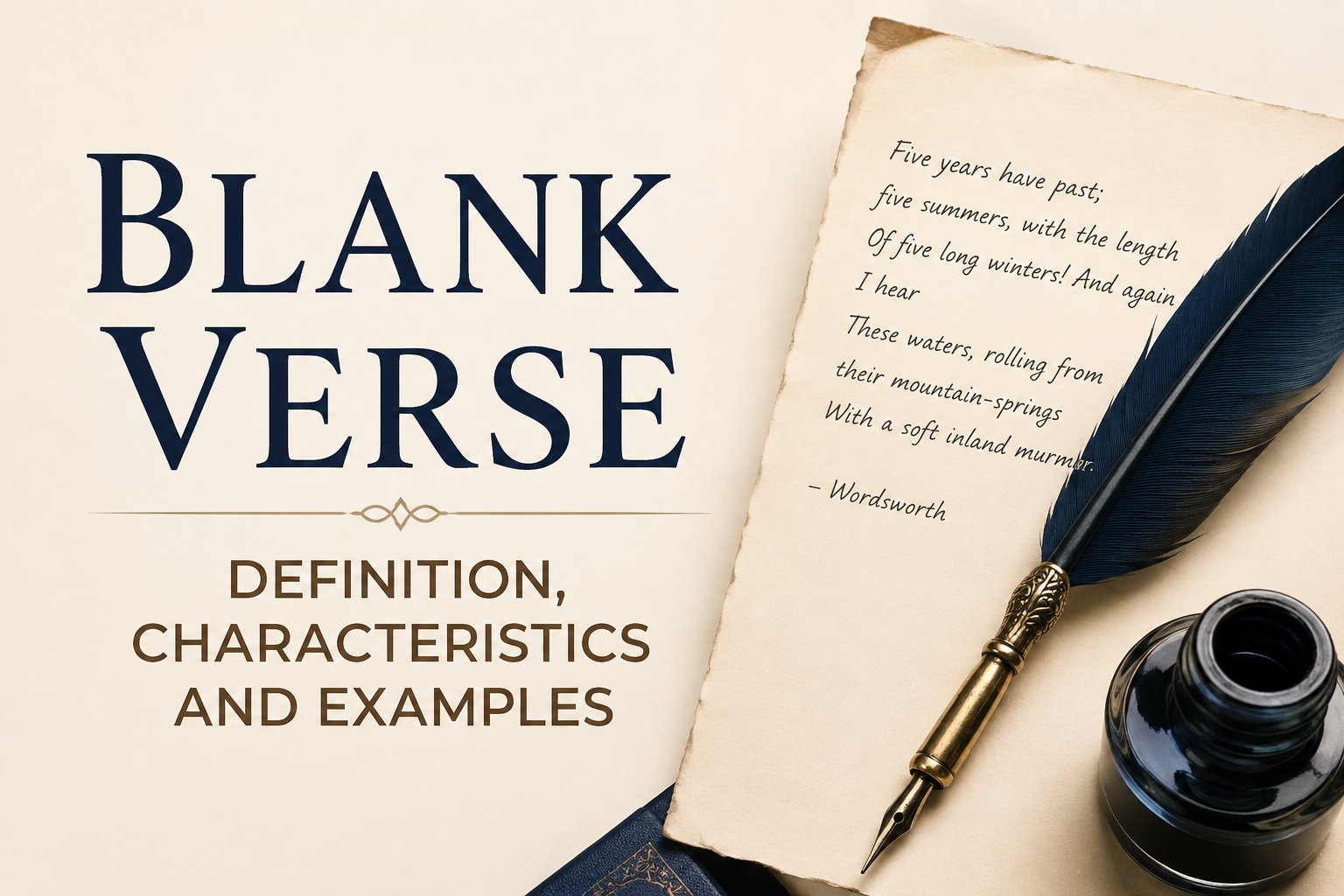
Blank verse allows an author to not be constricted by rhyme, which is limited in English. Yet it still creates a more poetic sound and sense of pattern due to the regular use of stressed and unstressed syllables. Meter is generally easier to use in English than rhyme since the majority of words are short (one or two syllables), unlike in Romance languages. Wordsworth especially, and Coleridge, made much use of it. For example:
Five years have past; five summers, with the length
Of five long winters! And again I hear
These waters, rolling from their mountain-springs
With a soft inland murmur. – Once again
Do I behold these steep and lofty cliffs…
All the poets of the Romantic period wrote blank verse extensively, and so did most of the great poets of the 19th c. The blank verse of Keats in Hyperion is mainly modeled on that of Milton, but takes fewer liberties with the pentameter and possesses the characteristic beauties of Keats’s verse. Shelley’s blank verse in The Cenci and Prometheus Unbound is closer to Elizabethan practice than to Milton’s. It is still quite widely practiced today, and dramatists like Maxwell Anderson and T. S. Eliot have experimented with it in their plays.
Conclusion
Blank verse is one of the most influential poetic forms in English literature. Although it is generally defined as unrhymed iambic pentameter, its significance extends beyond this technical definition. Its flexible rhythm, absence of rhyme, and closeness to natural English speech have made it particularly suitable for drama, narrative poetry, and serious reflection. From Surrey’s early experiments and the development of Elizabethan drama to Milton, the Romantic poets, and later writers, blank verse has remained an important medium for poetic expression. Its enduring presence in English literature demonstrates how metre can provide structure without severely restricting the poet’s freedom.
Also read: What is Meant by the Metaphoric Pole and Metonymic Pole of Language?