
Origin of Rhyme Royal
Rhyme Royal is one of the most important stanza forms in English poetry. It was introduced into English literature by Geoffrey Chaucer in the fourteenth century, probably under the influence of French poetry. The form later gained popularity among medieval and Renaissance poets because of its dignity, musicality, and flexibility. It acquired the name “Rhyme Royal” after King James I of Scotland employed it extensively in his celebrated poem The King’s Quair.
Characteristics of Rhyme Royal
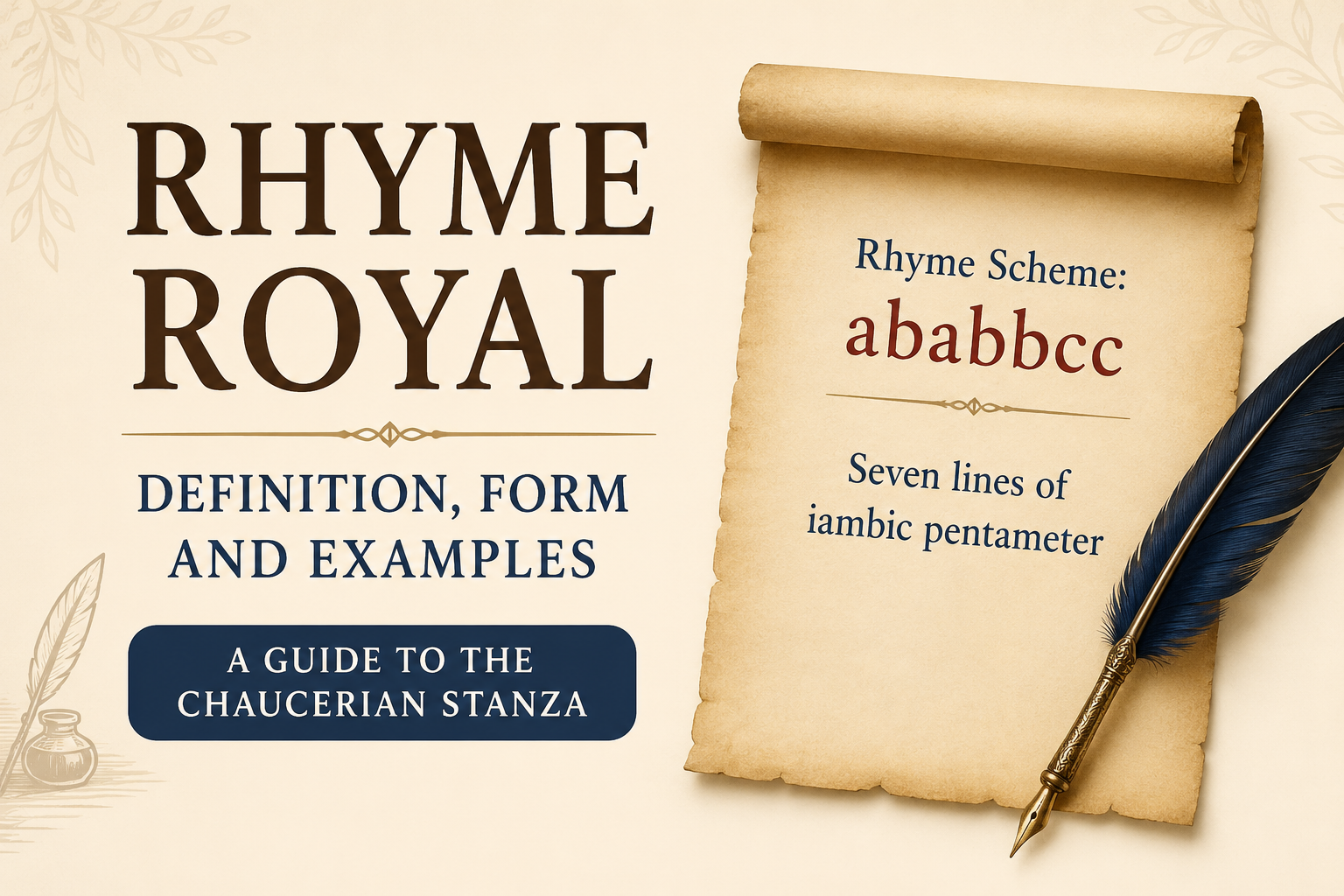
Rhyme Royal consists of seven lines, each written in iambic pentameter, with the rhyme scheme ababbcc. The concluding rhyming couplet gives the stanza a strong and memorable ending, making it especially suitable for reflective, narrative, and descriptive poetry. Because of its balanced structure and harmonious rhythm, the stanza allows poets to develop an idea gradually before bringing it to an effective conclusion in the final two lines.
Literary Significance
Rhyme Royal became one of the dominant verse forms of medieval English literature and influenced many later poets. It was widely used for romances, allegorical poems, historical narratives, and reflective verse. Although it gradually gave way to other stanza forms such as the Spenserian stanza and the heroic couplet, Rhyme Royal remains an important poetic form because of its elegance and its association with Geoffrey Chaucer and other major English poets.
Examples of Rhyme Royal
Example 1: Geoffrey Chaucer, Troilus and Criseyde
The double sorrow of Troilus to tellen, (A)
That was the king Priamus’ son of Troy, (B)
In loving, how his adventures fellen (A)
From woe to weal, and after out of joy, (B)
My purpose is, ere that I part fro you. (B)
Thesiphone, thou help me for t’endite (C)
These woeful verses that weep as I write. (C)
Example 2: William Wordsworth, Resolution and Independence (opening stanza)
There was a roaring in the wind all night; (A)
The rain came heavily and fell in floods; (B)
But now the sun is rising calm and bright; (A)
The birds are singing in the distant woods; (B)
Over his own sweet voice the Stock-dove broods; (B)
The Jay makes answer as the Magpie chatters; (C)
And all the air is filled with pleasant sounds. (C)
Conclusion
Rhyme Royal is one of the finest stanza forms in English poetry. Its combination of seven iambic pentameter lines and the ababbcc rhyme scheme creates a graceful and balanced structure suitable for narrative, reflective, and descriptive poetry. Introduced by Geoffrey Chaucer and adopted by many later poets, it continues to occupy an important place in the history of English prosody.
You may also like: Synecdoche: Definition, Types, Examples, and Literary Significance