
Definition
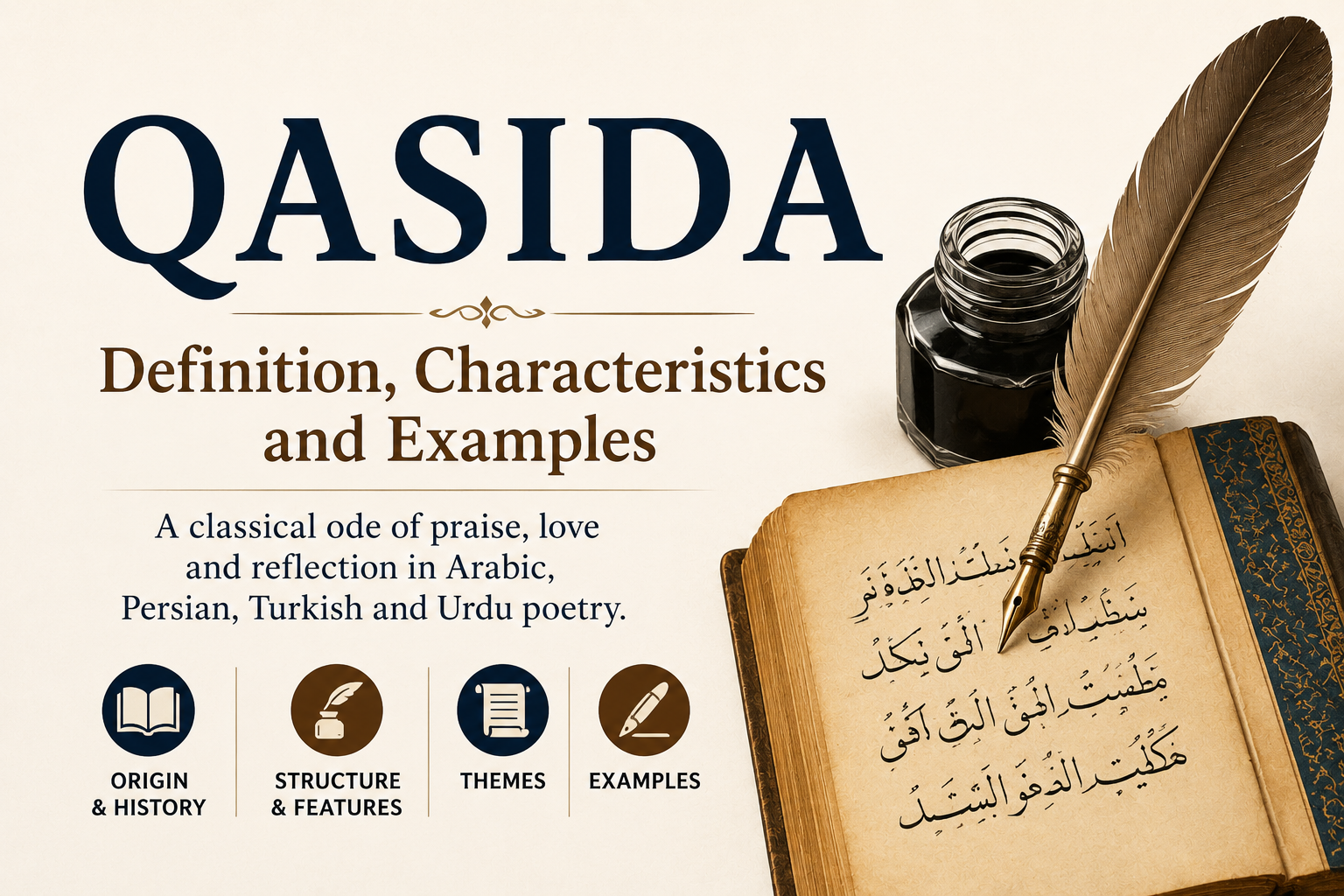
Qasida is a type of formal ode believed to have originated in the sixth century and used by Arabic, Persian, Turkish, and Urdu poets. The themes were varied: elegy, eulogy, panegyric, or satire. The length also varied—between thirty and two or three hundred lines. The form was imitated by Alfred Lord Tennyson in Locksley Hall, using couplets in octameters, for the most part trochaic. It is also used by James Elroy Flecker in his poetic drama Hassan (published in 1922).
In Spanish verse, the qasida is probably of Bedouin Arab origin and was a kind of elegy in which the meter might vary whereas the subjects (and their order) were fixed. The poet began with a nostalgic reference to a rediscovered place that recalled a lost love; then dwelt upon this love and the suffering it caused. There followed a lengthy account of the various journeys undertaken by the poet. Finally, the poem concluded with praise for a ruler, patron, or noble person whose generosity the poet hoped to secure. These verses were first transmitted orally before being preserved in written form.
Characteristics of a Qasida
A traditional qasida is distinguished by its single rhyme scheme, in which every line ends with the same rhyme throughout the poem. Despite its considerable length, it maintains a unified metrical pattern. Classical qasidas are often divided into thematic sections, beginning with a romantic or nostalgic prelude (nasib), followed by a journey or desert description (rahil), and concluding with the principal purpose of the poem, such as praise, satire, moral reflection, or elegy. This carefully structured progression became one of the defining features of the genre.
Famous Poets and Examples
The qasida flourished in Arabic literature through poets such as Imru’ al-Qais, Al-Mutanabbi, and Al-Busiri, whose celebrated Qasidat al-Burda (“Poem of the Mantle”) remains one of the most revered devotional poems in Islamic literature. In Persian literature, poets including Rudaki, Anvari, and Khaqani elevated the qasida into a sophisticated medium for philosophical reflection and royal panegyric. The tradition later influenced Turkish and Urdu poetry, where distinguished poets such as Mirza Ghalib and Muhammad Iqbal composed memorable qasidas alongside their ghazals and other poetic forms.
Literary Significance of the Qasida
The qasida occupies an important place in world literature because it reflects the cultural, political, and social values of the civilisations in which it developed. It is not only a vehicle for artistic expression but also a means of preserving history, celebrating rulers, expressing religious devotion, and recording personal emotions. Its influence extends beyond Middle Eastern literature and can be seen in European poetry, particularly during the nineteenth century, when poets experimented with Eastern poetic forms and themes.
Today, the qasida continues to be studied as one of the oldest and most enduring forms of lyric poetry. Its combination of formal discipline, elaborate imagery, and thematic richness has ensured its lasting significance in comparative literature and the study of world poetry.
Read also: Conceit in Literature: Definition, Types, Characteristics and Examples