
Ted Hughes’s genius, as a poet of varied subject matters, is indisputably acknowledged. But what is particularly remarkable and popular is his authorship of animal poems. The first collection of his poems, The Hawk in the Rain, published in 1957, contains a good many (more than a dozen) poems on animals, of course, irrational creatures, including the hawk. His two other poetical collections, Lupercal and Crow, both published in 1970, have similar poems on birds and beasts and snakes, and so on.
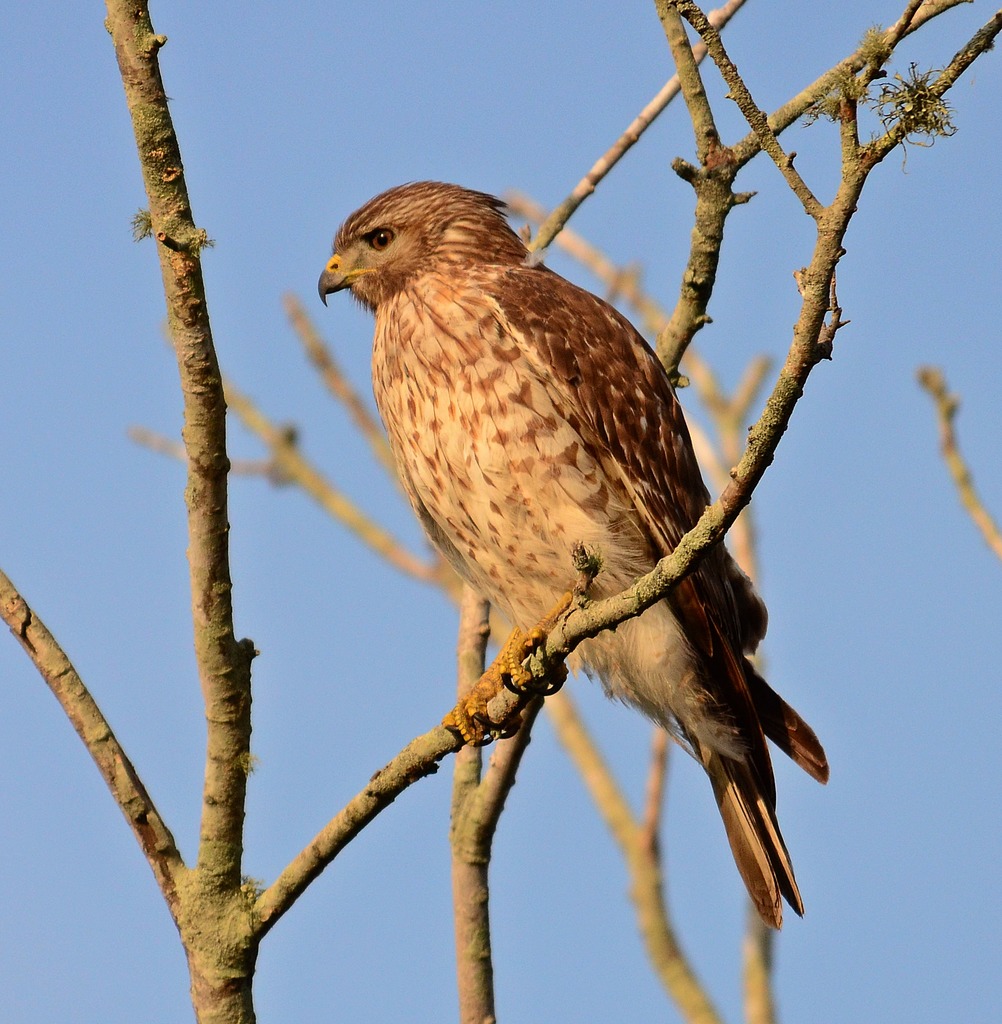
The present poem Hawk Roosting, included in the volume Lupercal, is on a hawk, a bird, rather an irrational animal. The poem entirely centres around a hawk in the posture of roosting at the topmost branch of a high tree. The hawk also speaks, of course, in the first person, and gives out its appraisal of its lofty situation, convenience, authority, and determination. Indeed, the hawk and its self-confident, self-conceited contention and assertion form the actual interest of the poem.
In Hawk Roosting, Hughes uses a dramatic monologue technique through which the hawk speaks in the first person. The entire poem becomes the direct utterance of the bird itself, and reveals its pride, arrogance, cruelty, and sense of absolute authority. The opening lines:
I sit in the top of the wood, my eyes closed.
Inaction, no falsifying dream.
This immediately establishes the hawk’s self-confidence and supremacy. The hawk remains calm and still, yet fully conscious of its own strength and power. The phrase “no falsifying dream” suggests that the hawk lives in a world of harsh reality, free from illusion, morality, or sentimentality. Hughes presents here the primitive instinct and fierce independence of the animal world.
This is definitely a poem that has only concern with that bird of prey, the hawk. Ted Hughes has another poem on the same bird, under the title The Hawk in the Rain. That poem, however, is not in the first person of the hawk.
Hawk Roosting traces rather the story of the hawk through its own mouth. Comfortably perched in its nest on a high tree, the hawk indulges in its egoistic satisfaction of its environment so high, so pleasing, so comfortably warm. The bird is arrogant enough to think, too, of its importace in the process as well as existence of creation. It glorifies its body, particularly its feet and feathers, which require no mean labour and pain in the process of creation What is more, the hawk’s ego leads it to think that it holds the whole creation in its feet. The hawk’s pride reaches its climax in the lines:
My feet are locked upon the rough bark.
It took the whole of Creation
To produce my foot, my each feather.
These lines indicate the hawk’s immense self-importance. The bird imagines itself as the supreme product of creation. Hughes magnifies the physical features of the hawk—its feet, claws, and feathers—to symbolize raw power and destructive energy. The hawk believes that nature itself has specially designed it to rule over other creatures. Such an attitude makes the bird appear almost tyrannical and dictatorial.
The hawk, thereafter, feels no hesitation to declare its savage manners to fly to its preys, catch and hold them dreadfully, tear off their heads, penetrate through their bones and kill and eat them with a clear authority. Such a cruel course of its dealing with its helpless victims is extolled by it as its right that no argument or logic can dispute. The hawk is also determined to continue its age-old manners which must remain unchanged, and be kept ever, as they are.
Another remarkable aspect of the poem is its political implication. Many critics interpret the hawk as a symbol of authoritarian rulers or dictators who justify violence through power. The famous declaration:
“I kill where I please because it is all mine”
It reveals the hawk’s belief in absolute ownership and unquestioned authority. The line sounds like the voice of a tyrant who considers power itself as the basis of justice. The hawk recognizes no morality, sympathy, or humanitarian value. Hughes thus uses the animal figure to expose the violent instincts hidden within power politics and human civilization.
The entire business of the hawk seems to tear the head. pierce through the bones and allot a cruel death to its helpless prey. It never wavers in carrying out its awful task of killing and eating its victims. The imagery of the poem is intensely vivid and brutal. Images like “tearing off heads,” “hooked head,” and “allotment of death” create an atmosphere of violence and terror.
Hughes’s language is sharp, compressed, and energetic, perfectly suited to the savage nature of the hawk, where survival depends on strength and aggression rather than reason or morality.
At the end of the poem, the hawk firmly declares:
Nothing has changed since I began.
My eye has permitted no change.
I am going to keep things like this.
These concluding lines emphasize the hawk’s determination to preserve its dominance forever. The tone becomes authoritarian and threatening. The hawk resists all change and seeks eternal control over the natural order.
Hughes’s Hawk Roosting is, thus, a poem, that specifically lights up violence and ferocity in the animal world, that bothers for no human sophistry or rationality. Here the poem comes closer to Pike, another animal poem from Hughes, and quite contrary to the other hawk poem, The Hawk in the Rain, as mentioned already.
Also read Summary and Critical Appreciation of Dylan Thomas’s poem A Refusal to Mourn the Death