
Definition of Pararhyme
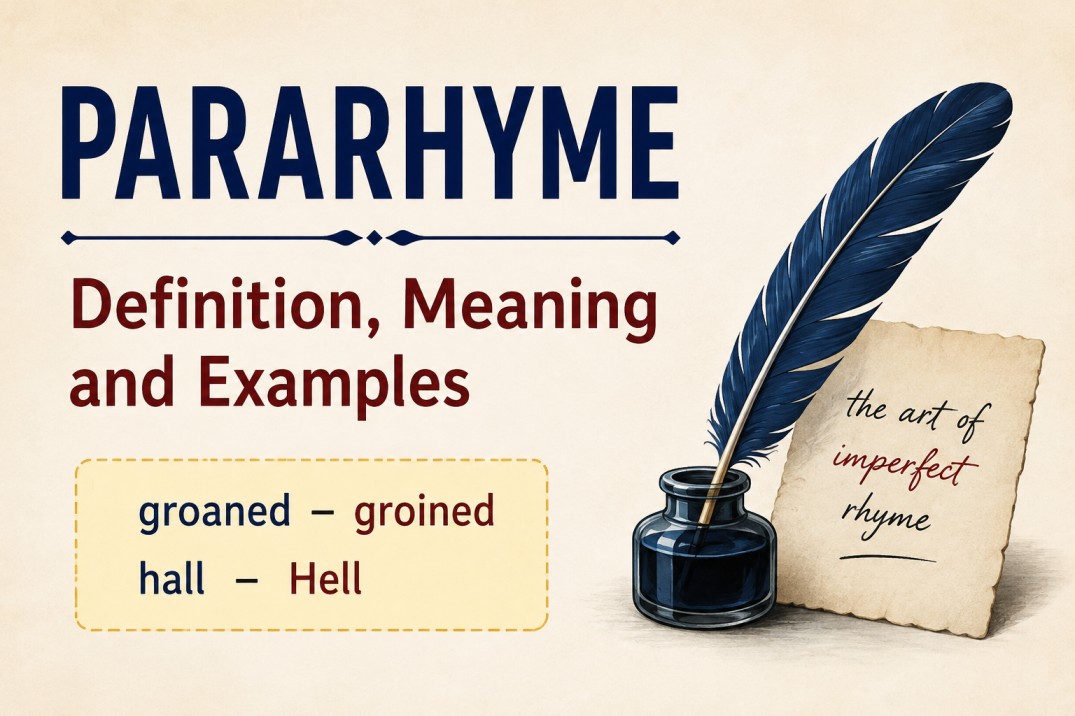
Pararhyme is a poetic device in which the final consonant sounds of two or more accented syllables correspond, while their vowel sounds are different. In other words, the consonants are similar, but the vowels do not match as they would in a perfect rhyme. It is therefore a form of consonance and is also associated with terms such as approximate rhyme, imperfect rhyme, near rhyme, oblique rhyme, and slant rhyme. For example, “groaned” and “groined” have different vowel sounds, but their consonant sounds are similar. This is an example of pararhyme.
Pararhyme is particularly effective because it produces a sense of rhyme without providing the complete harmony expected from a perfect rhyme. Pararhyme is associated with several other terms used in discussions of imperfect rhyme. These include Near rhyme, Slant rhyme, Half rhyme, Imperfect rhyme, Approximate rhyme, and oblique rhyme.
Meaning of Pararhyme
The word pararhyme can be understood as a rhyme that is close to, but not identical to, a perfect rhyme. In a perfect rhyme, the stressed vowel and the sounds following it correspond, as in light/night, day / say, moon/tune. In pararhyme, the consonant sounds correspond but the vowel sounds differ. This creates an incomplete or approximate rhyme.
Characteristics of Pararhyme
The major characteristics of pararhyme are:
- The consonant sounds correspond, particularly the final consonants of stressed syllables.
- The vowel sounds differ, unlike in perfect rhyme.
- It creates an imperfect or incomplete rhyme.
- It can give poetry a subtle and sometimes unsettling musical quality.
- It is especially useful when a poet wants to avoid the predictability of conventional rhyme.
- Pararhyme can reinforce the meaning and emotional atmosphere of a poem.
Examples of Pararhyme
Pararhyme has been used by a number of poets in English literature. It was common in Icelandic, Irish, and Welsh verse. Henry Vaughan appears to have been among the earliest English poets to use the technique. However, it became particularly significant in the poetry of Gerard Manley Hopkins and W. B. Yeats. Later, poets such as Wilfred Owen, John Crowe Ransom, T. S. Eliot, Emily Dickinson, Allen Tate, and W. H. Auden also employed forms of approximate or imperfect rhyme.
One of the most famous examples of pararhyme occurs in Wilfred Owen’s poem Strange Meeting:
It seemed that out of battle I escaped
Down some profound dull tunnel, long since scooped
Through granites which titanic wars had groined.
Here, “escaped” and “scooped” create an imperfect sound correspondence, while “groined” is closely related in sound to “groaned,” which appears shortly afterwards:
Yet also there encumbered sleepers groaned,
Too fast in thought or death to be bestirred.
The relationship between “groined” and “groaned” is particularly important. The consonantal framework is similar, but the vowel sounds differ. This produces the characteristic effect of pararhyme.
Another example occurs near the end of the poem:
And by his smile, I knew that sullen hall,—
By his dead smile I knew we stood in Hell.
The words “hall” and “Hell” create a close but imperfect sound correspondence. The difference between them contributes to the poem’s disturbing atmosphere.
Pararhyme in Other Poetry
Pararhyme and related forms of near or slant rhyme have been employed by numerous poets. Gerard Manley Hopkins experimented extensively with unusual patterns of sound and rhythm, while W. B. Yeats also employed imperfect rhyme in his poetry. Emily Dickinson frequently used unconventional rhyme, including slant and approximate rhymes. Her poems often resist the regularity of traditional poetic forms, and her unusual sound correspondences contribute to the distinctive rhythm and musicality of her verse.
Conclusion
Pararhyme is an important poetic device in which consonant sounds correspond while vowel sounds differ. Unlike perfect rhyme, it creates an incomplete or approximate sound relationship. It can produce subtle musical effects while also conveying tension, uncertainty, and emotional disturbance. Pararhyme is not only an imperfect form of rhyme; it can be an important artistic technique through which poets create both sound and meaning.
Read also: Definition of Syllables: Meaning, Types and Examples