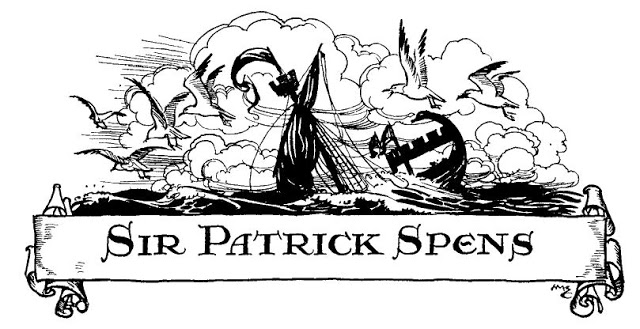

Sir Patrick Spens is an old English ballad dwelling upon the loss of a Scottish Ship together with its commander, Sir Patrick and the crew, existing in diverse versions. It is anonymous because the names of the original author or authors have been lost to us over time. In the shortest version, the ship puts to sea in foul and inclement atmosphere at the bidding of the King and Sir Patrick foresees the calamity ahead-brought about, apparently, by the vanity of the king.
The ballad mainly deals with themes of loyalty, fate, obedience, heroism, and tragic loss. Sir Patrick obeys the king despite foreseeing danger, which gives the poem a strong sense of fatalism and tragedy.
In the longest version, the ship floats to Norway to bring back a princess (perhaps the Maid of Norway meeting the marine grave in 1290 or the Scandinavian Queen of James VII). The Norwegian lords complain about the behavior of the Scottish nobility, who leave suddenly, in the horrid weather, having taken umbrage and offence. Both versions are fine examples of the art of the ballad, but the shortest exhibits that form at its most economical and dramatic.
The ballad is admired for its simplicity, emotional intensity, dramatic compression, and vivid narrative technique. It also reflects the dangers of medieval sea voyages and the harsh power of nature over human life.
It was first printed in Bishop Thomas Percy’s Reliques of Ancient English Poetry in 1765. Francis James Child collected some eighteen versions of Sir Patrick Spens. Like most traditional folk ballads, it was transmitted orally from generation to generation, which explains the existence of multiple versions. Like a traditional ballad form, this ballad also has important features, such as abrupt opening, dialogue, repetition, incremental progression, and impersonal narration, which enhance its musical and dramatic quality. The ballad stanza is a quatrain in Iambic Tetrameter and Trimeter alternately.
The king sits in Dunfermline toune
drinking the blude reid wine,
“O whar can I get skeely skipper,
To sail this ship o’ mine?”
Up and spak an eldern knicht,
Sat at the kings richt kne:
“Sir Patrick Spens is the best sailor
That sails upon the se.”
The king has written a braid letter,
And signed it wi his hand,
And sent it to Sir Patrick Spens,
Was walking on the strand.
To Noroway! to Noroway!
to Noroway oer the faem!
The king’s daughter to Noroway
‘Tis thou maun bring her hame.
The first line that Sir Patrick red,
A loud lauch lauched he;
The next line that Sir Patrick red,
A teir blinded his ee.
“O wha is this has don this deid,
This ill deid don to me,
To send me out this time o’ yeir,
To sail upon the se!
“Mak haste, mak haste, my mirry men,
Our guid ship sails the morne”:
“O say na sae, my master deir,
I feir a deadlie storme.
“Yestreen I saw the new moone,
Wi the auld moone in her arme,
And I feir, I feir, my master deir,
That we will cum to harme.”
O loth, o loth,
The Scots lords were
To weet their cork-heild schoone;
Bot lang owre a’ the play wer playd,
Thair hats they swam aboone.
O lang, lang may the ladies sit,
Wi’ their fans into their hand
Or ere they see Sir Patrick Spens
Come sailing to the strand.
O lang, lang may the ladies stand,
Wi thair gold kems in their hair,
Waiting for thair ain deir lords,
For they’ll se thame na mair.
Haf owre, haf owre to Aberdour,
Tis fiftie fathom deip,
And thair lies guid Sir Patrick Spens,
The Scots lords at his feit.
Also read: Epithalamion: Definition, Characteristics, and Examples