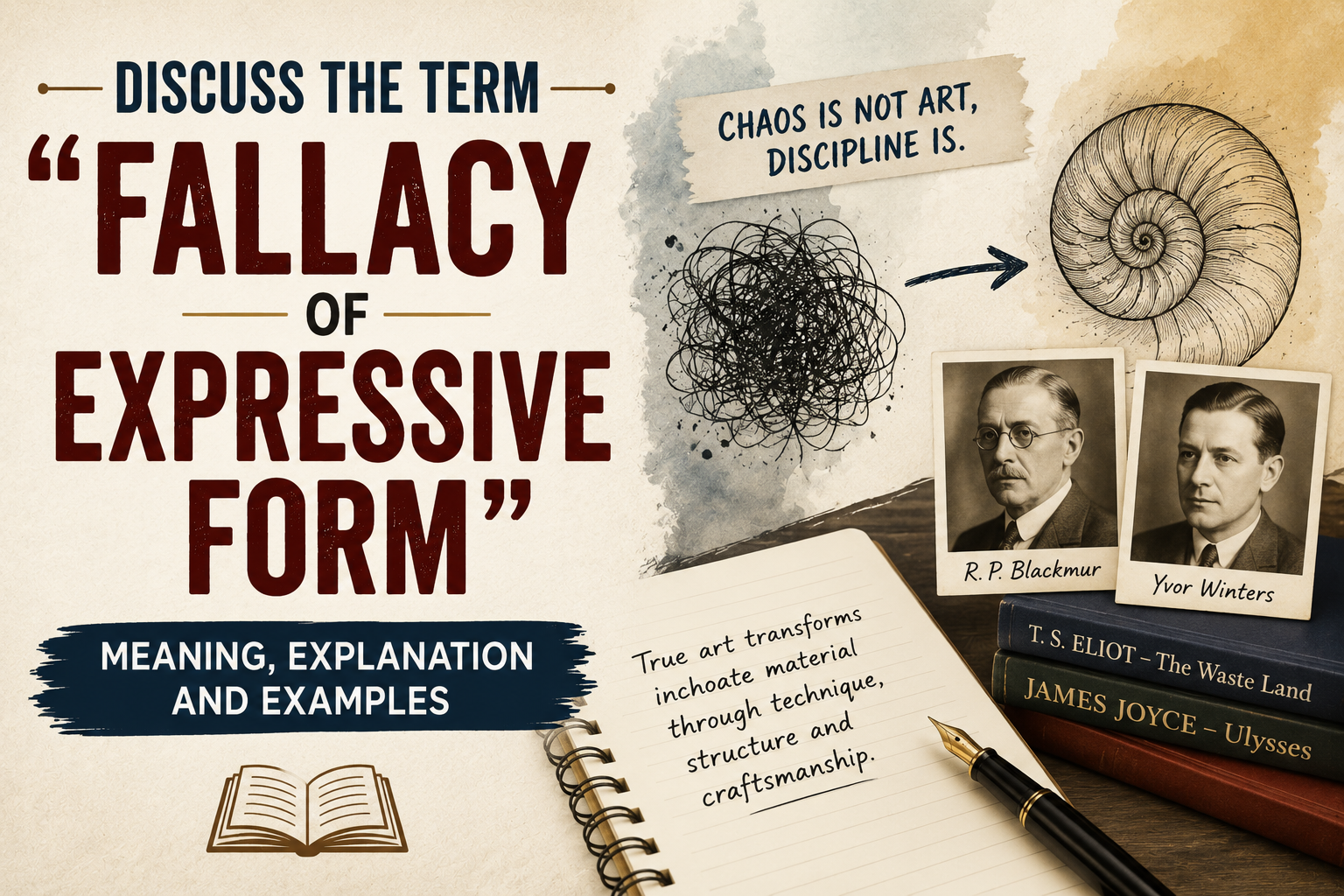

“Fallacy of expressive form” is a term adopted by R. P. Blackmur (1904-65) from observations made by the poet and critic Yvor Winters (1900-68). Winters wrote of the ‘heresy of expressive form’ apropos Coleridge’s concept of organic form and gave the view that it was not possible or desirable artistically to express or describe the disintegration of a belief or a civilisation in a chaotic form.
For example, he thought that James Joyce’s Ulysses (1922) was ‘disintegrated’, whereas it should have been disciplined and integrated. Critics pointed out that the transformation of inchoate material into the apparently chaotic was a matter of appearances, the result of the art that conceals art.
T. S. Eliot’s poem The Waste Land (1922) was not actually chaotic; it only appeared to be. The fallacy of expressive form refers to the idea that if a poet feels with sufficient intensity, then this will be enough to create a successful poem. But if a poet depends only on inspiration, then this will not be adequate. He or she must also judge, compare, and analyse.
The fallacy of expressive form emphasises the importance of artistic control in literature. A writer cannot merely reproduce confusion, disorder, or intense emotions and expect to create a successful work of art. Raw experience must be shaped and organised through technique, structure, and craftsmanship. The concept, therefore, rejects the notion that sincerity or emotional intensity alone is sufficient for literary excellence.
In short, the fallacy of expressive form is the mistaken belief that the form of a literary work should directly imitate the disorder or intensity of the experience it represents. Critics such as Winters and Blackmur argued that true art requires discipline and formal organisation, even when dealing with chaos, fragmentation, or emotional turmoil.