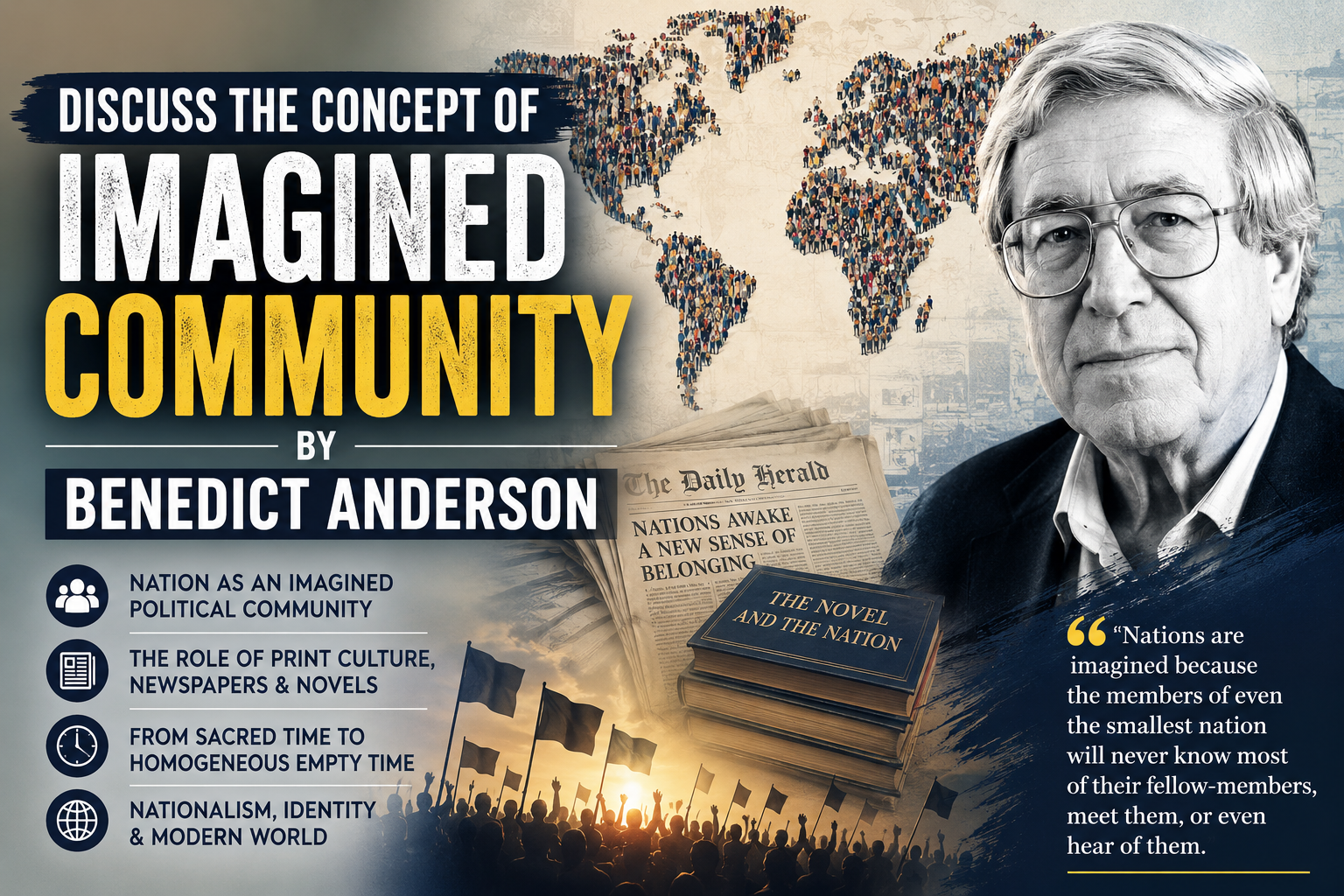

Imagined community is Benedict Anderson’s definition of the nation. In Imagined Communities (1983), Anderson argues that the nation is an imagined political community that is inherently limited in scope and sovereign in nature. It is imagined because the actuality of even the smallest nation exceeds what a single person can know; one cannot know every person in a nation, just as one cannot know every aspect of its economy, geography, history, and so forth. But as Anderson is careful to point out, imagined is not the same thing as false or fictionalized; it is rather the unselfconscious exercise of abstract thought.
The imagined community is limited because, regardless of size, it is never taken to be coextensive with humanity itself, not even extreme ideologies such as Nazism, with its pretensions to world dominance. Imagine this; in fact, as Giorgio Agamben has argued, such ideologies tend to be premised on a generalization of an exception. Its borders are finite but elastic and permeable. The imagined community is sovereign because its legitimacy is not derived from divinity as kingship is- the nation is its own authority, it is founded in its own name, and it invents its own people, which it deems citizens. The nation can be considered a community because it implies a deep horizontal comradeship which knits together all citizens irrespective of their class, color, or race. According to Anderson, the crucial defining feature of this type of comradeship is the willingness on the part of its adherents to die for this community.
The nation as the imagined community came into being after the dawning of the age of Enlightenment as both a response to and a consequence of secularization. It is the product of a profound change in the apprehension of the world, which Anderson specifies as a shift from sacred time to ‘homogeneous empty time’, a notion he borrows from Walter Benjamin. In sacred time, present and future are simultaneous. Because everything that occurs is ordained by God, the event is simultaneously something that has always been and something that was meant to be. In such a conception of time, there is no possibility of a ‘meanwhile’, or uneventful event, that is a mode of time that is empty of meaning rather than full of portent. Secularization, however, gave prominence to empty time, the time of calendars, clocks, and markets, which is concerned with temporal coincidence rather than destiny and fulfillment. This mode of time is perfectly embodied by the newspaper, which places in contiguity news of events that share only their temporality.
It was the establishment of print culture, firstly through the mechanical production of Bibles and then even more strongly through the distribution of newspapers, that was the most important causal factor in creating the cultural conditions needed for the idea of the nation to become the political norm. Print had three effects according to Anderson: first, it cut across regional idiolects and dialects, creating a unified medium of the exchange below the sacred language (Latin in Europe) and above the local vernacular; second, it gave language a fixity it didn’t previously have, and slowed down the rate of change so that there was far greater continuity between past and present; and thirdly it created languages of power by privileging those idiolects which were closest to the written form. Anderson’s emphasis on the print culture in all its forms, but particularly the newspaper and the novel, has been extremely stimulating for several scholars working in a wide variety of different disciplines.
Anderson states that a nation survives not through political institutions or geographical boundaries only, but through shared feelings of belonging and collective identity. National symbols such as flags, national anthems, memorials, and public ceremonies help strengthen this emotional bond among citizens. Even though members of a nation may never meet one another, they imagine themselves connected through common traditions, historical memories, and cultural practices. This emotional attachment often becomes so powerful that individuals are willing to sacrifice their lives for the nation. Along with newspapers, novels contributed significantly to the formation of imagined communities because they allowed readers to imagine themselves participating in a shared social world. Readers belonging to different regions could identify with the same characters, situations, and experiences represented in literary works. In this way, literature created a sense of simultaneity and common identity among people who were otherwise separated by geography and social class.
Anderson’s concept has been widely influential in postcolonial studies because it explains how colonized societies developed national identities during struggles against imperial rule. In many Asian and African countries, print culture, education, and vernacular languages became important means of mobilizing people against colonial domination. Newspapers and political writings enabled individuals from diverse linguistic, religious, and regional backgrounds to imagine themselves as part of one nation. Thus, nationalism became a unifying force in resistance movements against colonial powers.
However, Anderson’s theory has also faced criticism from several scholars. Some critics argue that he places too much emphasis on print capitalism and neglects other important factors, such as economic conditions, political struggles, religion, and military power in the formation of nations. Others believe that nationalism can also emerge through oral traditions, visual media, and digital communication rather than print alone. Feminist critics further point out that Anderson’s theory does not adequately address gender and the role of women in the construction of national identity. Despite these criticisms, Imagined Communities remains one of the most influential works in the study of nationalism and cultural identity.
Also read: A short note on Moscow Arts Theatre