
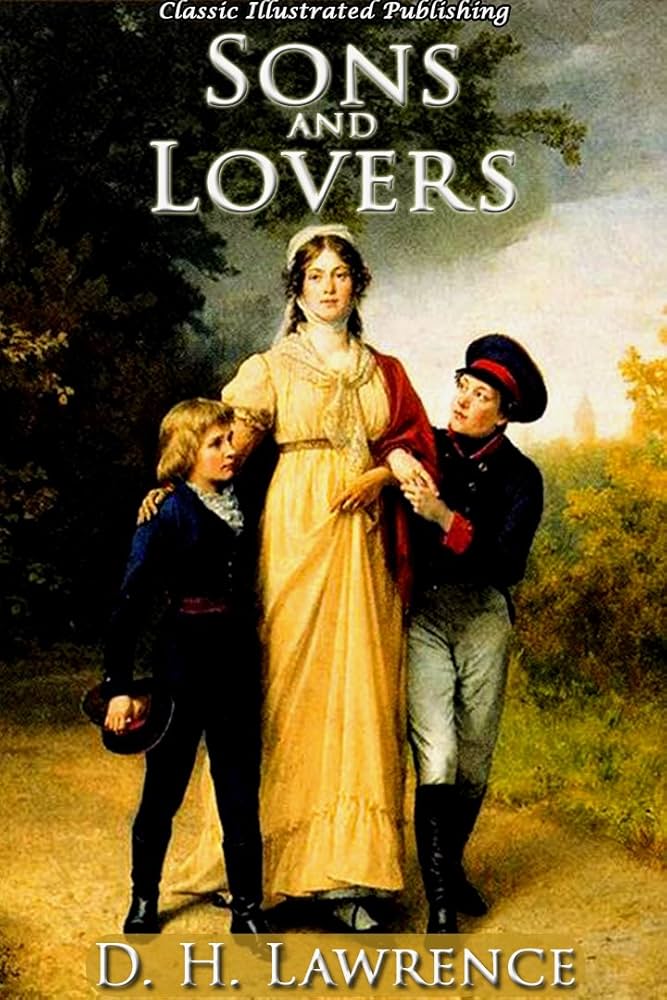

Keeping in mind the ‘myth of Oedipus ’, Freud and other psychoanalysts used the ‘Oedipus complex for a manifestation of the child’s unconscious attachment to the parent of the opposite sex and rivalry toward the parent of the same sex. D.H. Lawrence’s “Sons and Lovers” is a text that cries out for such a psychoanalytic interpretation. Gertrude Morel has a dysfunctional relationship with her two sons, William and Paul.
Sigmund Freud introduced the concept of the Oedipus complex in The Interpretation of Dreams (1900) and later developed it in Three Essays on the Theory of Sexuality (1905). According to Freud, during the phallic stage of psychosexual development, a young boy unconsciously develops affectionate and possessive feelings toward his mother while perceiving his father as a rival. If this conflict remains unresolved, it may continue into adulthood and affect the individual’s emotional and romantic relationships. D. H. Lawrence’s Sons and Lovers presents one of the finest literary representations of this Freudian concept. The emotional dependence of William and Paul on their mother and their hostility toward their father closely resemble the characteristics of the Oedipus complex described by Freud.
The beginning of the Oedipus complex appearing in William and Paul is exemplified in the relationship between the parents. The boys witness an abusive marriage in which Walter Morel often comes home drunk after squandering the family’s income gambling. All of this causes the boys to hate their father and be sympathetic and protective of their mother. In their mother, the children see someone who is good and pure. She, in turn, keeps her sons all to herself and sheltered from their father. By this act, Gertrud Morel is unconsciously moulding her sons into what she wants, so eventually, they can take the place of her husband. She is clearly unhappy in her marriage, so she tries to live vicariously through her sons.
Disappointed by Walter Morel’s irresponsible behaviour, she gradually withdraws her emotional investment from her husband and redirects it towards William and later Paul. Instead of encouraging their emotional independence, she unconsciously binds them to herself through affection, guilt, and emotional dependence. Her possessiveness prevents both sons from establishing healthy romantic relationships. Consequently, Gertrude herself becomes an active participant in sustaining the Oedipal attachment.
William is the oldest son and the mother’s favourite. He does everything he can to please her. Sibling rivalry exists between William and Paul as they compete for their mother’s affection. Mrs. Morel becomes jealous of William’s female companions and he eventually moves to London. William’s moving to London was his unconscious way of trying to break free from the oedipal attachment to his mother. In London, William meets a girl by the name of Lily. They become engaged, but William is not happy. He has a misogynistic attitude towards her. It is very clear Lily does not possess the good qualities he sees in his mother, and it angers and frustrates him. William exhibits classic symptoms of displacement. When William voices his dissatisfaction with Lily, his mother asks him to reconsider marrying her. He responds, “Oh well, I’ve gone too far to break it off now. ” These conflicted feelings that William is experiencing are a sign of his apparent struggle to rid himself of the oedipal fixation, and the reader is not surprised when William eventually gets sick and dies.
Paul’s relationships with Miriam and Clara reveal his inability to separate maternal affection from romantic love. Miriam represents spiritual love and emotional commitment, yet Paul cannot fully surrender himself because his emotional loyalty remains with his mother. Clara, on the other hand, represents physical desire without the expectation of permanent commitment. Since Clara is already married, Paul enters the relationship knowing it is unlikely to replace his bond with his mother. Lawrence thus portrays Paul’s divided psyche, caught between emotional attachment and sexual desire, a conflict that reflects the unresolved Oedipal fixation identified by Freud.
After William dies, Paul takes his place as his mother’s favourite. By her actions, one would think she thought of him as a suitor. This is evident when she accepts a bottle of perfume spray from him. “Pretty!” she said in a curious tone, of a woman accepting a love-token. As Paul reaches adulthood, it is quite evident the Oedipus complex has taken him over. His relationship with his father becomes strained, and he becomes jealous of him. He even asks his mother not to sleep with his father anymore. Paul meets Miriam Leivers, and although he likes her, he repeats the same misogynistic behaviour as William did with Lily. He feels he would be betraying his mother by being with her. However, the idea that Paul is interested in someone other than his mother shows an attempt to break the oedipal fixation he has. But the mother foils this attempt by making him feel guilty for wanting to be with Miriam. She says. “I can’t bear it. I could let another woman – but not her. She ‘d leave me no room, not a bit of room. And I’ve never – you know Pau! I’ve never had a husband, not really”.
This same behaviour the mother exhibited with William, by being jealous of his female companions, is now being inflicted on Paul. She reinforces the Oedipus complex that is within Paul by suffocating him and, in a subtle way, asking him to replace her husband. Paul’s relationship with Miriam is reduced to friendship. He has to repress any romantic feelings that he might have for her, so she will not replace his mother. Later in the novel, Paul does become physically intimate with Miriam, but it is short-lived because Paul will not marry her. This also shows that Paul suffers from a fear of intimacy as he continues to remain emotionally detached from Miriam. Once again, Paul succumbs to the oedipal attachment for his mother. However, Paul does have an affair with a married but separated woman by the name of Clara Dawes. Paul allows himself to have this relationship because he knows that realistically this relationship can never go anywhere. She would never divorce her husband. Therefore, Clara is not a threat to Paul’s oedipal fixation on his mother. There is no danger of her taking his mother’s place.
Paul’s mother becomes ill. Since she is bedridden and in pain, Paul gives her morphine. However, he administers an overdose of morphine to her, which leads to her death. While this might be seen as euthanasia, it seems equally likely that killing his mother was Paul’s unconscious way of releasing himself from the Oedipus complex once and for all. Her death leaves Paul devastated and alone. Although much time has passed, Miriam still wants to be with Paul, but he refuses. It is clear that even after his mother’s death, he is still not free from his attachment to her because he chooses to remain alone. The dysfunctional relationship with his mother is still present in Paul’s life, and it appears the Oedipus complex is still intact.
The conclusion of Sons and Lovers carries profound psychological significance. Although Gertrude Morel dies, Paul does not immediately attain emotional freedom. Instead, he experiences loneliness and psychological emptiness that suggests that the emotional dependence established during childhood cannot be erased simply through physical separation. His rejection of Miriam after his mother’s death indicates that the psychological influence of the Oedipus complex continues to shape his personality. Nevertheless, the novel ends with Paul walking toward the lights of the city, a symbolic image that suggests hope, resilience, and the possibility of constructing an independent identity despite the lasting effects of his past.
Also read Character of Cyril Fielding in Forster’s novel “A Passage to India”




1 Comment
Prasenjit Barman
Good job. Carry on 👍