
Introduction
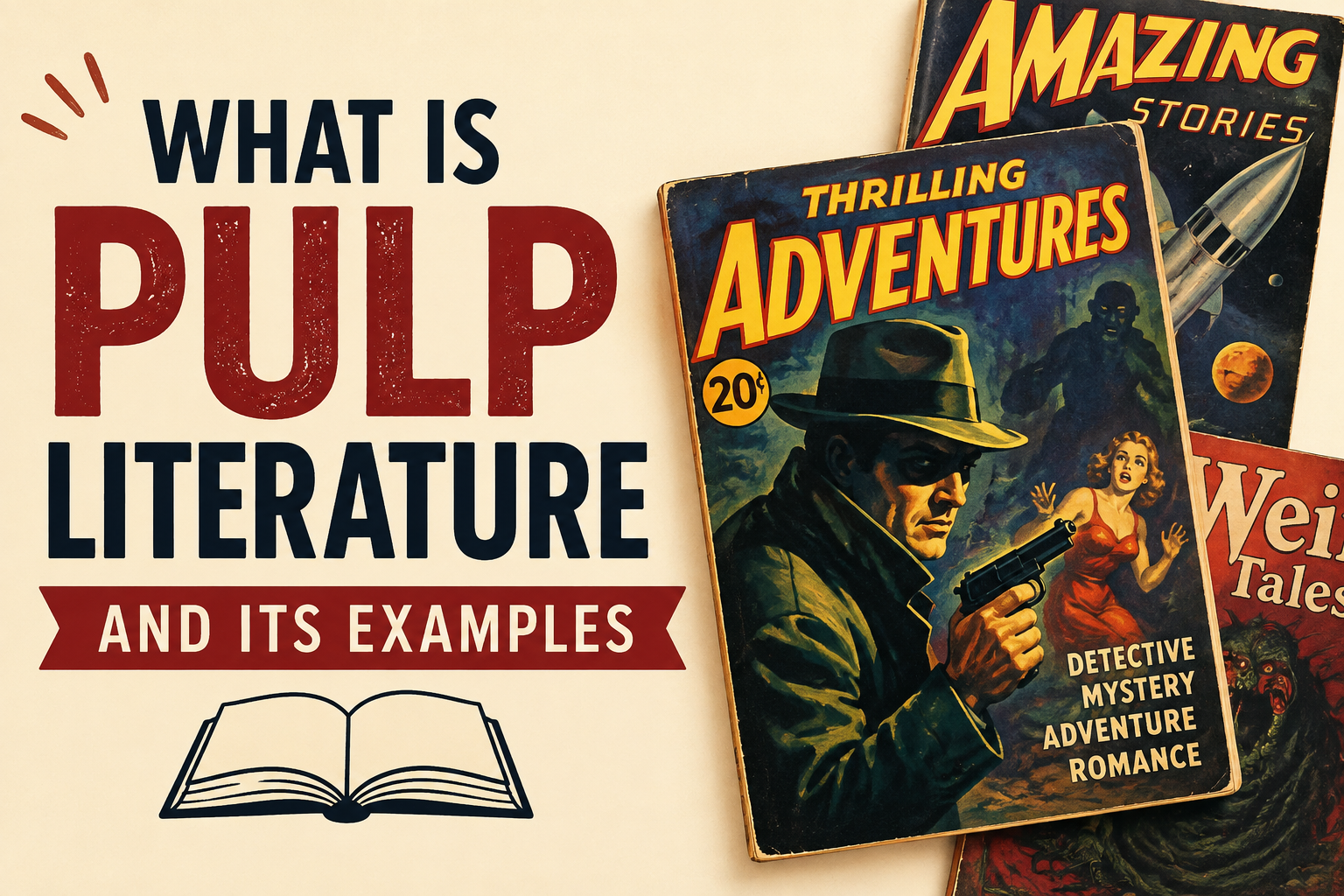
‘Pulp’ is a pejorative term for certain kinds of fiction (and its authors). Pulp magazines began to appear during the First World War or earlier and got their name from the fact that they were printed on wood pulp, which gave the content a coarse, grainy appearance. They were about 7 x 10 inches in size, had gaudy covers, and comprised about 120 pages. They published short stories and occasional extracts from novels. During the 1920s, they became extremely popular (there were well over 200 in existence), and they remained popular in the 1930s. Eventually, television brought about their demise.
Pulp literature is usually written for mass entertainment rather than artistic prestige. These stories are often fast-paced and rely heavily on action, suspense, mystery, romance, horror, or adventure. The language is generally simple and direct so that readers can follow the story easily. Pulp writers focused on keeping readers excited from one page to the next, which is why cliff-hangers, dramatic twists, and larger-than-life heroes became common features of pulp fiction.
Famous Examples of Pulp Literature
Pulp magazines published detective stories, various kinds of horror stories, and many tales of the weird and wonderful, the supernatural, and the fantastic. Well-known examples were The Black Mask, Dime Detective, Thrilling Detective, and the Detective Story Magazine, Oriental Stories, Planet Stories, Spicy Detective, Startling Stories, Thrilling Wonder Stories, Unknown, and Weird Tales. Science fiction stories also became very popular through the pulp magazine, especially Amazing Stories (first published in 1926), though this was by no means the first SF magazine. The most successful pulp magazines were Argosy, Adventure, Blue Book and Short Stories, collectively described by some pulp historians as “The Big Four”.
Many famous pulp characters and stories first became popular through these magazines. The Shadow by Walter B. Gibson became one of the most celebrated crime and mystery heroes of pulp fiction. Doc Savage, created by Lester Dent, combined adventure, science, and detective elements and later influenced modern superhero fiction. Tarzan by Edgar Rice Burroughs and Conan the Barbarian by Robert E. Howard are also associated with the pulp tradition. In detective fiction, Dashiell Hammett’s The Maltese Falcon, which appeared in Black Mask, is one of the most influential examples of hard-boiled pulp writing.
Cultural Importance of Pulp Fiction
Although critics sometimes dismissed pulp literature as low-quality or sensational writing, as Aldous Huxley would have described as ‘inconceivable twaddle’ or ‘semi-minus epsilon’. But its influence on popular culture has been enormous. Pulp magazines gave opportunities for many writers who later became famous and introduced millions of readers to genres that are now widely respected. Modern comic books, crime thrillers, fantasy novels, science-fiction films, and television series owe much to the storytelling techniques developed in pulp fiction.
Conclusion
Pulp literature was produced cheaply and was often criticized for its sensationalism and formulaic plots. Despite this, it had a significant role in the development of popular fiction in the twentieth century. What was once regarded as merely “cheap entertainment” has become an important subject for scholars interested in mass culture, genre fiction, publishing history, and the evolution of modern storytelling.
Read also: Theatre-in-the-Round: Definition, Features, Advantages and History