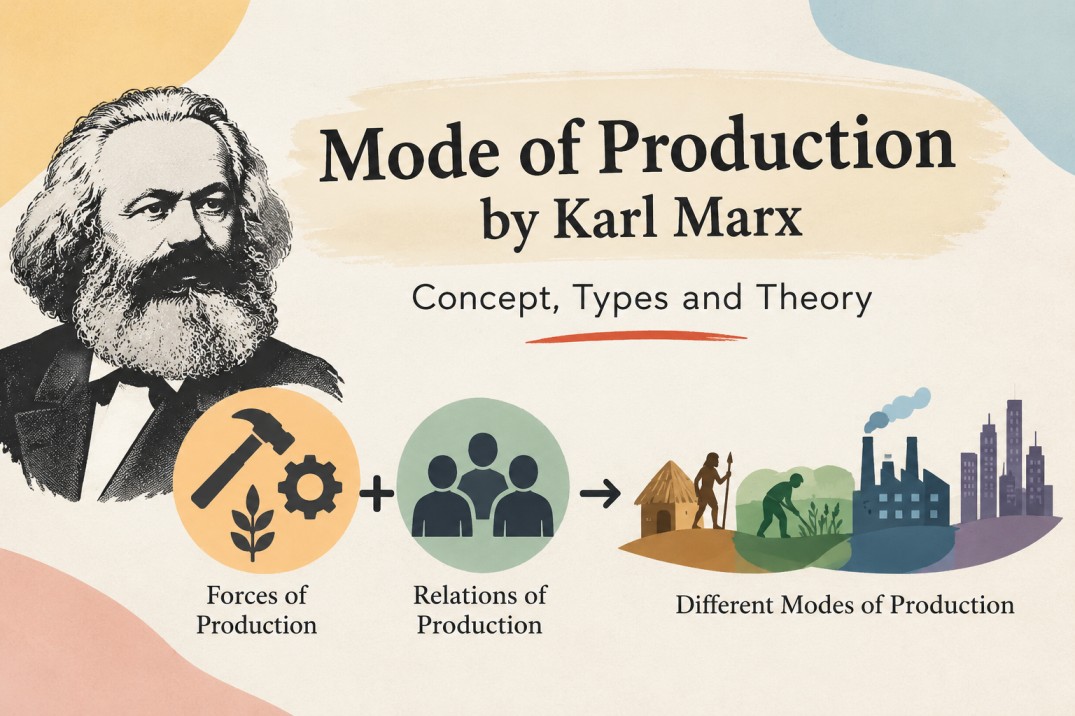

Karl Marx created the concept of “mode of production” to distinguish between different periods in history according to the varying ways in which the forces and relations of production were organized. Forces of production are the tools, machinery, and energy sources a society can put at its disposal, while the relations of production are the network of social rules regarding the ownership and the use of the forces of production (this distinction effectively corresponds to that between base and superstructure, which Marx also uses).
Marx’s thesis is that the composition of the economy-meaning, the relative forces available in society, and the distribution of access to those forces-conditions all other aspects of social life. As the great Marxist archaeologist, V. Gordon Childe has pointed out, for a society to have artists and shamans it must, first of all, produce sufficient surplus food to support non-producing members. The greater the amount of surplus it produces, the greater its potential to focus on addressing wants rather than needs. Thus, for Marx, the essential point of distinction between modes of production is the amount of surplus it generates and who benefits from that surplus. He identifies four modes of production, Asiatic, ancient, feudal, and bourgeoisie, and prophesies a fifth, namely communism. He also speaks of three prehistorical modes of production corresponding to the Stone, Bronze, and Iron Ages.
A mode of production, therefore, is not simply an economic arrangement but a broader social structure that shapes class relations, political institutions, and dominant ideas. When the existing relations of production become incompatible with the development of the forces of production, tensions and contradictions arise within society. For Marx, such contradictions can lead to major social transformations. For example, the growth of trade, manufacturing, and new productive technologies gradually challenged the feudal relations of medieval Europe and contributed to the emergence of capitalism. In this sense, historical change is closely connected with transformations in the material conditions through which human beings produce and distribute wealth.
The concept of the mode of production is consequently central to Marxist interpretations of history because it provides a materialist explanation of social change. Under capitalism, the bourgeoisie owns the means of production, while the proletariat primarily possesses its labour power, which it sells for wages. The unequal distribution of ownership enables the capitalist class to appropriate surplus value generated by workers. Marx’s analysis thus draws attention to the relationship between economic organization and class struggle. In contemporary critical theory, this concept is used by Louis Althusser and updated by Ernest Mandel, but probably its most widely debated incarnation is to be found in Fredric Jameson’s account of postmodernism. It remains an important framework for understanding how economic structures influence social relations, historical development, and systems of power.
Also read: Death Drive by Sigmund Freud: Meaning, Theory and Explanation