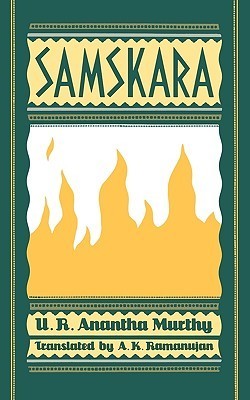

In his novella “Samskara”, an important work of the 1960s, U.R. Anantha Murthy has hurled a pungent attack on the contemporary Hindu Brahmin community. It is a religious novella about a decaying Brahmin colony in a Karnataka village, called Durvasapura. The author’s satirical picture of this community shows these Hindu Brahmins as the representatives of a generation in India, undergoing a sharp and inevitable process of change – a transformation from their rigid orthodoxy into modernity. The strait-laced village Brahmins are evidently caught between these two extremes; consequently, they are perplexed. Pranesacharya is the central character through whom Anantha Murthy epitomises the entire problem, the cobweb into which the whole Brahmin sect has been cast.
The spiritual bankruptcy and moral sterility of the Agrahara community emerge through the portrayal of its minor characters. They are shown as limited beings and are governed by the baser passions and instincts like material greed, voluptuousness, envy and voraciousness. They are devoid of any intellectuality; they believe in living by their hearts with powerful instinct rather than by the mind. They are God-fearing people; yet on account of their lack of self-respect and self-restraint, they commit all kinds of moral sins. These marginal Brahmins who are simply swayed by passions are always rendered thoughtless and inert in critical times. They lack the dynamism and energy of the Acharya, Naranappa or even Putta. For every problem, simple or complex, they look towards Pranesh, who always solves their problems after consulting the holy scriptures.
From its very title to the end, the novel allegorises a concept central to Hinduism. “Samskara” centres around a dilemma as to who is the rightful authority to perform the death-rite of Naranappa, an anti-Brahminical Brahmin. Naranappa was a modern man, totally defiant of the traditions and customs of the Brahmins. In fact, the heretic, Naranappa, by living the life of a libertine, questioned and challenged the Brahmins of an exclusive orthodox Agrahara, broke every known taboo and exposed their ‘samskara’ (maturation or refinement of spirit) or lack of it. He is truly the mocking anti-self of those greedy, hypocritical Brahmins, who are at heart jealous of his forbidden pleasures, of his modern way of life and crave a mistress like Chandri, protected fully by modern secular laws, more by the Brahmins’ bad conscience; the rebel lived defiantly in their midst. The orthodox Brahmins had their own inmost unspoken libidinous desires, as evident in their romanticised longing for Parijatpura, but had to put a bridle on their desires. They were so timid, nonvirile, afraid of their orthodoxy and traditions. They are now totally confused, faced with age-old human questions arising from Naranappa’s death, treacherous and double-edged: once raised, they turn on the questioner.
Another important aspect of Ananthamurthy’s critique lies in the distinction between ritual purity and moral responsibility. Throughout the novel, the Brahmins devote themselves to lengthy debates over the funeral rites of Naranappa, yet they remain indifferent to the suffering of others. Their concern rests primarily upon preserving caste purity rather than upholding compassion or justice. The inability of the community to perform a simple human duty exposes the emptiness of religious practices that have become detached from ethical values. Ananthamurthy therefore questions a social order in which ritual observance assumes greater importance than humanity itself.
Naranappa and Praneshacharya are binary opposites initially. But eventually, the Acharya becomes one with his opposite, in that contrary to all his “preparation’, he sleeps with Naranappa’s low-caste mistress, Chandri. All the battles of orthodoxy and modernity, of tradition and defiance, asceticism and sensuality, the meaning and meaninglessness of ritual, dharma as nature and law, desire and salvation have now become internal to the Acharya. The arena shifts from a Hindu village community to his body and spirit. The orthodoxy-modernity, religion-secularism tension has been clarified in the novel through the polarity of characters and situations, which are ultimately merged. Praneshacharya and Naranappa are merged through Chandri; the Acharya is initiated into the mysteries of the crude modern world by Putta, the Acharya’s erotic description of a classical heroine rouses Shripati, and he makes love to an outcaste woman. Thus, in Praneshacharya, Brahminism questions itself in modern existentialist mode. The questioning leads him into the new and ordinary worlds of Naranappa & Putta.
In presenting these two opposing characters, Naranappa and Pranesh, Anantha Murthy gives a detailed exposition of the thought crisis involving their whole Brahmin community. It is also shown that traditions and customs in any community are also flux-bound, liable to drastic changes and that the phase of such a transition is very crucial for the healthy growth of a community. Initially, though the Acharya is the object of reverence in the village and people have blind faith in his words like scripture, Naranappa, as a foil, shows that the Acharya actually lacks the dynamism and the true force of life. On the contrary, Naranappa is dynamic and forceful enough to trouble the orthodox villagers, including Praneshacharya, alive or in death. Ultimately, the Acharya has to accept the stark reality of a life of warm relationships. Ironically enough, he becomes what he has always opposed and disliked. The sad experiences with Mahabala and Naranappa have made him a moralist but eventually have to adopt the same route to discover his identity. Later, this bold acceptance of his present state serves as a clue to bring an end to his unrest and wanderings.
The Agrahara of Durvasapura functions as more than a physical setting; it becomes a symbol of a social order trapped in stagnation and fear. Every crisis in the village exposes the inability of the orthodox Brahmins to adapt to changing circumstances. They continue to depend upon ancient scriptural authority even when those texts fail to provide practical solutions. Their hesitation, indecision, and dependence upon Praneshacharya illustrate the gradual collapse of a community that has lost the capacity for independent moral judgment. Through this symbolic setting, Ananthamurthy presents the decline of an entire social structure rather than the failure of a few individuals.
Samskara” is a religious novel, but we must not oversimplify matters by calling it a mere criticism of a Hindu Brahmin community. With the Acharya’s final return to the village, the novelist explains clearly ‘the sense of dharma’ which had been so confusing so far. The problems of sin and salvation are resolved. The religious discussions assume metaphysical form, and the novel appears as a document of metaphysical thoughts and philosophical speculations. The hero’s dilemma bears clearly an existential tone. So, the novel offers something more than only criticism of Brahmanism or Hindu society in general. It’s a religious novel in its purpose and objective, i.e. the goal of human life.
Although Samskara presents a powerful critique of the decadent Brahmin community, Ananthamurthy’s vision extends beyond social criticism. The novel examines the larger questions of dharma, sin, identity, and self-realisation. Praneshacharya’s return to the village marks not merely the conclusion of a social conflict but the beginning of an inner transformation. The religious debates gradually assume a metaphysical dimension, while the protagonist’s moral dilemma acquires an existential significance. Consequently, Samskara emerges not only as a critique of Brahmanical orthodoxy but also as a profound philosophical exploration of human existence and the search for authentic values.
Also read; The Oedipus Complex in D.H. Lawrence’s Sons and Lovers: A Psychoanalytic Analysis