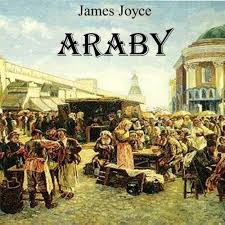

Araby, the title of Joyce’s story, is associated with the grand oriental fete, held in Dublin, from the 14th to the 19th May 1894. Against the background of Arab, a haunting place for romance and thrills in the boyish mind, the story expresses James Joyce’s boyhood craving for an ideal beauty in the drab surroundings of Dublin. As a boy, the author himself had a longing to go to Araby, which, however, after his actual visit, proved a disillusionment to him. He could not satisfy his appetite for romance there, and his dream of life remained unrealized, and he was made to leave the place in utter anguish and anger, ‘as a creature, driven and derided by vanity’.
Araby is a modern short story. Its theme is conceived rather symbolically. In the symbolism of modern literature, a theme, idea, or matter is conveyed by means of a symbol. In the short story Araby, ‘Araby’ represents an ideal of life, an ideal of romance and beauty to the young author. This is represented by the intense desire of a young mind lost in the dull and interminable pursuits of material life. Araby symbolizes the idea of romance and beauty. Again, the author’s fascination with Araby, his ideal of a life of all romance and charm, proved an utter illusion after his actual visit there. This is well symbolic of the hard fact that the romantic ideal remains ever beyond man’s reach amid the harsh reality of a grossly material existence.
Araby lacks many of the story elements in the conventional sense. As a sort of memoir, it contains the details of Dublin’s life as well as the psychological revelation of the subconscious state of dreams and desires. The author’s romantic sensation, his clearly cherished image of his friend Mangan’s sister, stood in sharp contrast to the atmospheric gloom of the streets of Dublin. There was a great difference between his vision for which he waited and the reality he saw before him. This, too, has a symbolic overtone and serves to expose the utter difference between a pleasant dream-like sensation and the dull, drab experience of life, lost in a commercial, mechanized surroundings.
Araby conveys the author’s expectation of the relish of beauty and romance he had long dreamt of. His eager watching for Mangan’s sister, or for a slight glimpse of her, is marked by an idealistic yearning and a romantic sensation. Her desire to go to Araby, which, to her imagination, is a splendid bazaar, and his promise to go there and to bring some gift for her, all, when symbolically interpreted, sharply indicate the long-drawn human expectations, aspirations for some ideal that is seldom realized, fulfilled.
Indeed, Araby and the girl (Mangan’s sister) gleamed before the author, like the Holy Grail of the Grail Legend, which had prompted the chivalrous Knights to undertake perilous journeys. The reference to the Holy Grail here has a specific symbolic significance. The author’s boyhood mind was fascinated and drawn by his own ideal of romance and beauty. Like the medieval knight, engaged in the quest for the Holy Grail, he waited and waited for that which he could never possess or relish. The story, indeed, records the longing, lingering waiting for the unattainable ideal of life and the satiable expectation for the beauty that is ever-alluring, never yielding. The symbolic overtones of the story are, indeed, distinct.
James Joyce’s story Araby subtly depicts the quest for the beauty of the mind, pinned down by the grim reality of a commercial world. In the hard situation of life, this quest never reaches the goal that draws and deludes a romantic visionary. Joyce’s childhood dream of Araby as a place of romance and beauty, and his desire to bring a gift for the girl of his ideal, got rudely shattered by the commercialism that he found and the frivolity with which he came across there. His quest for beauty was frustrated, and the story seems to highlight the tragedy of this quest, the cherished waiting for that which is deceptive. Araby, in fact, is not a mere story. It is a symbolic representation of a vivid waiting for the unattainable.