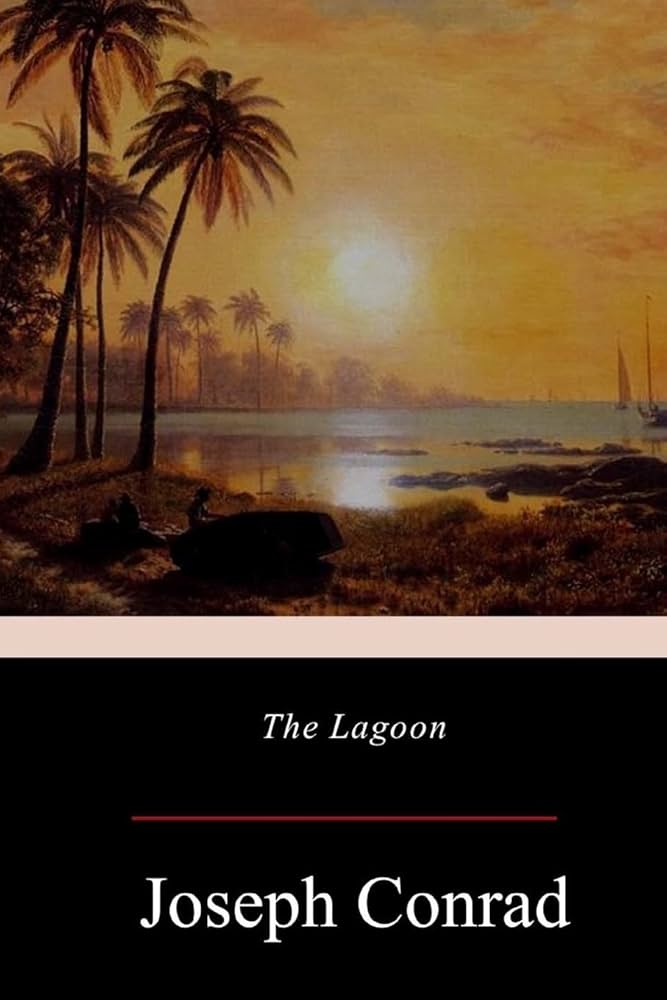

Joseph Conrad’s The Lagoon is a striking tale of human passion. It relates to a lust for life and love, and to the frustration of a longing heart. The hero here, Arsat, is made to tell his dreams of life, and also to convey the shock he feels to the white man, who remains throughout the silent hearer of a story of intense appeal and poignant human tragedy.
A short story has a very brief and composite plot. Brevity is always the mark of wit in a good story. This is seen as well applicable to Conrad’s The Lagoon. The plot here is quite limited in its pursuit of perfect unity of effect. Of course, the story embraces two distinct incidents of two different times. But the plot has the essential unity in the elemental theme of love-love that desires to conquer death-and the defeat of man’s lust for life and love by death. The hero of the story, Ársat, hoped to live in love and even allowed his brother to die without his aid for that purpose, but could not overcome death that came to take away the woman he had lost and suffered so much for, and was even ungrateful to his brother. The whole plot is conceived with a rare human touch, and the sense of unity is nowhere disturbed.
What is, however, remarkable in the story is its organic structure, which Conrad achieves so well. The two aspects of the story are joined and synthesized through the presence of the white man to whom Arsat narrates his past and before whom his present tragedy is enacted. The past and the present are joined, well balanced, and the exposition and the catastrophe never look truncated, cut off from each other. The two sides of the story are harmonized and integrated through the white man, who signifies the observer of life, watching and summing up the changing panorama of this life.
A good short story has a few characters. This has little scope for introducing numerous men and women or for elaborating or developing any particular character. The Lagoon has only two characters: Arsat and the white man. Of course, the story flashes back to other characters, including Arsat’s brother, who plays a significant role. In any case, the characters are not many, and they remain quite lively and forceful within an extremely limited space, although there is no attempt at elaboration. Moreover, the story’s important characters bear symbolic significance. While Arsat stands for love and remorse, his brother signifies faith and fidelity. The white man has almost the function of the chorus, observing and commenting. Here, again, The Lagoon seems to be a story, enriched with a precise yet effective characterization. Arsat’s beloved woman stands for transient love.
Moreover, the economy in the mode of stóry-telling, which is an important requisite in a good short story, is well perceived here, although Conrad’s story is rich in descriptions of the Malayan region. This description, however, is concise yet vivid and precise, and it meets the specific requirements of a good short story. Moreover, this is much in keeping with the tale’s gloom. An instance may be cited here as a specimen-“The ever-ready suspicion of evil, that growing suspicion that lurks in our hearts, flowed out into the stillness, profound and dumb and made it appear untrustworthy and infamous.” The Lagoon remains successfully a story of an exceedingly limited range, despite the scenic background and the narration of the flight and the fight. The colorful and graphic representation of the Malayan region is, no doubt, another feature of the story and adds to its gracefulness.
A good short story is an art, an impression, and The Lagoon undoubtedly leaves a profound impression. It has a tragic note of universal significance and brings out the irony of man’s littleness in the hands of the mighty force of the universe. The story brings out the inevitable note of human frustration and restlessness. It is a brief epitome of man’s dreams and desires, love, and losses, of his life, so full of sound and fury, without any real significance. Indeed, this is a story, well-conceived and told, that leaves a lasting impression.
Another essential characteristic of a good short story is concentration on a single dominant mood or effect. Edgar Allan Poe emphasized that a short story should create a “single impression,” and Conrad’s The Lagoon perfectly fulfills this requirement. From the very beginning, the atmosphere of mystery, sorrow, and impending tragedy is carefully built up through the description of the silent river, the dark forest, and the lonely hut. The entire narrative is steeped in gloom and melancholy. Even before Arsat begins his tale, the reader senses that the story will end in despair. This unity of mood is never broken, and every detail of the setting and narration contributes to the final tragic impression.
The narrative technique employed in The Lagoon also shows Conrad’s mastery of the short story form. Instead of presenting events in a straightforward chronological order, he adopts a framed-narration approach. The outer frame is provided by the white man’s visit to Arsat, while the inner story consists of Arsat’s recollection of his past. This technique enables Conrad to compress a long and complex history into a small narrative space, a major demand of the short story. The shifting between past and present is handled with great skill, keeping the plot’s movement smooth and natural. Such artistic control over structure proves that the work is carefully designed rather than loosely narrated.
Furthermore, the story’s language and style reinforce its short-story qualities. Conrad’s prose in The Lagoon is highly suggestive and poetic. Every image and metaphor serves a definite purpose. The repeated references to darkness, silence, and the mysterious river create symbolic overtones that deepen the tale’s meaning. In a short story, where space is limited, language must be precise and meaningful, and Conrad fulfills this condition admirably. His ability to convey deep emotions through brief dialogues and restrained descriptions heightens the narrative’s intensity.
The element of conflict, which is another vital aspect of the short story, is also powerfully presented. The central conflict in The Lagoon is not merely external but deeply internal. Arsat struggles between love and duty, desire and loyalty, memory and remorse. This inner conflict reaches its climax when his beloved dies, and he realizes the futility of his past actions. Such psychological focus is typical of the modern short story, which often centers on emotional crises rather than physical action. By concentrating on Arsat’s mental agony rather than on adventurous events, Conrad gives the story a depth and seriousness that go beyond its simple plot.
Finally, the story’s ending demonstrates one of the most important features of a short story: an effective, meaningful conclusion. A short story should end at the precise moment of maximum impact, and The Lagoon ends exactly at that point. After the death of his beloved, Arsat resolves to leave the lagoon and begin a new life, but the reader clearly understands that his sense of loss and guilt will remain with him forever. The conclusion is brief, suggestive, and emotionally powerful. It does not offer elaborate explanations, yet it leaves the reader with a deep sense of tragic realization. Such a controlled and poignant ending confirms the work as a well-crafted short story.
The Lagoon is a successful feat of Conrad’s storytelling. The tragic effect is achieved through a moral undertone in his story’s theme, which he conveys precisely and admirably through the stylistic pattern of a good short story.