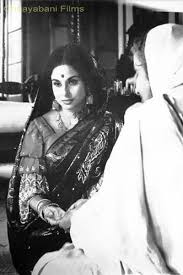

The appropriateness of the title of the story, The Wife’s Letter, is not beyond all disputes. It is contended that the letter is written by one Mrinal to one, appearing as her husband, and in this perspective, Mrinal’s Letter (and not The Wife’s letter) would seem more apt and applicable as the title of the story.
The expression ‘The Wife’s Letter’ actually means a letter received from a wife. The recipient must be the husband. But the husband remains practically absent in the story. The wife dominates here, and the husband remains in the background. He is not shown to read the letter. Mrinal, supposed to be his wife, writes the letter. Here, too, the actual sense and the implication of the title differ.
But to contest the propriety of the title on any technical sophistry is, perhaps, to miss the thematic profundity of the story. There is not the least doubt that the letter ends with the signature of Mrinal, and she is, therefore, its writer. She refers, at the very beginning, to her own married life for fifteen years. So she is the wife, rather, as she herself declares, the Meja Bou of her father-in-law’s house. She is a wife, and the letter is from her to her husband.
What is more, the story, told in her letter, is of much social significance, particularly for the time of Tagore’s writing. Through Mrinal’s letter, the humanitarian storyteller in Rabindranath speaks out about the grim situation of women in a conservative, man-ridden society. Through the story of her life and mind, he focuses on the wrongful denial of a woman’s self-dignity and human rights.
Here is the story’s serious social theme. This is about the sad plight of women in orthodox Indian society. Mrinal’s realization of her womanly liberty after her decision to release herself from her callous, unsympathetic domesticity and Bindu’s painful life and pitiful death are too hard revelations. These are not to be wiped away by any plea of social status or customary codes.
Indeed, Tagore brings out in his story the utterly helpless state of women in the conservative social order, dominated by men. Their beauty that matters in their selection as brides is soon forgotten and slighted. Their womanly right and dignity are hardly admitted. Even their domesticity is kept thoroughly unattended, even unhygienic. Their personal wishes and inclinations are the least considered and valued. Can such a situation be human and worth living for a wife? The answer is obvious.
And the picture is even worse for Bindu. Driven out of her home and tortured by her cousins, she sought shelter in her elder sister’s house, where she was treated as an unpleasant intruder. She was subjected to humiliation and even married to a mad person heedlessly. Her earnest plea was ruthlessly rejected, and her human feeling was rudely suppressed. Almost like a hunted creature, she fled away from her husband only to be thrown back there. She got her peace at last by setting her clothes on fire and killing herself.
This is the story of all grossness and gloom, cruelty and callousness. Rabindranath strikes his protest through Mrinal’s letter, the wife’s letter. Mrinal knows the bitter truth of a woman’s destiny: her helpless destitution. She registers her bold stand in her unequivocal declaration :
“But I will never, again, return to your house at number 27, Makhan Boral Lane. I have seen Bindu. I have learned what it means to be a woman in this domestic world. I need no more of it”.
The title is further appropriate because the letter becomes a symbolic weapon of self-expression. In a society where women were denied a public voice, writing a letter itself becomes revolutionary. Mrinal’s letter is not merely a private communication between husband and wife; it is a document of protest, self-realization, and emancipation. Tagore deliberately chooses the form of a letter to give authenticity and immediacy to the wife’s voice. Thus, the title rightly emphasizes the identity of the writer as “the wife” rather than as an individual named Mrinal.
Moreover, the title highlights the centrality of the wife’s perspective in the narrative. The entire story unfolds through Mrinal’s words, thoughts, and reflections. No male voice interrupts or dominates the narrative. The letter becomes a medium through which the inner world of an oppressed woman is revealed. Therefore, the title draws attention to the fact that the story is essentially about a wife’s awakening, not merely about one woman’s personal grievances.
Tagore’s use of the word “Wife” in the title also gives the story a universal dimension. Mrinal is not just a single character belonging to one household; she represents countless wives in traditional Indian families who suffer silently under patriarchal oppression. By choosing the general term “wife,” Tagore transforms Mrinal’s personal letter into the collective voice of womanhood. The title thus acquires a broader social and feminist significance.
Finally, the title is appropriate because it captures the irony at the heart of the story. A wife is expected to be obedient, submissive, and silent. Yet here the wife breaks all conventions by openly rejecting her husband’s home and authority. The letter becomes an act of rebellion. The very phrase “The Wife’s Letter” therefore suggests both conformity and defiance at the same time—conformity in social identity and defiance in personal assertion.
This is what a woman—a wife—sees and knows. She is no more a name—Mrinal the Mejo Bou of 27, Makhan Boral Lane. She signifies the slighted and suppressed womanhood. She rises above her individual name and place as a protest incarnate against the cultivated tyranny over women, particularly wives, by the man-made and man-led society. Her letter, bearing her protest, is of the harassed wife, not of one Mrinal of a particular house of a particular lane of Calcutta.
The universal wife in Mrinal triumphs here over the individual name, Mrinal. She writes the letter not for herself but to highlight the cause of her class—the wife—and her letter is from a wife, signed only as Mrinal. Hence, there is little to deny the appropriateness of the title—The Wife’s Letter.