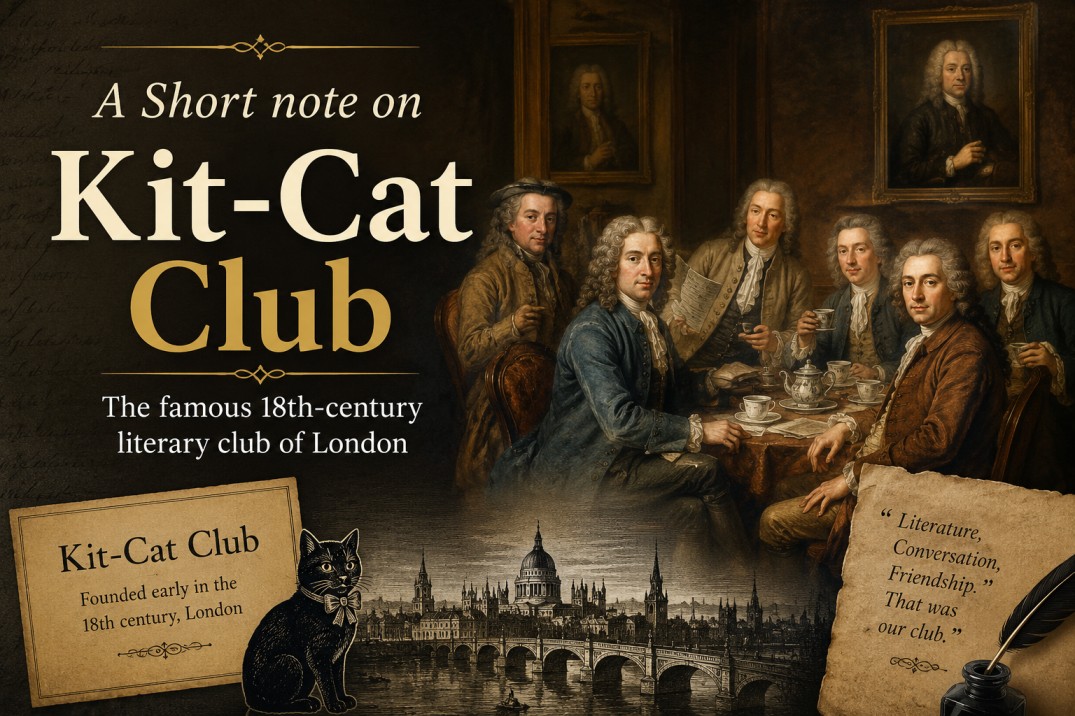
Kit-Cat Club is a literary club founded early in the 18th century in London. So-called because its members met at the house of a pastry-cook named Christopher Kat or Cat (or Katt or Catling) in Shire Lane (near Temple Bar). Kat’s mutton pies were called Kit-cats.
Distinguished members of the club were Joseph Addison, Richard Steele, William Congreve, Sir John Vanbrugh, John Locke, Sir Samuel Garth, Viscount Cobham, Abraham Stanyan, and Sir Robert Walpole. Other notables included Samuel Garth, Charles Dartiquenave, Richard Steele, and the Dukes of Grafton, Devonshire, Kingston, Richmond, Manchester, Dorset, and Lords Sunderland and Wharton. They later used the premises of Jacob Tonson, the publisher, at Barn Elms. Many members had their portraits painted by Sir Godfrey Kneller, and these paintings became symbols of prestige and intellectual identity. They are less than half-length because the dining room was too low for half-size portraits. This size of canvas has come to be known as kit-cat (36 X 28 inches, it shows the head and one hand). Through these portraits, the club achieved a lasting place not only in literary history but also in the history of English art.
The Kit-Cat Club was not only a social gathering of intellectuals and writers; it gradually became one of the most influential cultural and political clubs of eighteenth-century England. Most of its members supported the Whig political party and believed in constitutional government, literary refinement, and artistic progress. The discussions on literature, politics, society, and other issues encouraged the growth of literary culture in London.
Men like Joseph Addison and Richard Steele later became famous for their essays in The Spectator and The Tatler, periodicals that greatly influenced eighteenth-century prose and social manners. The friendly intellectual environment of the Kit-Cat Club helped such writers exchange ideas freely and promote polite literature among the educated classes. In many ways, the Kit-Cat Club reflects the vibrant coffee-house culture of eighteenth-century London, where conversation, debate, and creativity flourished. It represents an age in which literature was deeply connected with politics, art, and public life. Even today, the club is remembered as an important centre of intellectual activity that contributed significantly to the development of English literary and cultural traditions.
Also read Epithalamion: Definition, Characteristics, and Examples